Over 60 percent of british construction projects experience cost overruns linked to inaccurate material estimates. In such a fast-paced industry, even small mistakes in quantity takeoff can cause significant financial and scheduling headaches. Understanding how professionals translate blueprints into precise lists of materials not only clarifies the construction process but also helps avoid common pitfalls. This guide breaks down quantity takeoff in a british context, helping you grasp its impact on budgets, timelines, and overall project success.
Table of Contents
- Defining Quantity Takeoff In UK Construction
- Types Of Quantity Takeoff Methods And Tools
- Step-By-Step Process: From Drawings To Data
- Key Roles And Responsibilities In Takeoff
- Implications For Accuracy, Cost, And Project Risk
- Common Pitfalls And How To Avoid Errors
Key Takeaways
| Point | Details |
|---|---|
| Importance of Quantity Takeoff | Quantity takeoff is essential for accurate material estimation, cost control, and efficient project planning in construction. |
| Methods of Quantity Takeoff | Both manual and digital methods are utilised, with digital tools offering greater accuracy and efficiency over traditional techniques. |
| Professional Roles in Quantity Takeoff | Various experts, including quantity surveyors and building estimators, contribute vital skills to ensure precise project estimation. |
| Risk Management in Quantity Takeoff | Accurate quantity takeoff mitigates financial risks by preventing material shortages, budget overruns, and project delays. |
Defining Quantity Takeoff in UK Construction
Quantity takeoff represents a critical process in construction project planning where professionals meticulously measure and calculate the precise materials and resources required for a specific build. According to Wikipedia, quantity takeoff (QTO) involves generating a comprehensive list of materials and their specific quantities necessary to complete a construction project.
In practical terms, quantity takeoff transforms architectural drawings and project blueprints into detailed material quantifications. Construction professionals carefully examine design plans, identifying every component needed – from bricks and cement to electrical wiring and plumbing fixtures. This process enables precise cost estimation, material procurement planning, and helps prevent potential resource shortages or unexpected budget overruns. By conducting a thorough quantity takeoff, teams can create accurate Bill of Quantities (BoQ) that serve as foundational documents for project budgeting and resource management.
The quantity takeoff process typically involves several key steps:
- Reviewing detailed architectural and engineering drawings
- Measuring and calculating material quantities with precision
- Categorising materials by type and specification
- Converting measurements into standardised units
- Cross-referencing quantities against project requirements
Professional quantity takeoff services like our quantity takeoff service utilise advanced measurement techniques and specialised software to ensure exceptional accuracy. Skilled estimators analyse every project detail, ensuring that material quantities are calculated with microscopic precision, which ultimately reduces financial risks and supports smoother project execution.
Types of Quantity Takeoff Methods and Tools
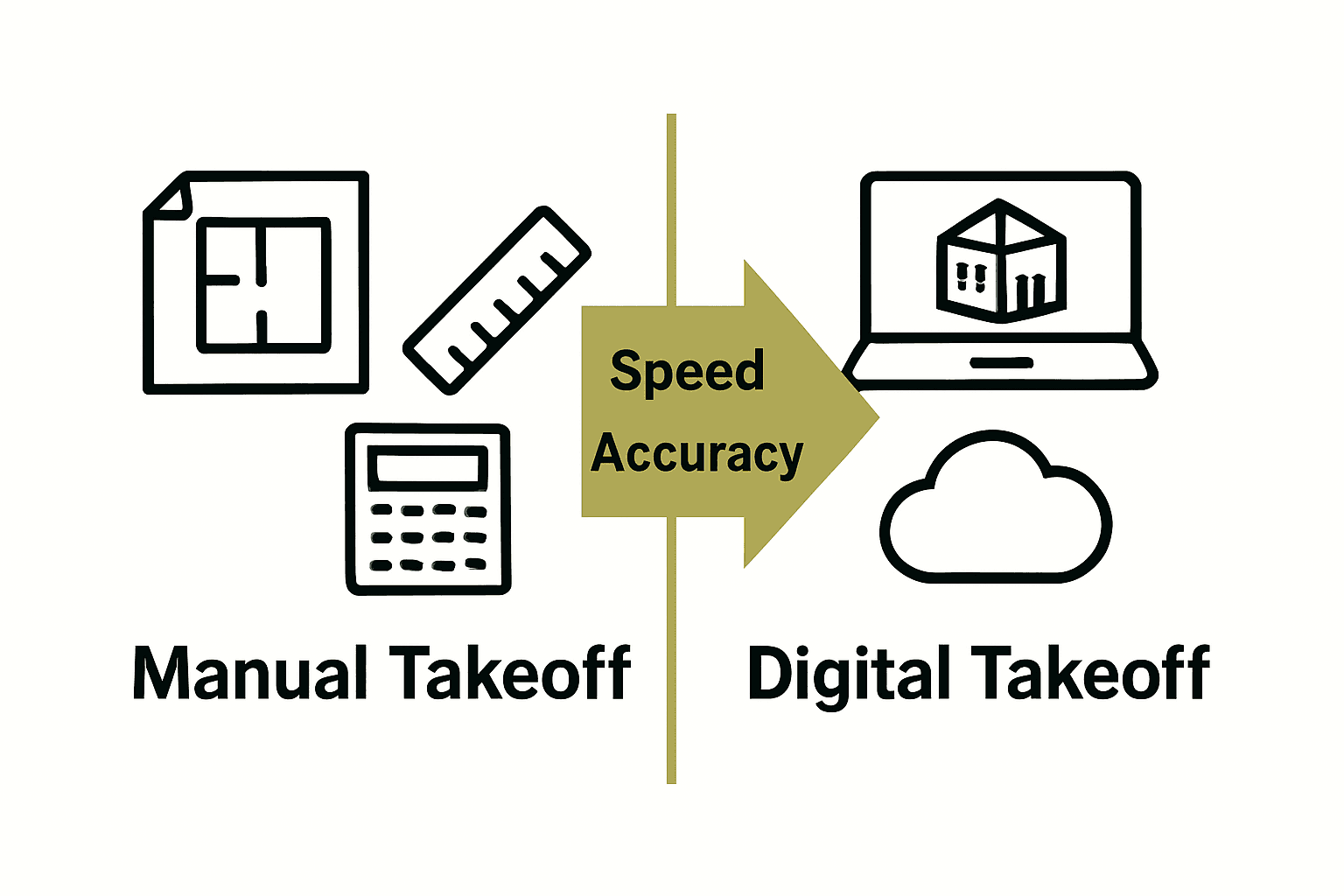
Manual quantity takeoff and digital quantity takeoff represent two primary approaches construction professionals utilise to measure and calculate project materials. Traditional manual methods involve physically measuring drawings with scaling tools like rulers and measuring wheels, requiring meticulous hand calculations and extensive time investment. These conventional techniques demand exceptional attention to detail and mathematical precision from skilled estimators.
Modern digital quantity takeoff methods have transformed the construction estimation landscape. According to Bartleby, digital takeoff tools such as calibrated raster/vector measurement and cloud-based Bill of Quantities (BoQ) modules significantly accelerate measurement processes while simultaneously storing measurement evidence. These advanced technological solutions offer unprecedented efficiency and accuracy compared to traditional manual approaches.

Key digital quantity takeoff tools and methods include:
- Computer-aided design (CAD) measurement software
- Geographic Information System (GIS) integration tools
- 3D building information modelling (BIM) platforms
- Cloud-based estimation software
- Automated measurement calculation programmes
Professional construction estimators increasingly rely on comprehensive Bill of Quantities preparation services that leverage these sophisticated digital tools. By combining cutting-edge technology with expert human analysis, these services provide construction professionals with rapid, precise material quantification that supports more effective project planning and financial forecasting.
Step-by-Step Process: From Drawings to Data
Quantity takeoff transforms complex architectural designs into precise material measurements through a systematic, methodical approach. According to Bartleby, the fundamental strategy involves breaking the project down into smaller, more manageable parts that are easier to evaluate, ensuring a comprehensive and accurate takeoff.
The process begins with comprehensive document review, where construction professionals meticulously examine architectural blueprints, engineering drawings, and project specifications. Skilled estimators carefully analyse every technical detail, identifying specific material requirements across different project segments. This initial stage demands exceptional attention to detail, as even minor overlooked elements can significantly impact project costings and resource allocation.
Key steps in the quantity takeoff process include:
- Document Collection and Verification
- Gather all relevant project drawings
- Confirm drawing versions and compatibility
- Identify scale and measurement standards
- Measurement and Quantification
- Systematically measure required materials
- Calculate precise quantities for each component
- Cross-reference measurements against project specifications
- Data Recording and Analysis
- Document material quantities
- Categorise materials by type and specification
- Prepare preliminary cost estimates
Professional construction estimating services specialise in executing these complex procedures with remarkable precision. By combining advanced digital measurement tools with expert human analysis, these specialists transform raw architectural drawings into actionable, financially robust project blueprints that support effective planning and resource management.
Key Roles and Responsibilities in Takeoff
The quantity takeoff process involves multiple professional roles, each contributing critical expertise to ensure accurate project estimation. According to Wikipedia, building estimators play a pivotal role by quantifying the materials, labour, and equipment needed to complete a construction project, serving as fundamental architects of precise project planning.
Quantity surveyors represent another essential professional group in the takeoff ecosystem. As noted by Wikipedia, these specialists are responsible for managing all contractual and financial aspects of construction projects, ensuring comprehensive budget control and meticulous financial oversight. Their expertise extends beyond mere measurement, encompassing strategic financial planning, risk assessment, and detailed cost management throughout the project lifecycle.
Key professional roles in the quantity takeoff process include:
- Quantity Surveyors: Financial management and cost control
- Building Estimators: Material and resource quantification
- Construction Managers: Overall project coordination
- Architectural Drafters: Technical drawing interpretation
- Digital Measurement Specialists: Advanced technological measurement
Professional construction estimating services integrate these diverse skill sets, combining human expertise with advanced digital tools to deliver precise, reliable project estimations. By leveraging the collective knowledge of these specialists, construction teams can develop robust financial strategies that minimise risks and maximise project efficiency.
Implications for Accuracy, Cost, and Project Risk
Quantity takeoff precision represents a critical determinant of construction project success, directly influencing financial outcomes and operational efficiency. According to Bartleby, inaccurate quantity takeoffs can lead to significant cost overruns and project delays, underscoring the paramount importance of meticulous measurement and calculation processes.
The financial implications of quantity takeoff accuracy extend far beyond initial estimations. Minor measurement discrepancies can cascade into substantial budgetary challenges, potentially compromising project viability and organisational financial health. Precise takeoff methodologies mitigate risks by providing granular insights into material requirements, labour allocations, and potential contingency expenses, enabling construction teams to develop robust financial strategies with enhanced predictability.
Key risk management considerations include:
- Material Procurement: Preventing over or under-ordering
- Budget Forecasting: Minimising unexpected financial variations
- Project Timeline Management: Reducing potential delays
- Resource Allocation: Optimising labour and equipment deployment
- Contractual Compliance: Ensuring accurate cost representations
Professional cost planning services play a crucial role in transforming complex measurement challenges into strategic financial solutions. By leveraging advanced digital tools and expert human analysis, these specialists help construction professionals navigate potential risks, ensuring projects remain financially viable and operationally efficient.
Common Pitfalls and How to Avoid Errors
Quantity takeoff processes are fraught with potential measurement challenges that can derail project planning and financial forecasting. Professional estimators must navigate a complex landscape of potential errors that can significantly impact project outcomes. Precision is not just desirable – it is absolutely essential.
According to Bartleby, avoiding errors requires implementing a well-organized systematic checklist and rigorously cross-checking measurements against project drawings and specifications. The most common pitfalls emerge from hasty calculations, outdated reference materials, and inadequate verification processes.
Critical error prevention strategies include:
-
Drawing Verification
- Confirm most recent drawing versions
- Check scale and measurement consistency
- Validate drawing compatibility across disciplines
-
Measurement Techniques
- Use calibrated digital measurement tools
- Implement double-checking protocols
- Maintain consistent measurement units
-
Documentation Management
- Archive measurement evidence
- Create comprehensive audit trails
- Update records in real-time
Professional construction estimating services provide critical safeguards against these potential errors, leveraging advanced technologies and expert human oversight to ensure measurement accuracy and project reliability. By combining meticulous verification processes with cutting-edge digital tools, these specialists transform potential risks into manageable, predictable project parameters.
Master Your Quantity Takeoff Challenges with Expert Estimating Support
Accurate quantity takeoff is crucial to avoid costly errors and delays that can jeopardise your UK construction project. If you feel overwhelmed by measuring complex drawings or managing risk linked to material procurement and budgeting, you are not alone. With critical roles like building estimators and quantity surveyors highlighted in the article, it is clear that precision and expert oversight are essential to transform architectural plans into reliable, actionable data.
At My Project Estimating, we understand the pressure of juggling digital measurement tools alongside manual verifications to ensure every material quantity is exact. Our professional services, including detailed Bill of Quantities preparation and bespoke construction estimating, empower you to gain full control over your project costs with transparent, fast, and UK-specific solutions. Experience peace of mind by partnering with experienced estimators who prioritise accuracy and swift turnaround times.
Ready to eliminate uncertainty and secure your project’s financial success? Discover how our experts can help you streamline quantity takeoff and cost planning today by visiting My Project Estimating and take the first step towards a reliable, risk-free project.
Frequently Asked Questions
What is the purpose of quantity takeoff in construction?
Quantity takeoff is used to measure and calculate the precise materials and resources needed for a construction project. It helps create accurate cost estimates, plan material procurement, and prevent resource shortages or budget overruns.
What are the main steps involved in the quantity takeoff process?
The quantity takeoff process typically involves reviewing architectural drawings, measuring material quantities, categorising materials, converting measurements into standardised units, and cross-referencing against project requirements.
What types of tools are used for digital quantity takeoff?
Key tools for digital quantity takeoff include computer-aided design (CAD) software, cloud-based estimation software, 3D building information modelling (BIM) platforms, and calibrated measurement tools that ensure enhanced accuracy and efficiency in calculations.
How does accuracy in quantity takeoff affect project outcomes?
Accuracy in quantity takeoff directly impacts financial outcomes and operational efficiency. Inaccurate measurements can lead to cost overruns, project delays, and resource misallocation, thus affecting the overall viability of a construction project.