More than 60 percent of british construction projects face budget overruns before completion. In such a competitive local industry, keeping costs in check matters not just for profits but for reputation and client trust. Understanding cost management in construction arms professionals with practical strategies for smarter planning, risk reduction, and long-term financial stability, making the difference between a successful project and a stressful one.
Table of Contents
- Defining Cost Management In Construction
- Common Methods And Key Processes
- Major Project Stages And Applications
- Uk Regulations And Compliance Requirements
- Roles, Risks, And Common Pitfalls
Key Takeaways
| Point | Details |
|---|---|
| Cost Management Process | Involves four stages: cost planning, estimating, budgeting, and control. This ensures systematic oversight of project finances throughout its lifecycle. |
| Importance of Compliance | Adhering to UK regulations and industry standards is critical for ensuring project integrity and safety while managing costs effectively. |
| Risk Mitigation Strategies | Focus on addressing potential risks, like cost overruns, through robust financial planning and communication among stakeholders. |
| Roles in Cost Management | Key roles such as Quantity Surveyor and Project Manager are essential for effective financial oversight and strategic decision-making in construction projects. |
Defining Cost Management in Construction
Cost management represents the strategic financial process of planning, tracking, and controlling expenses throughout a construction project’s lifecycle. According to the Association for Project Management, cost management involves systematically estimating project costs, establishing an agreed budget, and continuously monitoring actual versus projected expenditures.
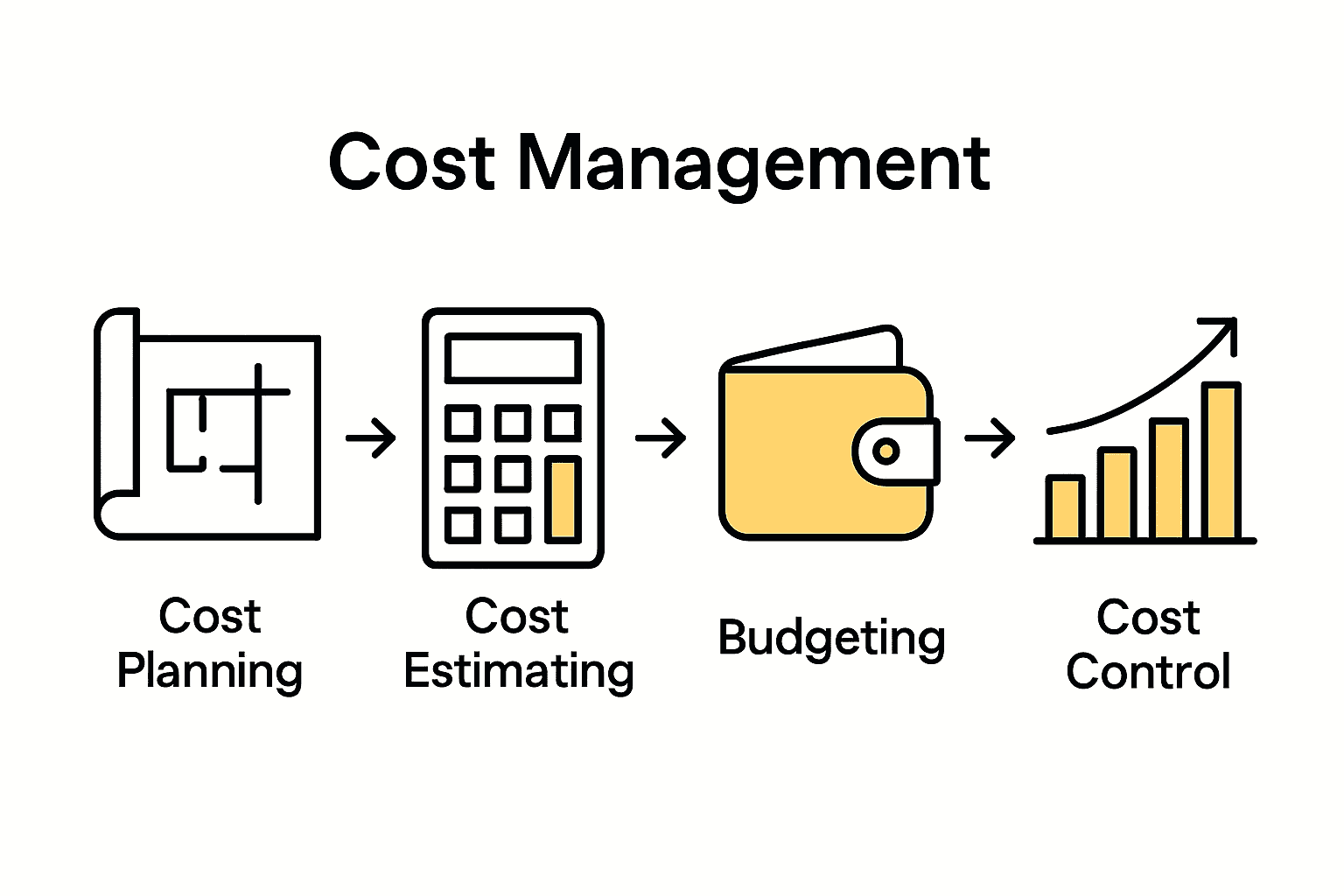
At its core, project cost management encompasses four critical stages: cost planning, cost estimating, budgeting, and cost control. As research from Aston University highlights, this process requires meticulously understanding the resources needed to complete project activities and comprehending the complex factors influencing construction expenses. Effective cost management goes beyond simple number-crunching; it demands a holistic approach that anticipates potential financial challenges and develops proactive mitigation strategies.
Successful cost management in construction requires a combination of technical skill, financial acumen, and strategic thinking. Project managers must develop comprehensive financial models that account for variables such as material costs, labour expenses, equipment rentals, regulatory compliance, and potential contingencies. By implementing robust cost management practices, construction professionals can minimise financial risks, improve project predictability, and ultimately deliver high-quality results within budgetary constraints.

To support your cost management efforts, our construction estimating services provide detailed, transparent financial planning tailored to your specific project requirements.
Common Methods and Key Processes
Cost management in construction involves several interconnected methods and processes that ensure financial control and project success. According to the Association for Project Management, these key processes fundamentally include cost planning, which focuses on estimating project expenses, and cost control, which monitors ongoing expenditures to maintain budgetary alignment.
Research from Aston University identifies four primary methods within project cost management: cost planning, cost estimating, budgeting, and cost control. Each method serves a distinct purpose in the financial management lifecycle.
Cost planning involves preliminary assessment of potential expenses, cost estimating quantifies specific financial requirements, budgeting allocates financial resources, and cost control tracks and manages actual spending against initial projections.
Practical implementation of these methods requires sophisticated strategies and tools.
 Construction professionals typically employ techniques such as:
- Detailed quantity surveying
- Parametric cost estimation
- Bottom-up and top-down budgeting approaches
- Regular financial reporting and variance analysis
- Advanced software for real-time expense tracking
To enhance your project’s financial precision, our construction estimating services provide comprehensive cost management solutions tailored to your specific project requirements.
Major Project Stages and Applications
Cost management is a dynamic process that spans the entire lifecycle of a construction project, with distinct financial considerations at each stage. According to Imperial College London, project cost management can be comprehensively broken down into seven distinct stages, ranging from initial prefeasibility estimates to post-project financial review.
The project lifecycle stages typically involve:
- Stage 0: Prefeasibility Estimate – Initial financial scoping and preliminary budget assessment
- Stage 1: Feasibility Cost Estimate – Detailed preliminary financial analysis and potential investment evaluation
- Stage 2-3: Cost Planning – Comprehensive budgeting and detailed financial strategy development
- Stage 4-6: Cost Reporting – Ongoing financial monitoring, tracking, and variance analysis
- Stage 4-5: Valuations – Assessing project value and financial performance
- Stage 7: Post-Takeover Cost Management – Final financial review and long-term cost implications assessment
Research from Aston University emphasises that effective cost management requires continuous application of key processes such as cost planning, estimating, budgeting, and control throughout these stages. This holistic approach ensures financial transparency, reduces risk, and enables proactive decision-making, ultimately supporting the project’s overall financial health and success.
To support you through each project stage, our construction estimating services provide tailored financial guidance and expert cost management solutions designed to optimise your project’s financial performance.
UK Regulations and Compliance Requirements
Cost management in construction demands rigorous adherence to a complex landscape of regulatory requirements that ensure project safety, financial integrity, and professional standards. According to Skills England, the fundamental objective of project controls is to ensure projects are delivered successfully and safely, meeting critical parameters of time, cost, and quality while maintaining strict compliance with applicable regulations.
The key regulatory frameworks impacting construction cost management include:
- Health and Safety Regulations (Construction Design and Management Regulations)
- Financial Reporting Standards (UK GAAP and International Financial Reporting Standards)
- Environmental Compliance Requirements
- Building Regulations and Planning Permissions
- Tax and Procurement Legislation
As outlined by UK Standards, professional project controls must comprehensively interpret project scope and develop robust control plans that meet environmental, social, and governance requirements. This involves a multifaceted approach to compliance that goes beyond mere financial tracking, encompassing broader organisational and regulatory expectations.
To navigate these complex regulatory landscapes, our construction estimating services provide expert guidance that ensures your project remains fully compliant while maintaining financial efficiency and strategic control.
Roles, Risks, and Common Pitfalls
Successful cost management in construction requires a nuanced understanding of the complex interplay between various professional roles and potential financial risks. Research from Aston University highlights that effective project cost management fundamentally addresses risks such as cost overruns through systematic processes of planning, estimating, budgeting, and continuous financial control.
Key roles critical to effective cost management include:
- Quantity Surveyor: Financial tracking and cost estimation
- Project Manager: Overall financial strategy and risk mitigation
- Financial Controller: Budgetary oversight and compliance
- Cost Engineer: Detailed expense analysis and forecasting
- Procurement Specialist: Supply chain cost optimisation
The most prevalent risks and common pitfalls in construction cost management often stem from:
- Inadequate initial cost planning
- Scope creep and unmanaged project changes
- Insufficient contingency budgeting
- Poor communication between project stakeholders
- Underestimating complexity of material and labour costs
- Lack of robust financial monitoring systems
To mitigate these challenges and ensure comprehensive financial control, our construction estimating services provide expert guidance, detailed financial analysis, and proactive risk management strategies tailored to your specific project requirements.
Master Your Construction Costs with Expert Support
Cost management in construction can feel overwhelming when faced with fluctuating material prices, unexpected risks, and the complexity of budgeting each project stage. This guide highlights common challenges like inaccurate cost planning, scope creep, and compliance pressures that often lead to costly overruns or delays. Tackling these issues requires clear financial insight, detailed cost estimating, and proactive monitoring — concepts at the heart of successful project cost control.
At My Project Estimating, we understand how vital it is to have transparent, accurate, and UK-specific cost information to keep your construction projects on track and within budget. Our tailored services offer detailed quantity takeoffs, comprehensive cost reports, and early-stage cost planning designed to reduce risks and improve financial predictability. Discover how our expert guidance can smooth your path through budgeting and financial control by exploring our Uncategorized Archives which covers essential insights and practical solutions.
Do not let financial uncertainty hold your project back. Start making confident, informed decisions today with professional support from My Project Estimating. Visit us now to share your drawings and get a detailed, fast turnaround estimate that empowers your next move.
Frequently Asked Questions
What is cost management in construction?
Cost management in construction refers to the strategic process of planning, estimating, budgeting, and controlling expenses throughout the lifecycle of a construction project, ensuring that it remains within financial constraints.
What are the key processes involved in project cost management?
The key processes include cost planning, cost estimating, budgeting, and cost control. Each of these processes plays a crucial role in maintaining financial oversight and ensuring project success.
What are the main stages of cost management in construction projects?
Cost management spans several stages, including prefeasibility estimates, feasibility cost estimates, detailed cost planning, ongoing financial monitoring, valuations, and post-project financial reviews.
How can construction professionals mitigate financial risks during a project?
Construction professionals can mitigate financial risks by employing detailed cost planning, maintaining effective communication among stakeholders, establishing contingency budgets, and utilising advanced financial tracking systems.