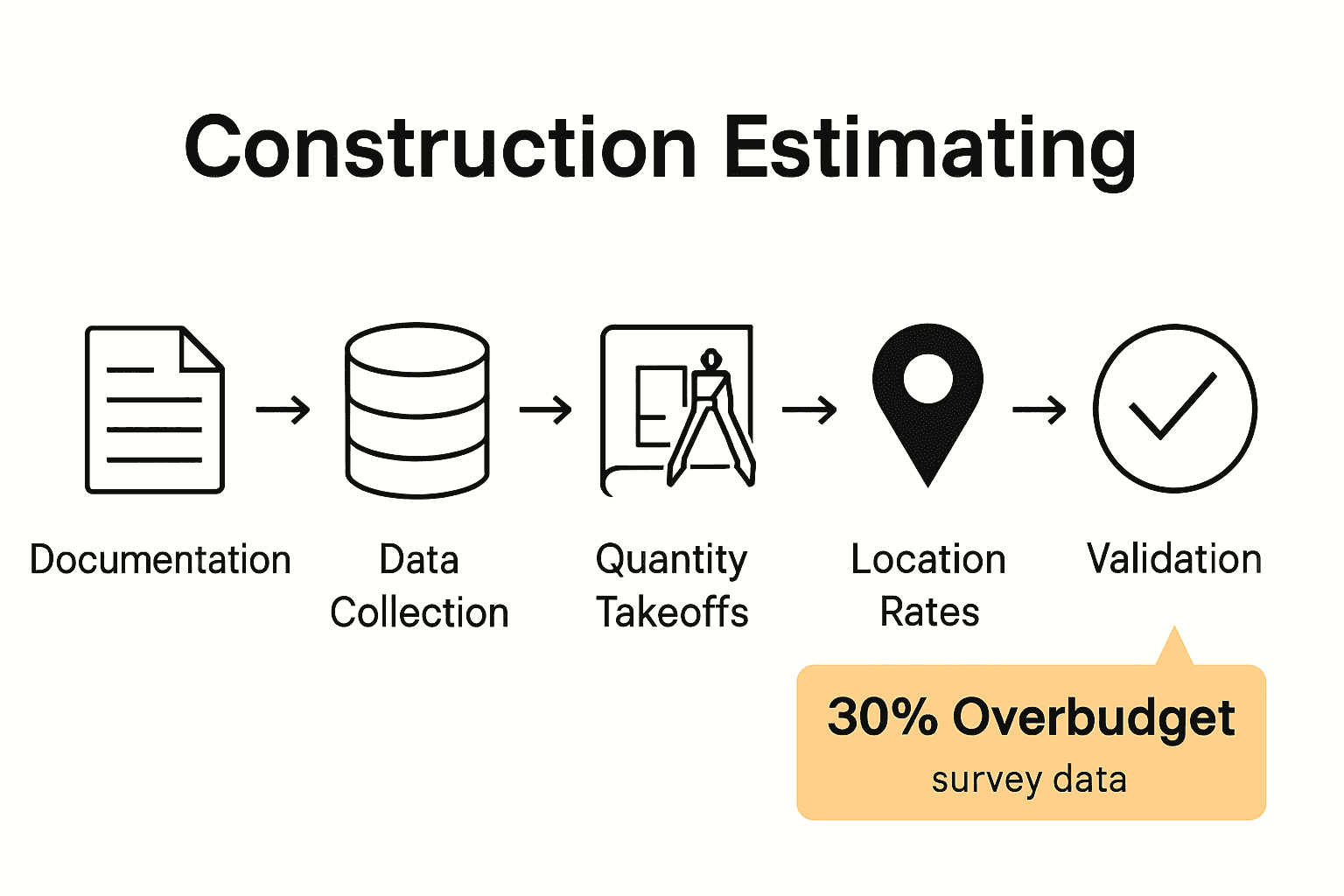
Getting a construction estimate wrong can quickly derail even the best planned project. With budgets tighter and timelines shorter, accuracy is everything for UK builders and project managers. Industry surveys reveal that nearly 30 percent of construction projects exceed initial cost estimates, leading to costly delays and disputes. Mastering each key step from gathering reliable documents to presenting a clear, professional report gives you the foundation for reliable estimates and ultimately, project success.
Table of Contents
- Step 1: Gather Accurate Project Documentation
- Step 2: Select Reliable UK Cost Data Sources
- Step 3: Perform Detailed Quantity Takeoffs
- Step 4: Apply Location-Specific Unit Rates
- Step 5: Review And Validate Your Estimate
- Step 6: Prepare And Deliver Professional Reports
Quick Summary
| Key Point | Explanation |
|---|---|
| 1. Gather accurate project documentation | Collect comprehensive technical drawings, plans, and specifications to ensure a solid foundation for estimates and minimize risks. |
| 2. Use reliable UK cost data sources | Source construction cost information from authoritative UK databases to reflect accurate market conditions and regional pricing trends. |
| 3. Conduct detailed quantity takeoffs | Measure material quantities from technical drawings to impact budgeting and ensure precise estimates are generated. |
| 4. Apply location-specific unit rates | Accurately reflect material and labor costs that vary significantly across different regions in the UK by referencing current price indices. |
| 5. Validate your estimate rigorously | Perform a thorough review of your cost estimates to catch errors, ensuring your project plan is financially reliable and defensible. |
Step 1: Gather accurate project documentation
Successfully gathering accurate project documentation is your first critical step in creating a robust construction estimate. This phase sets the foundation for everything that follows ensuring precision and minimising potential risks.
Start by collecting comprehensive technical drawings architectural plans engineering specifications site surveys and any existing condition reports. According to Ams India, maintaining meticulous records is essential for legal compliance and project success. You will want to systematically organise these documents ensuring they are high resolution clear and represent the most recent versions.
Be thorough in your document collection process. Verify each document’s authenticity and date of issue. As Plan the Job recommends creating a detailed documentation checklist can dramatically improve your efficiency. Key documents should include:
- Architectural blueprints
- Structural engineering drawings
- Mechanical electrical and plumbing schematics
- Site investigation reports
- Zoning and permit documentation
- Soil and environmental assessment reports
Pro tip: Always request digital copies alongside physical documents and maintain a secure backup system. Digital files are easier to share annotate and update throughout the project lifecycle.
Once you have gathered all necessary documentation your next step will involve a comprehensive review and initial cost assessment to prepare for detailed project estimation.

Step 2: Select reliable UK cost data sources
Selecting reliable cost data sources is fundamental to creating accurate construction estimates in the UK market. Your goal is to gather precise financial information that reflects current market conditions and regional pricing trends.
Begin by focusing on authoritative UK specific sources that provide comprehensive and up to date construction cost information. Key resources include the Royal Institution of Chartered Surveyors (RICS) which publishes detailed quarterly construction market surveys and cost indices. You should also consult the Building Cost Information Service (BCIS) which offers granular data on construction costs across different project types and regions in the United Kingdom.
Your reliable data sources should encompass multiple reference points to ensure accuracy:
- Official government infrastructure reports
- Regional construction industry publications
- Professional quantity surveyor cost databases
- Material price tracking services
- Regional construction tender price indices
- Academic research on construction economics
Pro tip: Cross reference multiple sources to validate pricing information and identify potential discrepancies. No single source provides absolute certainty so developing a comprehensive research approach is crucial.
Once you have gathered and verified your cost data sources you will be prepared to move into the detailed analysis and initial cost estimation phase of your project planning.
Step 3: Perform detailed quantity takeoffs
Detailed quantity takeoffs represent the critical process of measuring and calculating precise material quantities required for your construction project. This meticulous step transforms architectural drawings into actionable quantitative data that directly impacts your project budgeting and cost estimation.
Begin by carefully reviewing your technical drawings and blueprints using professional measurement tools and techniques. You will need to systematically measure and record quantities for every material category including concrete steel timber glass and other essential building components. Pay extraordinary attention to dimensional accuracy converting linear measurements area calculations and volume estimates with precision.
Your quantity takeoff process should include comprehensive documentation for:
- Structural elements
- Architectural materials
- Mechanical systems
- Electrical components
- Plumbing infrastructure
- Finishing materials
Pro tip: Leverage digital measurement software and advanced scanning technologies that can provide millimetre precise measurements. Manual calculations are prone to human error so investing in accurate digital tools will significantly enhance your estimation reliability.
Explore our quantity takeoff service to streamline this critical phase of your construction cost planning. Accurate quantity measurements form the foundation of your entire project financial framework ensuring you can develop a robust and reliable cost estimate.
Step 4: Apply location-specific unit rates
Applying location-specific unit rates is a critical step in developing accurate construction cost estimates that reflect the unique economic characteristics of different UK regions. Your goal is to ensure that every material and labour cost precisely matches the current market conditions of your specific project location.
Start by segmenting your project into distinct categories like residential commercial or industrial construction. Each sector has nuanced pricing variations across UK regions with significant differences between metropolitan areas like London and rural locations in Scotland or Wales. Research current regional price indices from authoritative sources such as the Royal Institution of Chartered Surveyors which provides comprehensive quarterly market surveys detailing regional construction cost variations.
Key considerations when applying location-specific unit rates include:
- Regional labour cost variations
- Transportation and logistics expenses
- Local material availability
- Regional market competition levels
- Supply chain infrastructure
- Municipal regulatory requirements
Pro tip: Do not rely on a single source for unit rates. Cross reference multiple professional databases and recent tender price indices to develop a comprehensive and accurate pricing strategy. Location can impact project costs by up to 25% depending on regional economic conditions.
Access our cost planning service to leverage expert insights into UK regional pricing dynamics. Understanding these location specific nuances will transform your construction estimate from a generic projection to a precise financial roadmap.
Step 5: Review and validate your estimate
Reviewing and validating your construction cost estimate represents the critical final checkpoint that ensures the financial accuracy and reliability of your entire project plan. This meticulous process transforms your raw calculations into a trustworthy financial blueprint that can withstand professional scrutiny.
Initiate your validation process by conducting a comprehensive line-by-line review comparing your estimated quantities and unit rates against multiple reference sources. Look for potential discrepancies anomalies or unexpected variations that might indicate calculation errors or overlooked project requirements. Pay extraordinary attention to high value line items and complex system integrations where small percentage differences can significantly impact overall project costs.
Key validation strategies include:
- Cross referencing unit rates from multiple professional databases
- Checking dimensional accuracy of quantity measurements
- Verifying material specifications match current market standards
- Comparing estimate against recent similar project benchmarks
- Identifying potential risk contingency factors
- Reviewing mathematical calculations for precision
Pro tip: Consider implementing a structured peer review process where another experienced construction estimator independently reviews your work. A fresh perspective can uncover subtle errors or potential optimisation opportunities that might have been missed during your initial review.
Explore our professional cost estimating services to ensure your project estimate meets the highest standards of accuracy and reliability. A thoroughly validated estimate is your first line of defence against potential financial risks and unexpected project overruns.
Step 6: Prepare and deliver professional reports
Preparing and delivering professional construction cost reports transforms your detailed estimates into a comprehensive communication tool that bridges technical complexity and clear financial understanding. Your goal is to create a document that provides stakeholders with precise insights while maintaining clarity and professional presentation.
Structure your report with a logical narrative flow that guides readers through your estimation process. Begin with an executive summary highlighting key financial metrics project scope and critical cost considerations. Follow this with detailed sections breaking down quantity takeoffs material specifications unit rates and regional pricing variations. Use clear visual elements like charts graphs and tables to illustrate complex financial data making the information immediately digestible for architects developers and project managers.
Critical components of a professional construction cost report include:
- Comprehensive executive summary
- Detailed quantity takeoff breakdown
- Unit rate analysis and justification
- Regional cost variations explanation
- Material specification details
- Potential risk and contingency assessments
- Comparative cost benchmarking
- Visual data representation
Pro tip: Invest time in formatting and visual presentation. A well designed report communicates professionalism and builds stakeholder confidence. Consistent typography clear section headings and professional colour schemes can significantly enhance report comprehension and perceived value.
Learn about our comprehensive reporting services to understand how professional documentation can transform your project communication strategy. A meticulously prepared report is more than just numbers it is a strategic tool for project success.
Enhance Your Construction Estimates with Expert UK Cost Planning
Accurate construction estimating is essential to avoid costly surprises and keep your project on track. This guide highlights common challenges such as gathering precise project documentation, obtaining reliable UK cost data, and applying location-specific rates – all crucial steps that often cause stress and delays. If you want to turn complex data into clear, trustworthy cost plans tailored for the UK market, you need expert support that understands these pain points.
Discover how My Project Estimating offers professional solutions designed to simplify every stage of your cost planning journey. From detailed quantity takeoffs to comprehensive cost reports, our experienced UK estimators deliver fast turnaround with transparent pricing. Explore our services in the Uncategorized Archives to learn how we transform raw data into reliable financial insight. Don’t let uncertainties hold your project back. Visit My Project Estimating now and empower your team with precise, UK-specific cost estimates to make confident decisions from concept to completion.
Frequently Asked Questions
How can I gather accurate project documentation for construction estimating?
Gather accurate project documentation by collecting technical drawings, architectural plans, engineering specifications, and site surveys. Organize these documents systematically to ensure they are high resolution and represent the most recent versions, enabling you to establish a solid foundation for your cost estimates.
What are reliable sources for UK construction cost data?
Select reliable UK cost data sources by focusing on authoritative publications that provide current market information, such as construction market surveys and cost indices. Consult multiple sources to cross-check unit rates and market conditions, ensuring the financial accuracy of your construction estimates.
How do I perform detailed quantity takeoffs for my construction project?
Perform detailed quantity takeoffs by systematically measuring material quantities from your architectural drawings. Document quantities for categories like concrete and steel, ensuring dimensional accuracy to transform raw drawings into actionable data that directly impacts your budgeting.
What is the importance of applying location-specific unit rates in construction estimating?
Applying location-specific unit rates is crucial to ensure your cost estimates reflect the economic characteristics of your project area. Consider regional labor costs, material availability, and local competition to create a precise financial overview tailored to the project’s location.
How can I validate my construction cost estimates effectively?
Validate your construction cost estimates by conducting a line-by-line review, comparing quantities and unit rates against multiple reference points. Implement a peer review process to identify discrepancies and enhance the overall accuracy of your financial calculations.
What key components should I include in a professional construction cost report?
Include an executive summary, detailed breakdowns of quantity takeoffs, unit rate analysis, and visual representations of financial data in your construction cost report. Ensure your report is well-structured and clear, helping stakeholders easily grasp the financial details of your project.