Costs in british construction projects can spiral quickly without clear planning. With construction prices rising over 15 percent in recent years across the UK, knowing where every pound goes is vital. Whether you are a developer or a small contractor, understanding a construction cost breakdown can help you control budgets, avoid surprises, and improve project success from day one.
Table of Contents
- Defining Construction Cost Breakdown In The UK
- Core Cost Components And Their Roles
- Direct, Indirect, And Contingency Costs Explained
- Accurate Construction Cost Estimating Methods
- Common Mistakes And How To Avoid Them
Key Takeaways
| Point | Details |
|---|---|
| Understanding Cost Breakdown | A construction cost breakdown is essential for precise budgeting and resource allocation in UK projects, helping stakeholders identify financial opportunities and risks. |
| Core Cost Components | Recognising direct and indirect costs, along with contingency allocations, is vital for comprehensive financial management and effective project execution. |
| Accurate Estimating Methods | Employing various estimation techniques, including parametric and bottom-up approaches, ensures reliable financial forecasting and strategic planning. |
| Avoiding Common Mistakes | Identifying pitfalls in cost estimation, such as inadequate scope definition and miscommunication, can significantly enhance budget accuracy and project success. |
Defining Construction Cost Breakdown in the UK
A construction cost breakdown provides a comprehensive financial blueprint that systematically categorises and analyses all expenses associated with a building project. In the UK construction industry, this detailed financial mapping is crucial for project planning, budgeting, and effective resource allocation. Professionals rely on standardised frameworks like the Common Arrangement of Work Sections to ensure precision and consistency in their cost analysis.
The purpose of a construction cost breakdown extends beyond simple number-crunching. It serves as a strategic tool that helps architects, contractors, and developers understand exactly where financial resources will be invested throughout a project’s lifecycle. By dissecting expenses into granular categories such as labour, materials, equipment, overheads, and contingencies, stakeholders can make informed decisions, identify potential cost-saving opportunities, and mitigate financial risks before construction begins.
In the United Kingdom, organisations like the Building Cost Information Service play a pivotal role in standardising cost analysis methodologies. These industry bodies provide comprehensive datasets and benchmarking tools that enable construction professionals to develop accurate and reliable cost breakdowns. Typically, a robust construction cost breakdown will include detailed segments such as:
- Preliminary costs
- Site preparation expenses
- Material procurement
- Labour and workforce expenditures
- Equipment and machinery investments
- Subcontractor fees
- Regulatory compliance and permit expenses
- Contingency and risk management allocations
Understanding these intricate financial components allows project managers to create realistic budgets, negotiate more effectively with suppliers, and maintain financial control throughout the construction process.
Core Cost Components and Their Roles
In construction projects, understanding the core cost components is fundamental to successful financial management. The UK government’s Infrastructure Cost Review highlights the critical importance of identifying and analysing each expense category meticulously. These core components represent the financial building blocks that collectively determine a project’s overall economic feasibility and potential profitability.
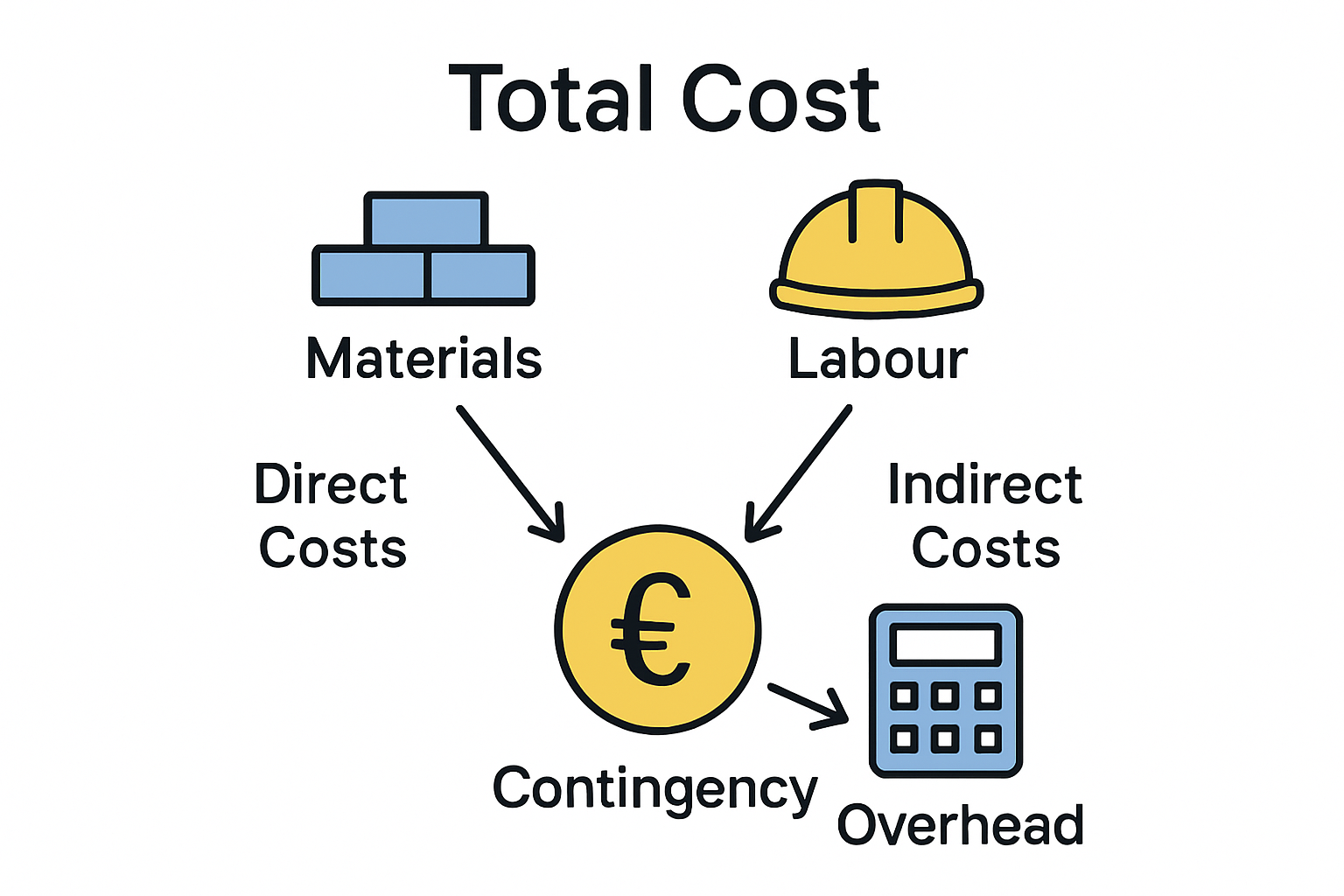
The primary cost components can be broadly categorised into direct and indirect expenses. Direct costs are tangible and immediately visible, including materials, labour, and equipment. These represent the physical inputs required to transform architectural designs into functional structures. Indirect costs, while less apparent, are equally significant and encompass expenses such as project management, site overheads, insurance, permits, and administrative support. These background expenses often constitute a substantial portion of the total project expenditure and require careful strategic planning.
Breakdown of core cost components typically includes:
- Material Costs: Raw building materials like concrete, steel, timber, and finishing elements
- Labour Expenses: Wages for skilled tradespeople, engineers, and construction workers
- Equipment Investment: Machinery rental, purchase, and maintenance costs
- Site Preparation Costs: Groundwork, surveying, and initial infrastructure development
- Professional Service Fees: Architectural design, engineering consultancy, and project management
- Regulatory Compliance Expenses: Permits, inspections, and legal documentation
- Contingency Allocations: Financial buffers for unexpected challenges or variations
Effective cost management requires a holistic approach that considers both the immediate expenses and potential long-term financial implications. Project managers must develop comprehensive strategies that balance immediate budget constraints with overall project quality and sustainability.
Direct, Indirect, and Contingency Costs Explained
Navigating the complex landscape of construction expenses requires a deep understanding of how different cost categories interact. The UK government’s Cost Estimating Guidance provides critical insights into the nuanced world of direct, indirect, and contingency costs that form the financial architecture of construction projects.
Direct costs represent the most transparent and immediately identifiable expenses in a construction project. These include tangible resources directly attributed to specific project activities, such as labour wages, material purchases, and equipment usage. Unlike direct costs, indirect costs are less visible but equally crucial. They encompass overhead expenses like project management, site maintenance, insurance, permits, and administrative support that cannot be directly linked to a single project element but are essential for overall project execution.
The third critical cost category is contingency costs, which serve as a financial safety net. As detailed in research by construction cost experts, these allocations protect projects from unforeseen circumstances and potential risks. Contingency costs typically range between 5-15% of the total project budget and provide flexibility to address:
- Unexpected material price fluctuations
- Potential design modifications
- Potential site condition challenges
- Potential regulatory compliance adjustments
- Potential equipment breakdowns or replacement needs
- Weather-related delays or interruptions
Successful construction financial management demands a strategic approach that carefully balances these three cost categories. Professionals must develop sophisticated budgeting techniques that anticipate potential variations, maintain financial resilience, and ensure project completion within acceptable economic parameters.
Accurate Construction Cost Estimating Methods
Accurate construction cost estimating represents a critical skill that bridges technical expertise and financial precision. The UK government’s Cost Estimating Guidance emphasises the importance of developing robust methodologies that transform complex project requirements into reliable financial projections.
Professional cost estimators employ multiple sophisticated techniques to ensure maximum accuracy. These methods range from traditional quantity surveying approaches to advanced computational models that leverage historical data and predictive analytics. Machine learning algorithms are now emerging as powerful tools that can classify and analyse construction cost documents with unprecedented efficiency, enabling more nuanced and precise financial forecasting.
Key approaches to accurate construction cost estimation include:
- Parametric Estimation: Using statistical relationships between historical project data and specific parameters
- Analogous Estimating: Comparing current project costs with similar past projects
- Bottom-Up Estimating: Detailing individual cost components and aggregating them
- Three-Point Estimating: Calculating potential cost variations using optimistic, pessimistic, and most likely scenarios
- Computerised Estimating: Utilising advanced software with integrated cost databases
- Expert Judgment: Incorporating experienced professionals’ insights and historical knowledge
Modern cost estimation demands a multifaceted approach that combines technological sophistication with deep industry understanding. Successful professionals blend quantitative analysis with qualitative insights, ensuring that financial projections are not just numbers, but strategic tools for effective project management.
Common Mistakes and How to Avoid Them
The construction industry is fraught with potential financial pitfalls that can derail project budgets and timelines. The UK Infrastructure Cost Review highlights the critical importance of identifying and mitigating common estimation errors before they escalate into significant financial challenges.
Research from construction cost experts reveals that many estimation mistakes stem from systemic oversights rather than isolated incidents. Detailed academic research suggests that professional cost estimators frequently encounter predictable traps that can be strategically avoided through disciplined approaches and comprehensive understanding.
The most prevalent estimation mistakes include:
- Inadequate Scope Definition: Failing to comprehensively outline project parameters
- Historical Data Misinterpretation: Incorrectly applying past project cost models to current scenarios
- Overlooking Indirect Costs: Neglecting hidden expenses like site management and regulatory compliance
- Insufficient Risk Contingency: Underestimating potential financial uncertainties
- Poor Communication Between Stakeholders: Miscommunication leading to fragmented cost understanding
- Ignoring Market Price Fluctuations: Not accounting for material and labour cost variations
- Underestimating Complexity: Simplifying project intricacies that impact financial projections
Mitigating these risks requires a proactive, multifaceted approach that combines meticulous planning, continuous learning, and adaptive strategies. Successful professionals cultivate a holistic perspective that views cost estimation as a dynamic, evolving discipline rather than a static mathematical exercise.
Take Control of Your Construction Costs with Expert Estimating Support
Understanding the intricacies of a construction cost breakdown is vital for staying on budget and avoiding unexpected financial risks. This guide highlights common challenges such as accurately separating direct, indirect, and contingency costs as well as preventing estimation mistakes that could compromise your project’s success. If you have faced difficulty managing complex cost components or struggled with unclear budgeting, you are not alone.
At My Project Estimating, we specialise in transforming these detailed financial concepts into clear, reliable, and transparent estimates tailored for UK construction projects. Our services include early-stage cost planning, detailed quantity takeoffs, and comprehensive cost reports built on verified UK market data. With fast turnaround times and a straightforward process, we empower architects, developers and builders to make confident, informed decisions from project conception through to completion.
Ready to simplify your cost planning and keep your project on track? Explore our insights and resources in the Uncategorized Archives and start your journey to financial clarity today by visiting My Project Estimating. Let us help you control risks and achieve budgeting confidence now.
Frequently Asked Questions
What is a construction cost breakdown?
A construction cost breakdown is a detailed financial analysis that categorises and details all expenses associated with a building project, helping professionals plan budgets and allocate resources effectively.
What are the core components of construction costs?
Core components include material costs, labour expenses, equipment investment, site preparation costs, professional service fees, regulatory compliance expenses, and contingency allocations.
How do direct, indirect, and contingency costs differ?
Direct costs are tangible expenses directly linked to project activities, while indirect costs encompass overhead expenses like project management. Contingency costs act as a financial buffer for unexpected challenges during the project.
What common mistakes should be avoided in cost estimation?
Common mistakes include inadequate scope definition, misinterpretation of historical data, overlooking indirect costs, insufficient risk contingency, poor communication between stakeholders, and underestimating project complexity.
Recommended
- Master the Construction Cost Breakdown Workflow in the UK – My Project Estimating
- 7 Essentials for a Complete Construction Cost Checklist – My Project Estimating
- 7 Essential Steps for a Construction Budget Checklist UK – My Project Estimating
- What Is Cost Planning? Complete UK Construction Guide – My Project Estimating