Over 60 percent of british construction projects face cost overruns before completion. Managing these expenses is not just about crunching numbers. It shapes a project’s success and builds client trust across the industry. When construction professionals master cost planning, they bring order to complex budgets, reduce risk, and set every stage of a project on stronger financial ground. This guide reveals proven strategies and insights that help british teams keep projects on track from concept to completion.
Table of Contents
- Defining Cost Planning in Construction
- Main Types and Stages of Cost Planning
- How Cost Planning Works in Projects
- Financial Benefits and Budget Management
- Common Pitfalls and How to Avoid Them
Key Takeaways
| Point | Details |
|---|---|
| Importance of Cost Planning | Cost planning is essential for managing and predicting expenses throughout a construction project, helping to align tender amounts with estimates. |
| Stages of Cost Planning | It involves several stages, including conceptual, detailed, and elemental cost planning, each critical for effective resource management. |
| Financial Benefits | Comprehensive cost planning enhances budget management, optimises resource allocation, and mitigates risk, contributing to a project’s financial success. |
| Avoiding Common Pitfalls | Identifying common pitfalls such as inadequate scoping and poor communication is vital for developing effective strategies that ensure project stability. |
Defining Cost Planning in Construction
Cost planning is a strategic financial management process fundamental to successful construction projects, designed to control and predict project expenditures from inception through completion. According to Taylor Francis, cost planning represents “a continuous process involving progressive checks on individual elements as the design develops, ensuring that the tender amount aligns closely with initial estimates and that funds are allocated economically across project components”.
At its core, cost planning involves creating a comprehensive financial roadmap that tracks potential expenses, anticipates challenges, and enables proactive budget management. Construction professionals use sophisticated techniques to break down project costs into granular categories, including materials, labour, equipment, and overhead expenses. This meticulous approach allows teams to:
- Establish realistic budget expectations
- Identify potential cost overruns early
- Allocate resources strategically
- Make informed financial decisions throughout the project lifecycle
The process typically begins during the initial design phase and continues through project completion, with regular reviews and adjustments. By implementing robust cost planning services, construction teams can minimise financial risks, maintain transparency, and ensure that projects remain financially viable from conceptualisation to final delivery.
Main Types and Stages of Cost Planning
Cost planning encompasses several distinct types and stages that guide construction projects from initial concept to final completion. These comprehensive approaches help professionals manage financial resources effectively and minimise potential budgetary risks. When conducting detailed cost management in construction, teams typically navigate through four primary stages of cost planning.
The main types of cost planning can be categorised into strategic approaches that address different project phases:
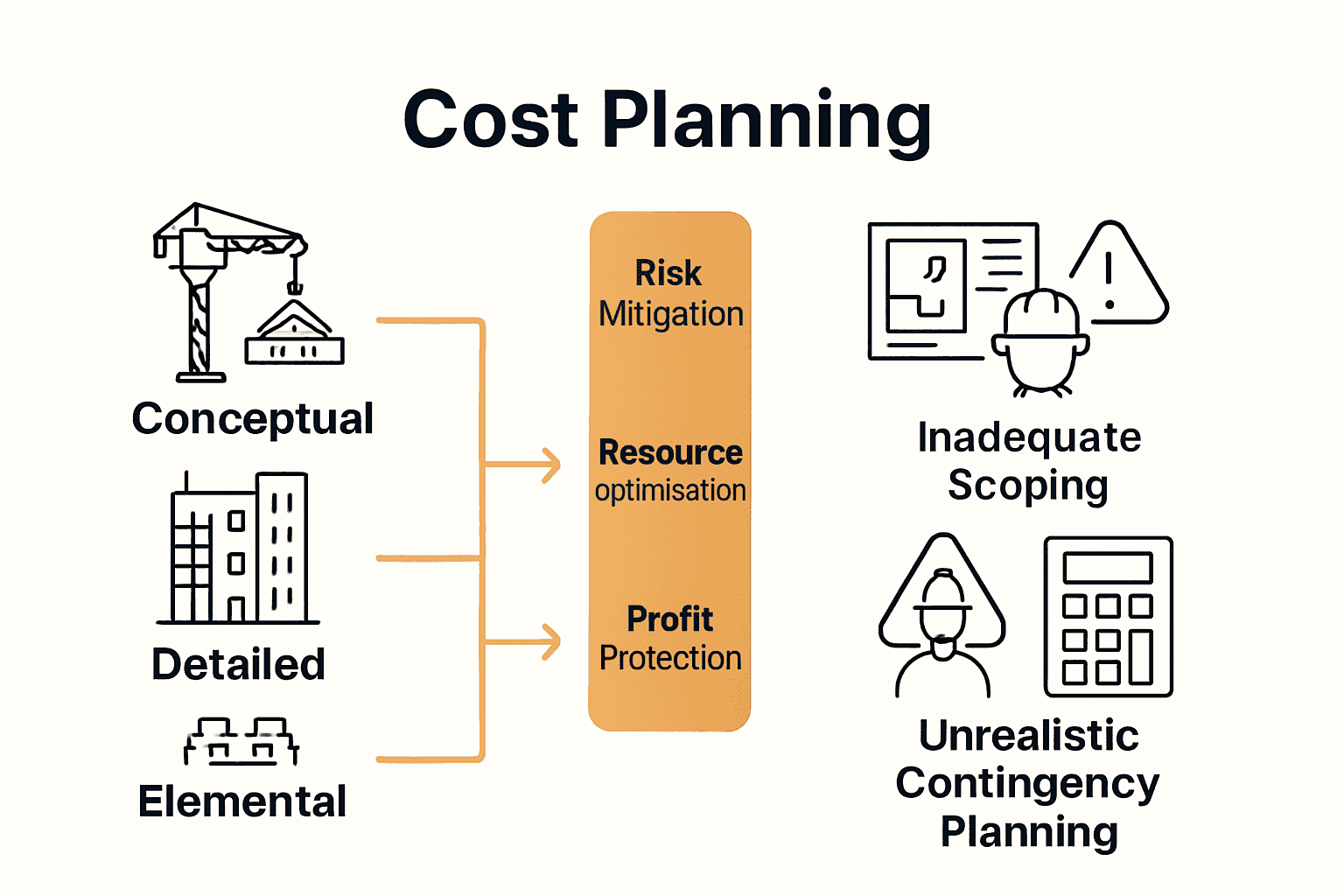
- Conceptual Cost Planning: Occurs during initial design stages
- Develops rough budget estimates
- Assesses project feasibility
- Establishes preliminary financial parameters
- Detailed Cost Planning: Happens during developed design phases
- Breaks down specific project components
- Provides granular cost allocations
- Refines initial budget projections
- Elemental Cost Planning: Focuses on individual project elements
- Analyses costs of specific construction components
- Helps identify potential cost-saving opportunities
- Enables precise financial tracking

Each stage requires meticulous attention to detail and continuous monitoring. Construction professionals must remain adaptable, updating cost plans as project designs evolve and unexpected challenges emerge. By implementing robust cost planning strategies, teams can maintain financial control, optimise resource allocation, and increase the likelihood of project success.
How Cost Planning Works in Projects
Cost planning is a dynamic process that transforms complex construction financial management into a structured, systematic approach. According to Taylor Francis, effective cost planning “requires close collaboration among engineers, architects, and quantity surveyors, involving continuous monitoring and adjustments to ensure the project remains within budget as the design evolves”.
The implementation of cost planning typically follows a comprehensive workflow that integrates multiple professional disciplines and strategic checkpoints:
- Initial Assessment
- Gather project requirements
- Define preliminary budget parameters
- Identify potential financial constraints
- Design Integration
- Collaborate with project designers
- Estimate costs for proposed design elements
- Develop initial cost projections
- Detailed Analysis
- Break down individual project components
- Calculate precise material and labour costs
- Evaluate potential cost-saving strategies
For construction professionals seeking more detailed insights, our cost forecasting guide provides additional strategies for financial management. Successful cost planning demands ongoing communication, flexibility, and a proactive approach to financial tracking, ensuring projects maintain fiscal discipline while meeting design and quality objectives.
Financial Benefits and Budget Management
Budget management in construction projects represents a critical financial strategy that directly impacts project success and organisational profitability. By implementing robust cost planning mechanisms, construction teams can unlock significant financial advantages that extend far beyond simple expense tracking. When applied systematically, these approaches transform financial management from a reactive process to a proactive, strategic discipline.
The primary financial benefits of comprehensive cost planning include:
- Risk Mitigation: Identifying potential financial vulnerabilities before they escalate
- Resource Optimisation: Allocating funds more efficiently across project components
- Profit Protection: Preventing unexpected cost overruns that could erode project margins
- Competitive Advantage: Demonstrating financial discipline to stakeholders and clients
Precise budget management requires a multilayered approach that integrates detailed financial forecasting with real-time monitoring. Construction professionals can leverage cost estimating techniques to develop sophisticated financial models that adapt to changing project parameters. These models enable teams to make data-driven decisions, redistribute resources dynamically, and maintain financial flexibility throughout the project lifecycle. Ultimately, effective budget management transforms financial constraints into strategic opportunities for innovation and efficiency.
Common Pitfalls and How to Avoid Them
Cost planning in construction projects is fraught with potential challenges that can derail financial management and project success. Budgetary risks emerge from multiple sources, requiring construction professionals to develop sophisticated strategies for anticipating and mitigating potential financial vulnerabilities. Understanding these common pitfalls is the first step towards creating more resilient and financially stable project frameworks.
The most critical pitfalls in cost planning include:
- Inadequate Initial Scoping
- Underestimating project complexity
- Failing to conduct comprehensive preliminary assessments
- Overlooking potential hidden costs
- Poor Communication
- Miscommunication between project stakeholders
- Lack of transparent financial reporting
- Insufficient documentation of cost variations
- Unrealistic Contingency Planning
- Setting insufficient financial buffers
- Neglecting potential market fluctuations
- Underestimating potential risk factors
Construction teams can leverage cost management techniques to develop more robust financial strategies. Proactive risk management involves continuous monitoring, regular financial reassessments, and maintaining flexible budget frameworks that can adapt to changing project dynamics. By implementing comprehensive tracking mechanisms and fostering open communication, professionals can transform potential pitfalls into opportunities for strategic financial planning.
Take Control of Your Construction Costs with Expert Planning
Cost planning is key to avoiding unexpected expenses and ensuring your project stays on budget from start to finish. This article highlights common challenges such as inadequate scoping and poor communication that can put financial stability at risk. If you want to overcome these hurdles with confidence, it is vital to have detailed, UK-specific cost planning strategies that provide clarity and control.
At My Project Estimating, we specialise in delivering precise cost estimates and tailored cost planning services designed to meet the needs of architects, builders, developers, and homeowners. Our professional UK estimators ensure your budget is realistic with transparent pricing and quick turnaround times. Explore our Uncategorized Archives to find valuable insights and tools that support your decision-making at every stage.
Don’t leave your project’s financial future to chance. Visit My Project Estimating today and take the first step towards secure, effective cost planning that empowers you to deliver successful construction projects on time and within budget.
Frequently Asked Questions
What is cost planning in construction?
Cost planning is a strategic financial management process that involves predicting and controlling project expenditures throughout the construction lifecycle. It ensures that funds are allocated effectively and that the tender amount aligns closely with initial estimates.
What are the main types of cost planning?
The main types of cost planning include conceptual cost planning, which develops rough estimates during initial design stages; detailed cost planning, which provides granular cost allocations; and elemental cost planning, which focuses on specific project components to track costs accurately.
How does cost planning work in construction projects?
Cost planning works through a systematic approach that begins with an initial assessment of project requirements, followed by design integration and detailed analysis of individual components. Ongoing communication and adjustments are essential to ensure the project remains within budget as designs evolve.
What are common pitfalls in cost planning, and how can they be avoided?
Common pitfalls in cost planning include inadequate initial scoping, poor communication among stakeholders, and unrealistic contingency planning. These can be avoided by conducting thorough preliminary assessments, maintaining transparent communication, and ensuring sufficient financial buffers are set to accommodate potential risks.
Recommended
- Complete Guide to Cost Management in Construction – My Project Estimating
- Cost Planning Service | Accurate UK Construction Budgets
- Construction Estimating Guide 2025: Accurate UK Cost Plans – My Project Estimating
- Cost Forecasting in Construction UK | Accurate UK Construction Cost Forecasts
- Cost to Move House UK 2025: Guide for Homeowners and Businesses | Schott Removals
- Kitchen Renovation Costs Breakdown: Complete UK Guide – WordPress