Unexpected expenses can derail even the best-planned construction projects. In the UK, nearly one in three major builds goes over budget, often due to poor financial forecasting. With rising material costs and shifting deadlines, getting cost predictions right matters more than ever. Understanding cost forecasting gives construction professionals the insight they need to protect profits and avoid costly surprises while keeping stakeholders confident at every stage.
Table of Contents
- Defining Cost Forecasting In Construction Projects
- Main Types And Methods Of Cost Forecasting
- How Cost Forecasting Supports UK Construction
- Common Challenges And Pitfalls In Forecasting
- Best Practices For Accurate Cost Control
Key Takeaways
| Point | Details |
|---|---|
| Cost Forecasting Definition | A strategic financial planning process essential for predicting and managing project expenses throughout the construction lifecycle. |
| Methodologies | Utilizes various methods like analogous, parametric, and bottom-up estimating to provide accurate financial projections tailored to project characteristics. |
| Supports Financial Management | Enhances project planning, risk mitigation, and stakeholder confidence by providing transparent and precise financial insights. |
| Challenges | Addresses prevalent issues such as data inconsistencies and market volatility, necessitating continuous updates and sophisticated strategies for effective forecasting. |
Defining Cost Forecasting in Construction Projects
Cost forecasting in construction represents a strategic financial planning process that enables project managers and stakeholders to predict, estimate, and manage potential expenses throughout a project’s lifecycle. According to the UK Government, cost forecasting is defined as the systematic method of predicting future project costs by utilizing established data points and analytical techniques.
At its core, cost forecasting involves a comprehensive evaluation of multiple financial variables that could impact project expenses. The Royal Institution of Chartered Surveyors (RICS) highlights that effective cost prediction considers critical factors such as:
- Project quality standards
- Anticipated project schedule
- Geographical location
- Funding mechanisms
- Selected procurement routes
Successful cost forecasting goes beyond simple number-crunching. It requires a nuanced understanding of construction economics, market fluctuations, and potential risk factors. Experienced professionals use advanced techniques like statistical modeling, historical data analysis, and parametric estimating to create accurate financial projections.
The ultimate goal of cost forecasting is risk mitigation. By anticipating potential financial challenges early in the project lifecycle, construction teams can develop strategic contingency plans, negotiate more effectively with suppliers, and maintain greater financial control. Accurate forecasting helps prevent budget overruns, ensures more reliable project planning, and provides stakeholders with transparent financial insights. For professionals seeking detailed support in this complex process, our cost planning service offers comprehensive and precise financial forecasting tailored to UK construction standards.
Main Types and Methods of Cost Forecasting
Cost forecasting in construction encompasses multiple sophisticated methodologies that enable project teams to generate accurate financial predictions. UK Government guidance highlights two primary approaches: deterministic and probabilistic cost estimation techniques, each serving distinct purposes in project financial planning.
The primary cost forecasting methods include:
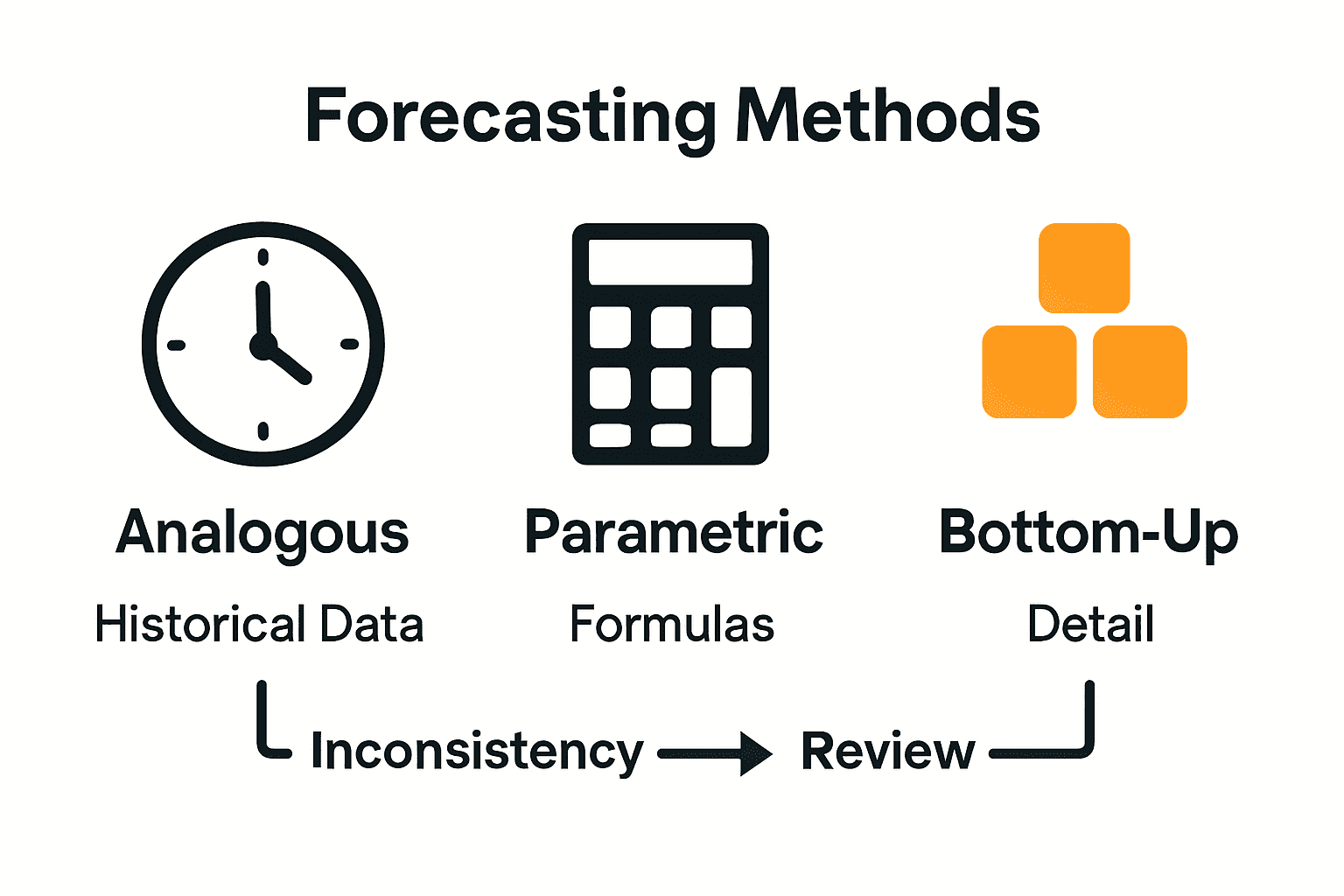
- Analogous Estimating: Uses historical data from similar past projects to predict current project costs
- Parametric Estimating: Applies statistical modeling and mathematical relationships between project variables
- Bottom-Up Estimating: Calculates detailed costs for individual project components, then aggregates them
- Three-Point Estimating: Considers optimistic, pessimistic, and most likely cost scenarios
- Regression Analysis: Utilizes advanced statistical techniques to identify cost relationships
Deterministic methods provide straightforward, single-point cost estimates based on known parameters, making them suitable for well-defined projects with minimal complexity. Probabilistic approaches, conversely, incorporate statistical variations and risk factors, offering more nuanced financial projections that account for potential uncertainties.
Advanced cost forecasting requires sophisticated tools and deep domain expertise.
IMAGE:descriptive_key_1] Professionals must carefully select estimation techniques based on project characteristics, available data quality, and specific industry requirements. Our [cost planning service specializes in delivering precise, context-specific financial forecasts that help construction teams make informed strategic decisions.
How Cost Forecasting Supports UK Construction
Cost forecasting plays a critical role in supporting the UK construction industry by providing strategic financial insights and risk management capabilities. According to Indeed.com UK, accurate cost estimation fundamentally enhances project planning, risk mitigation, and operational efficiency, ensuring construction projects remain financially viable and strategically aligned.
The primary ways cost forecasting supports UK construction include:
- Early Problem Detection: Identifying potential financial challenges before they escalate
- Budget Optimization: Allocating resources more effectively and precisely
- Stakeholder Confidence: Providing transparent financial projections
- Risk Management: Developing contingency strategies for potential cost variations
- Competitive Bidding: Enabling more accurate and competitive project proposals
ProjectManager.com emphasizes that effective cost forecasting enables construction teams to proactively identify potential cost overruns, facilitating timely corrective actions that protect project financial integrity. This approach transforms cost forecasting from a passive accounting exercise into a dynamic strategic tool that drives project success.
For UK construction professionals seeking comprehensive financial planning support, our construction estimating services offer tailored solutions that leverage advanced forecasting methodologies. By combining sophisticated analytical techniques with deep industry expertise, we help construction teams navigate complex financial landscapes, minimize risks, and optimize project financial performance.
Common Challenges and Pitfalls in Forecasting
Cost forecasting in construction presents numerous complex challenges that can significantly impact project financial management. Arcom research highlights that traditional cost estimating methods frequently suffer from inherent accuracy limitations, particularly during early project stages, due to significant uncertainties and the construction industry’s historically slow adoption of robust risk management practices.
The most prevalent challenges in construction cost forecasting include:
- Data Inconsistency: Unreliable or incomplete historical project data
- Scope Creep: Unexpected project modifications that disrupt initial financial projections
- Market Volatility: Rapid changes in material and labor costs
- Complex Interdependencies: Intricate relationships between project components
- Technology Integration: Challenges in implementing advanced forecasting tools
NetSuite emphasizes that dynamic challenges like project scope changes, labor cost variability, and project duration significantly impact cost estimates. These variables demand continuous forecast updates and a flexible approach to financial planning.
Navigating these challenges requires sophisticated strategies and professional expertise. Our construction estimating services provide comprehensive solutions that address these complex forecasting obstacles, ensuring construction professionals can develop more accurate, resilient financial projections that withstand the unpredictable nature of construction projects.
Best Practices for Accurate Cost Control
Accurate cost control represents a critical strategic imperative for successful construction project management. Effective financial oversight requires a multifaceted approach that combines rigorous analytical techniques, proactive risk management, and sophisticated forecasting methodologies.
Key best practices for maintaining precise cost control include:
- Comprehensive Documentation: Meticulously record all project expenses and variations
- Regular Financial Reviews: Conduct frequent and detailed cost assessments
- Advanced Tracking Systems: Implement robust digital tracking mechanisms
- Realistic Contingency Planning: Develop flexible financial buffers
- Transparent Stakeholder Communication: Maintain clear financial reporting
NetSuite recommends implementing tri-scenario cost forecasting, which involves developing comprehensive financial projections that consider optimistic, pessimistic, and most likely cost scenarios. This approach enables project teams to understand potential financial outcomes and craft nuanced contingency strategies that mitigate potential risks.
For construction professionals seeking comprehensive financial management support, our professional cost estimating service provides advanced tools and expert insights to transform cost control from a reactive process into a strategic competitive advantage. By leveraging sophisticated analytical techniques and industry-specific expertise, we help construction teams navigate complex financial landscapes with precision and confidence.
Take Control of Your Construction Costs with Expert Forecasting
Understanding the complexities of cost forecasting can be overwhelming when faced with fluctuating market prices, unforeseen project changes, and tight budgets. This article highlights the challenges of inaccurate estimates and scope creep that can threaten your project’s financial success. You deserve a clear, reliable solution that gives you confidence to plan ahead, control risks, and avoid costly surprises.
Discover how our UK-focused services at My Project Estimating transform complex financial data into transparent, detailed cost plans customised to your project. Whether you need early-stage cost planning or comprehensive estimates, our skilled estimators help you stay on track. Visit our Uncategorized Archives to explore resources and insights that empower your decision-making. Don’t let uncertainty hold your project back. Take the next step by contacting us today and ensure your construction costs are forecasted with precision to match your ambitions.
Frequently Asked Questions
What is cost forecasting in construction?
Cost forecasting in construction is a strategic financial planning process that allows project managers to predict and manage potential expenses throughout a project’s lifecycle by analyzing established data points and utilizing various analytical techniques.
What are the main types of cost forecasting methods?
The main types of cost forecasting methods include Analogous Estimating, Parametric Estimating, Bottom-Up Estimating, Three-Point Estimating, and Regression Analysis. These methods vary in complexity and application based on project characteristics.
How does cost forecasting help in managing construction projects?
Cost forecasting helps in managing construction projects by enabling early detection of financial challenges, optimizing budgets, maintaining stakeholder confidence through transparent projections, managing risks, and enhancing competitive bidding processes.
What are some common challenges in construction cost forecasting?
Common challenges in construction cost forecasting include data inconsistency, scope creep, market volatility, complex interdependencies, and difficulties in integrating advanced forecasting technologies. These factors can significantly impact the accuracy of cost projections.