Budget overruns and delayed programmes are a constant concern for UK project managers tackling residential developments. The challenge is not just about predicting costs, but selecting the right estimation methods and applying them to changing designs and incomplete information. Construction cost estimation gives you the tools to break down complex projects into clear, measurable elements, improving accuracy at every stage. This guide covers practical steps and proven strategies for achieving reliable estimates, so you can manage risks and keep your projects running efficiently.
Table of Contents
- Construction Estimation Basics And Core Concepts
- Main Types Of Estimates In UK Construction
- Step-By-Step Outline Of The Estimating Process
- Legal Requirements And RIBA Framework Integration
- Common Risks, Pitfalls, And Accuracy Strategies
Key Takeaways
| Point | Details |
|---|---|
| Construction Estimation Requires Skill and Experience | Effective estimators blend technical knowledge with market insights to create accurate cost forecasts. Understanding cost elements and estimation methods is crucial for reliable budgeting. |
| Different Estimate Types Suit Specific Project Phases | Utilise the appropriate estimate type—ranging from rough orders of magnitude to detailed estimates—based on the project development stage to avoid miscommunication and budget discrepancies. |
| Accurate Documentation and Assumptions Are Essential | Document all assumptions, gaps in information, and the basis for your estimates clearly to safeguard against disputes and provide clarity for clients. |
| Identify and Manage Risks Proactively | Recognise common risks such as documentation gaps, supply chain volatility, and scope creep to implement appropriate accuracy strategies and contingencies in your estimates. |
Construction Estimation Basics And Core Concepts
Construction estimation is both an art and a science. On one hand, it requires technical skill in interpreting design drawings, specifications, and construction methodologies. On the other hand, it demands an understanding of market conditions, labour costs, material pricing, and project complexity that can only come from experience. When estimators prepare cost forecasts for residential developments, they’re essentially making informed predictions about what a project will actually cost to build, not just what it should theoretically cost. This distinction matters enormously because reality rarely matches theory on site.
At its core, cost estimation involves breaking down a project into measurable components and assigning realistic values to each one. Think of it like pricing a custom kitchen refit. You don’t just say “it’ll cost £15,000.” Instead, you itemise everything: cabinet units, worktops, appliances, plumbing connections, electrical work, tiling, labour hours per task, and contingencies for unforeseen issues. Construction estimation works identically, but scaled up significantly. The fundamental challenge lies in the accuracy of your assumptions. When you underestimate a single trade’s labour cost by just 15%, that miscalculation ripples across your entire project budget. Understanding different cost estimation methods helps you select the right approach for your project phase and complexity level.
Estimators working in the UK context must grasp several core concepts that directly influence whether budgets hold or collapse. First, there’s the concept of cost elements, which refers to how you categorise and break down project costs. The Royal Institution of Chartered Surveyors (RICS) provides foundational guidance on how to structure these cost analyses and establish reliable benchmarks against comparable projects. Second, you need to understand estimation accuracy levels. A rough order of magnitude estimate during early design stages might be accurate within ±25%, whereas a detailed unit price estimate in pre-contract phases should achieve ±5% accuracy. Third, comprehend the relationship between project information completeness and estimation reliability. Incomplete design documents or unclear scopes create estimation blind spots that lead directly to budget overruns once construction begins.
The practical reality for UK residential projects involves working with incomplete information more often than you’d like. Site conditions can surprise you (contaminated soil, unexpected structural repairs), supply chain disruptions affect material costs (we’ve all felt the impact of recent price volatility), and subcontractor availability influences labour scheduling and costs. This is why building contingencies into your estimates isn’t optional—it’s essential practice. Your contingency percentage should reflect your project’s uncertainty level, not just serve as a convenient buffer. A renovation project with extensive unknowns warrants a larger contingency than a new-build on a straightforward site.
Pro tip: Start every estimation process by documenting your assumptions in writing. Record what design information you received, what you assumed about site conditions, which cost benchmarks you referenced, and what contingency percentage you applied. When (not if) your client questions the estimate, you can point to exactly how you arrived at those figures rather than defending vague calculations.
Main Types Of Estimates In UK Construction
Not all estimates are created equal, and using the wrong type at the wrong project stage is a reliable way to either underbid a project or shock your client with a sudden price jump. The construction industry uses different estimation approaches depending on how far along the project has progressed and how much information you actually have to work with. Early in a project, when designs are rough sketches and specifications don’t exist yet, you’ll use broad brush estimates. As the project develops and details emerge, your estimates become progressively more detailed and accurate. Understanding which estimate type suits each phase prevents miscommunication and protects your budget.
The journey typically starts with a rough order of magnitude estimate, sometimes called a ballpark figure or preliminary estimate. This arrives before design is complete, often from just a site description and floor area. Accuracy here sits around ±25 to 40%, which sounds loose until you realise this estimate’s only job is helping clients decide whether a project is financially viable at all. A developer considering a £2 million residential scheme doesn’t need pinpoint accuracy at this stage; they need to know if it’s sensible to invest in proper design development. Next comes the conceptual estimate once you have initial design layouts and material selections outlined. This tightens accuracy to roughly ±15 to 20% and helps stakeholders understand cost implications as design decisions get made. Then comes the schematic estimate when design drawings are substantially complete but specifications remain general. You’re now at around ±10% accuracy and can justify line items more thoroughly.
As projects progress toward construction, different estimation approaches become more granular and exacting. The detailed estimate or definitive estimate arrives when construction documents are finalised, all specifications are locked in, and you can measure actual quantities from drawings rather than guessing. This estimate achieves ±5% accuracy or better because you’re pricing specific items: 47 metres of cavity brick wall at £85 per square metre, not “walls cost what walls cost.” For competitive bidding on residential projects, contractors often prepare tender estimates based on these detailed documents, breaking costs into labour, materials, plant, and overheads with precision that protects their profit margin. Some organisations also use parametric estimates that rely on historical data and cost models to predict expenses based on comparable past projects, which works brilliantly when you have reliable historical records from similar residential developments.
The critical insight for UK project managers is this: your estimate type must match your project phase. Asking an estimator to produce a definitive estimate when designs are 30% complete wastes everyone’s time and produces meaningless numbers. Conversely, presenting a rough order of magnitude to a contractor expecting final pricing creates conflict and contract disputes. Each estimate type serves a purpose and should be communicated clearly to stakeholders so expectations align with accuracy levels. When you’re moving between estimate types, explain to your team and clients why the figures shift. That’s not a problem; that’s normal project development.
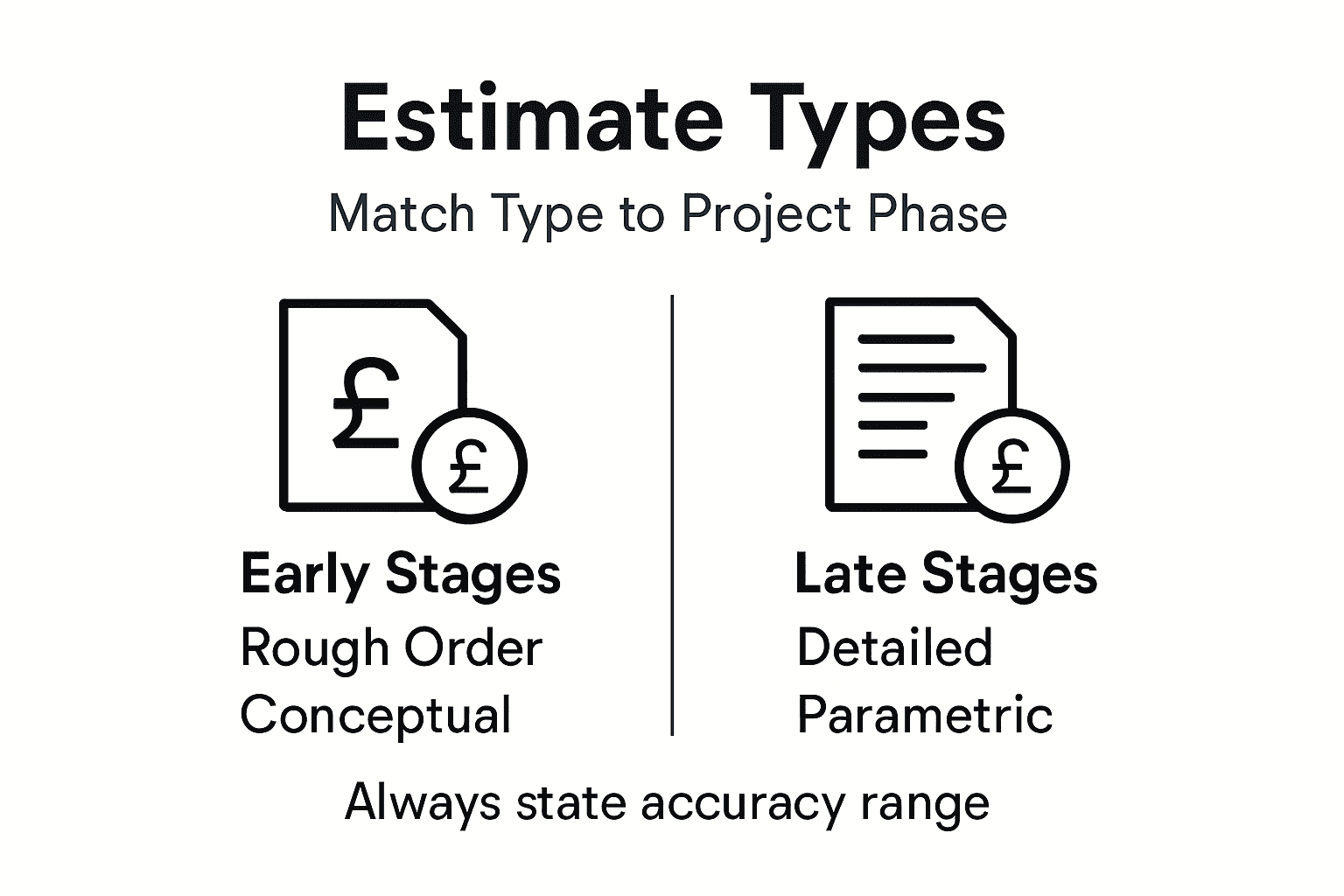
Pro tip: Always document which estimate type you’re providing and clearly state its accuracy range (±25%, ±10%, etc.) in writing. When design information evolves and you move to a more detailed estimate type, present the revision alongside an explanation of what additional information became available. This transparency prevents clients from viewing price increases as estimator errors rather than natural progressions as projects develop.
Here’s an overview of main cost estimation types used in UK residential projects:
| Estimate Type | Typical Project Stage | Accuracy Range | Key Use Case |
|---|---|---|---|
| Rough Order of Magnitude | Feasibility/early concept | ±25–40% | Initial viability assessment |
| Conceptual Estimate | Early design/layouts | ±15–20% | Guiding design decisions |
| Schematic Estimate | Design near completion | ±10% | Budgeting with detailed line items |
| Detailed/Definitive Estimate | Final construction documents | ±5% or better | Tendering and final budget alignment |
| Parametric Estimate | Any stage with comparable data | Variable | Reference costs from similar projects |
Step-By-Step Outline Of The Estimating Process
The estimating process isn’t something you can rush through or improvise. It requires a structured approach where each step builds on the previous one, and missing a stage creates gaps that cost you money later. Whether you’re working on a £500,000 terraced house renovation or a multi-unit residential development, the fundamental workflow remains consistent. The Real Institution of Chartered Surveyors has established structured measurement and estimation standards that professional estimators follow because they work. Understanding this process helps you recognise when corners are being cut and why proper estimation takes time rather than being an afternoon task.
Start by gathering and reviewing all available project information. This sounds obvious, but it’s where most problems begin. You need design drawings (preferably digital copies you can measure from), specifications that detail material grades and finishes, site surveys or reports covering ground conditions, and any existing information about the property if it’s a renovation or extension. Read specifications word by word, not skimmed. Clarify ambiguities with the architect or client immediately because assumptions become expensive mistakes once work starts. Next, you need to establish the scope of work boundaries in writing. What’s included in your estimate? Temporary works and site facilities? Demolition? Making good after? Snagging? A vague scope creates disputes when the bill arrives and you’ve included items the client thought were their responsibility. Then move into measuring and quantifying project elements. For residential work, this involves calculating floor areas, wall lengths, window and door counts, and other physical quantities from drawings. Structured measurement techniques ensure you don’t double-count elements or miss components entirely. Use a spreadsheet or quantity takeoff software to keep track methodically.
Once quantities are locked down, you transition to pricing each element based on current market rates for labour, materials, and plant in your region. This is where experience and market knowledge matter enormously. A square metre of brickwork costs dramatically different amounts depending on whether it’s cavity wall, solid wall, or decorative facing. Labour rates vary based on complexity, accessibility, and whether specialist trades are required. Don’t assume last year’s prices still apply. Get quotes from suppliers and subcontractors for major items rather than relying on outdated benchmarks. Then calculate your overheads and profit. Overhead costs include office staff, insurance, vehicle running, and site management time. Many estimators apply overhead as a percentage of direct costs, typically 12 to 18% depending on your business size and structure. Profit margin varies by market competitiveness and project risk. After calculating everything, review your estimate for reasonableness by comparing it against the gross cost per square metre or the cost per unit for residential projects. If your estimate sits significantly above or below comparable projects, investigate why. Did you include items others didn’t? Miss a major cost category? Have you priced one trade dramatically differently than market rates suggest?

The final steps involve documenting your assumptions and presenting your estimate clearly. Write down what information you received, what you assumed where information was incomplete, which cost databases or quotes you used, what contingency you applied and why, and any exclusions. This documentation protects you if disputes arise later. Then present the estimate in a format your client understands, typically broken down by major work packages or trade sections so they can see where money goes and can question specific items rather than the overall figure.
Pro tip: Build a reusable cost database specific to residential projects you’ve completed. Record actual costs against your estimate quantities for completed work. Over time, this gives you accurate historical pricing data tailored to your market and your methods, making future estimates faster and more reliable than generic benchmarks.
Legal Requirements And RIBA Framework Integration
Construction estimation doesn’t exist in a legal vacuum. UK residential projects operate within a framework of contractual obligations, building regulations compliance, and professional standards that directly influence how you estimate costs and structure your estimates. The RIBA Plan of Work is the standard project delivery framework used by architects and many other construction professionals in the UK, and it’s not just a nice-to-have organisational tool. It’s integral to legal compliance because it defines clear stages where decisions lock in, responsibilities shift, and cost implications crystallise. If you’re estimating without understanding how your estimate fits into the RIBA framework, you’re missing critical context about what the client actually needs and when they need it.
The RIBA Plan of Work divides projects into eight stages, each with distinct purposes and cost implications. During the preparation and brief stages, you’re producing high-level estimates to help clients understand financial feasibility. By the concept design stage, your estimates need sufficient detail to inform design decisions without being so specific that they lock the designer into unsuitable solutions. The design development stage requires more detailed estimates as the design solidifies. The technical design stage demands precise estimates because you’re now preparing information for tender documents and contractor pricing. RIBA framework integration with cost planning ensures that your estimates align with the information available at each stage and with the legal requirements that emerge. This matters because a client cannot make informed decisions without knowing cost implications, and construction law increasingly emphasises that clients must have adequate information to make those decisions.
Beyond the RIBA framework, several legal and regulatory requirements shape estimation. The Building Safety Act and Building Regulations require that designs be buildable and safe, which means your estimate must reflect realistic construction methods and costs. The JCT and NEC contract forms (the standard construction contracts used in the UK) contain specific clauses about how estimates, contracts, and variations interact. If your estimate excludes something that’s actually required for compliance or safe construction, that creates a contractual trap. Hidden costs emerge when work starts, disputes arise about whether items should have been included, and budgets blow out. Professional indemnity insurance covers estimators and surveyors who make genuine errors, but it won’t cover deliberate underestimation or exclusion of necessary work.
Practically speaking, your estimate document itself becomes a legal document once it’s presented to a client. It forms the basis of discussions, negotiations, and eventually contracts. Vague wording creates disputes. If you write “internal decoration to client specification” without defining what that includes, you’re asking for trouble later. Similarly, exclusions must be crystal clear. “Excludes external works” is vague. Better to say “excludes all external works including drainage connections to main sewer, boundary treatments, and external hard landscaping.” The estimates you produce should always include explicit assumptions about what’s included and excluded, what information was available when you prepared the estimate, and what contingencies are included. This transparency protects both you and your client by ensuring expectations align.
Pro tip: Always cross-reference your estimate against the relevant RIBA stage and note which stage information your estimate is based on. If a client presents you with incomplete information for a detailed estimate, document what information was missing and flag that the estimate should be revisited once those details are confirmed. This single practice prevents most disputes about estimate accuracy.
Common Risks, Pitfalls, And Accuracy Strategies
Every estimator develops a horror story about a project that went catastrophically over budget. Sometimes the estimator made a genuine mistake. Often the problem was something nobody predicted. More frequently though, the budget blew out because common risks weren’t identified early or managed properly. The difference between estimators who consistently deliver accurate forecasts and those who struggle isn’t intelligence or experience level. It’s whether they systematically identify and plan for the risks that derail budgets. Construction estimation risks fall into several categories: documentation and information gaps, supply chain volatility, labour availability and cost inflation, programme delays that stack costs, and scope creep where work gradually expands beyond what was estimated.
Documentation errors represent perhaps the most controllable risk category yet remain surprisingly common. Missing or ambiguous specifications create situations where you assume one approach costs £8,000 and the client assumes something costing £12,000. Incomplete drawings mean you miss a structural element or misunderstand site conditions. Vague scope boundaries allow different stakeholders to interpret what’s included differently. The accuracy strategy here is straightforward: refuse to estimate from incomplete information. Write down explicitly what information gaps exist and flag that your estimate will require revision once those gaps are filled. Don’t estimate on assumptions. Get clarification. The cost of that extra conversation prevents budget disasters later. Supply chain risks have intensified in recent years. Material costs fluctuate wildly, and lead times shift unexpectedly. Rather than using fixed prices from three months ago, obtain current quotes from suppliers and subcontractors for major cost items. For items where quotes aren’t practical, apply a price volatility buffer to your estimate that reflects current market uncertainty. Labour availability and cost escalation create similar challenges. Skilled trades face genuine shortages in many regions, which drives costs upward and extends programmes. Your estimate should reflect current labour rates in your specific area, not national averages or old benchmarks.
Programme delays cascade into cost increases because site supervision costs continue regardless, plant sits idle, and team members get reassigned to other projects. Construction risks including weather impacts, subcontractor defaults, and supply delays directly influence how much contingency your estimate should include. A tight 12-week programme has less built-in buffer than a 20-week programme, so contingency percentages should reflect that reality. Scope creep represents perhaps the most insidious risk because it’s often invisible in the estimate phase. The client says they want “minor kitchen improvements” without defining what minor means. During design development, minor becomes a complete kitchen refit. By the time work starts, the scope has grown 40% without anyone formally revising the estimate. The accuracy strategy here involves detailed scope documentation at the start and a formal change control process where any scope additions require estimate revisions and client sign-off on cost implications.
Accuracy strategies centre on three fundamentals. First, use appropriate contingency levels that match your project’s risk profile. A routine extension on a straightforward site might justify 5 to 10% contingency, while a complex renovation with ground conditions unknown might warrant 15 to 25%. Second, obtain current market pricing rather than relying on historical data or generic benchmarks. Prices change monthly in current markets. Third, document everything. Record your assumptions, your information sources, your risk assessments, what contingency you applied and why. This documentation protects you and provides a foundation for explaining estimate variations when projects develop.
This table summarises common estimation risks and recommended accuracy strategies for UK residential projects:
| Risk Category | Typical Impact | Accuracy Strategy |
|---|---|---|
| Documentation Gaps | Missed costs, budget overruns | Demand complete info, document gaps |
| Supply Chain Volatility | Unpredictable material pricing | Use current quotes, add volatility buffer |
| Labour Shortages | Programme delays, higher costs | Base rates on current regional data |
| Scope Creep | Hidden costs, disputes | Define scope, control changes formally |
Pro tip: Create a risk register specifically for your estimate. List every identified risk, assess its probability and potential impact, and note what mitigation you’ve built into your estimate or what contingency you’ve applied. When presenting the estimate to clients, briefly walk them through major risks you’ve identified. This transparency builds confidence and prevents surprises if those risks materialise.
Gain Control Over Your UK Construction Budgets with Expert Estimation Support
Budget overruns in UK residential projects often stem from incomplete information, unclear scope, and inaccurate cost assumptions as discussed in the article “Construction Estimation – Preventing UK Budget Overruns”. These challenges cause stress, disputes, and financial loss for architects, builders, and developers striving to keep projects on track. If you want to avoid the pitfalls of underestimating labour or material prices, navigate supply chain volatility, and apply realistic contingency levels aligned with your project’s complexity, you need a trusted partner who understands these core concepts inside out.
At My Project Estimating, we specialise in delivering transparent and accurate cost forecasts informed by UK-specific market data. Whether you require early-stage cost planning or detailed definitive estimates to support tendering, our experienced estimators help you translate incomplete drawings and design assumptions into reliable budgets. Explore our tailored solutions within the Uncategorized Archives to see how structured estimating processes and clear documentation can protect your project’s financial success. Don’t let estimation risks derail your plans. Take the first step today by visiting My Project Estimating to request a personalised estimate and secure your project’s budget confidence.
Frequently Asked Questions
What is construction estimation?
Construction estimation involves predicting the costs of a construction project by breaking it down into measurable components and assigning realistic values to each part, taking into account design, materials, and labour.
How do I ensure my construction estimate is accurate?
To ensure accuracy, gather complete project information, document assumptions, use current market rates for materials and labour, and apply appropriate contingency levels based on project risks.
What are the types of estimates used in construction?
The main types of estimates include rough order of magnitude, conceptual, schematic, detailed/definitive, and parametric estimates, each serving different purposes depending on the project phase and available information.
Why is it important to document assumptions in construction estimation?
Documenting assumptions is crucial because it provides clarity on how the estimate was derived, protects against disputes, and allows for adjustments if project information changes during development.