More than 40 percent of major British construction projects experience significant budget overruns due to inaccurate cost estimation. As project complexity grows, getting financial forecasts right has never mattered more for builders, developers, and stakeholders across the United Kingdom. This guide breaks down the core cost estimation methods at the heart of British construction, showing you how strategic choices and proven techniques can deliver reliable, transparent project budgeting every time.
Table of Contents
- What Are Cost Estimation Methods?
- Main Types Of Estimation Approaches
- How Methods Differ In UK Construction
- Real-World Applications And Use Cases
- Financial Risks And Common Pitfalls
Key Takeaways
| Point | Details |
|---|---|
| Cost Estimation Methods | Various systematic approaches, including parametric, analogous, bottom-up, and three-point estimation, are utilised to predict project expenses accurately. |
| Risk Management | Effective estimation involves recognising potential financial risks such as scope creep and inaccurate material pricing, necessitating robust contingency plans. |
| UK Construction Specifics | UK cost estimation requires adherence to local regulations, market variations, and specific risk management protocols unique to the British construction environment. |
| Professional Expertise | Successful estimation is reliant on the combination of analytical skills, historical data analysis, and knowledge of construction methodologies to ensure accurate financial forecasting. |
What Are Cost Estimation Methods?
Cost estimation methods represent systematic approaches used by construction professionals to predict and analyse potential project expenditures with precision and reliability. These analytical techniques transform raw project specifications into comprehensive financial projections that guide strategic decision making across infrastructure developments.
Primary cost estimation methods typically encompass several key approaches: parametric estimation, analogous estimation, bottom-up estimation, and three-point estimation. Each method offers unique advantages depending on project complexity, available historical data, and specific industry requirements. Professional cost estimators leverage these techniques to provide accurate financial forecasts that minimise unexpected budget overruns.
The UK government’s Cost Estimating Guidance emphasises rigorous principles for developing reliable estimates, highlighting the importance of comprehensive documentation and transparent methodological processes. Construction professionals must consider multiple variables including material costs, labour expenses, equipment requirements, and potential contingencies when developing precise financial models.
Understanding these estimation methods requires deep technical knowledge and strategic analytical skills. Construction practitioners must evaluate project-specific parameters, analyse historical performance data, and apply sophisticated mathematical models to generate accurate cost predictions. By combining quantitative techniques with industry expertise, professionals can develop robust financial frameworks that support successful project planning and execution.
Main Types Of Estimation Approaches
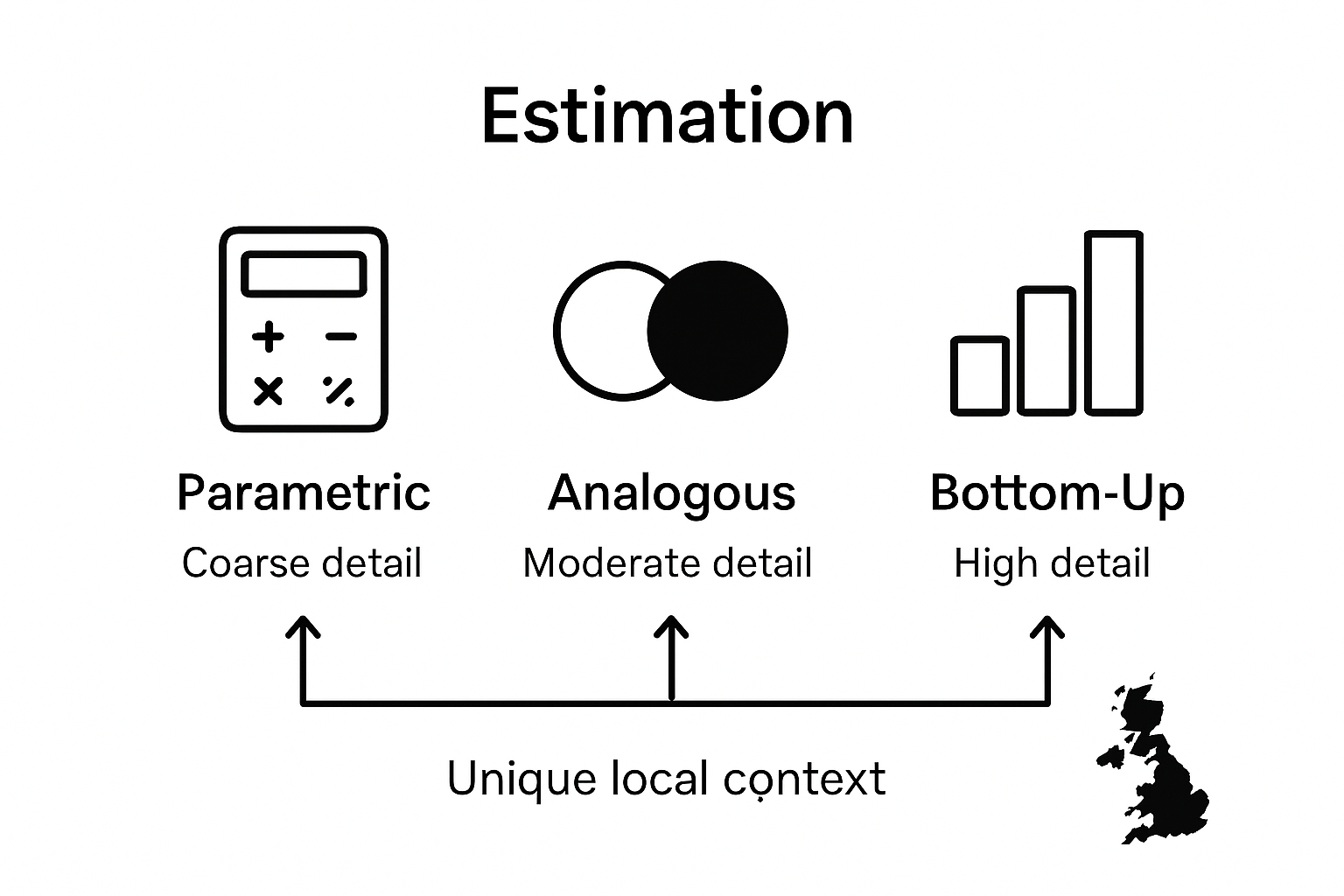
Construction cost estimation encompasses several sophisticated methodological approaches, each designed to provide accurate financial projections for complex infrastructure projects. Parametric estimation represents a statistical technique that utilises mathematical models to predict costs based on quantifiable project parameters such as square metres, linear footage, or specific technical characteristics.
Research from Heriot-Watt University demonstrates multiple regression techniques as a powerful analytical approach to understanding cost prediction. The primary estimation methods include:
- Analogous Estimation: Utilising historical data from similar past projects to forecast current project expenses
- Parametric Estimation: Applying statistical modelling and quantitative analysis
- Bottom-Up Estimation: Calculating costs by breaking down individual project components
- Three-Point Estimation: Considering optimistic, pessimistic, and most likely cost scenarios
The construction estimating best practices underscore the importance of selecting appropriate estimation methods based on project complexity, available historical data, and specific industry requirements. Construction professionals must carefully evaluate each approach’s strengths and limitations to develop precise financial models that support successful project planning and risk management.
How Methods Differ In UK Construction
The UK construction industry demonstrates unique characteristics in cost estimation approaches, reflecting a sophisticated blend of traditional practices and innovative analytical techniques. Construction price and cost indices reveal nuanced methodological distinctions that set British construction estimation apart from international practices.
Key differentiators in UK construction cost estimation include:
- Regulatory Compliance: Strict adherence to UK building regulations and standards
- Local Market Sensitivity: Deep understanding of regional material and labour cost variations
- Risk Management Protocols: Comprehensive contingency planning specific to British construction environments
- Technological Integration: Advanced digital tools tailored to UK project management requirements
The construction cost estimation for UK projects emphasises a contextualised approach that considers unique local economic factors. Professional estimators must navigate complex variables including regional pricing dynamics, specific material availability, labour market conditions, and stringent regulatory frameworks that distinguish UK construction methodologies from global counterparts.

Professional bodies like the Royal Institution of Chartered Surveyors (RICS) play a crucial role in standardising estimation practices, ensuring that cost prediction methods remain robust, transparent, and aligned with both national and international best practices. This approach allows UK construction professionals to develop more precise, context-aware financial models that account for the nuanced economic landscape of British infrastructure development.
Real-World Applications And Use Cases
Cost estimation methods find critical practical applications across diverse construction sectors, transforming theoretical approaches into tangible financial strategies. Function-based cost models developed for new-build school projects demonstrate how sophisticated estimation techniques provide precise early-stage financial planning for complex infrastructure developments.
Real-world applications span multiple construction domains:
- Educational Infrastructure: Accurate budgeting for school and university construction projects
- Residential Development: Precise cost forecasting for housing estates and individual property builds
- Commercial Spaces: Detailed financial modelling for office complexes and retail developments
- Industrial Facilities: Comprehensive cost estimation for manufacturing and logistics infrastructure
Building Information Modelling (BIM) cost estimation techniques represent a transformative approach in modern construction planning. These advanced methodologies integrate digital technologies with traditional estimation approaches, enabling construction professionals to generate more accurate, dynamic, and responsive financial projections.
The professional cost estimating service plays a crucial role in translating these sophisticated estimation methods into actionable insights. By leveraging cutting-edge analytical tools and deep industry expertise, construction professionals can develop robust financial frameworks that mitigate risks, optimise resource allocation, and support successful project delivery across diverse construction environments.
Financial Risks And Common Pitfalls
Construction cost estimation involves navigating a complex landscape of potential financial vulnerabilities that can significantly impact project outcomes. Allowable costs guidance highlights the critical importance of identifying and mitigating risks before they escalate into substantial financial challenges.
Common financial risks in construction cost estimation include:
- Scope Creep: Uncontrolled expansion of project requirements without corresponding budget adjustments
- Inaccurate Material Pricing: Failing to account for market fluctuations and supply chain disruptions
- Labour Cost Underestimation: Miscalculating workforce expenses and potential overtime
- Contingency Shortfalls: Insufficient buffer funds for unexpected project complications
- Technological Obsolescence: Inadequate provisions for emerging construction technologies
Cost analysis and benchmarking techniques provide crucial strategies for risk mitigation. Professional estimators must develop comprehensive risk management frameworks that anticipate potential financial challenges and create robust contingency plans.
The professional cost estimating service plays a pivotal role in identifying and managing these financial risks. By combining sophisticated analytical tools, deep industry expertise, and proactive risk assessment strategies, construction professionals can develop more resilient financial models that protect project investments and minimise unexpected economic disruptions.
Master UK Construction Costs with Professional Estimating Support
Understanding and applying accurate cost estimation methods can be challenging especially when navigating the complexities of UK construction regulations, market fluctuations, and risk management. This article highlights the critical need for precise forecasting techniques such as parametric, analogous, and bottom-up estimation methods to avoid costly surprises and keep projects financially on track. If you are an architect, builder, or developer seeking to reduce uncertainty and improve budget control these key insights will resonate with your goals.
At My Project Estimating, we specialise in delivering detailed, transparent, and reliable construction cost estimates tailored specifically for the UK market. Our professional service offers rapid turnaround times alongside comprehensive reporting that integrates market-specific data and robust risk assessments. Explore our Uncategorized Archives to discover how advanced estimation techniques can be transformed into actionable cost plans that empower your project decisions. Don’t leave your budget to chance when expert support is just a few clicks away. Visit myprojectestimating.co.uk now to start your journey towards precise, confident construction cost planning.
Frequently Asked Questions
What are the main cost estimation methods used in construction?
The primary cost estimation methods in construction include analogous estimation, parametric estimation, bottom-up estimation, and three-point estimation. Each method offers unique benefits based on project complexity, available historical data, and specific industry requirements.
How does parametric estimation work in cost forecasting?
Parametric estimation is a statistical technique that uses mathematical models to predict costs based on quantifiable project parameters, such as square metres or specific technical characteristics. This approach allows for data-driven cost analysis.
What financial risks are associated with construction cost estimation?
Common financial risks in construction cost estimation include scope creep, inaccurate material pricing, labour cost underestimation, contingency shortfalls, and technological obsolescence. It’s crucial to identify and manage these risks to prevent budget overruns.
How can Building Information Modelling (BIM) enhance cost estimation in construction projects?
BIM enhances cost estimation by integrating digital technologies with traditional approaches, enabling professionals to create more accurate, dynamic, and responsive financial projections. This results in better planning and resource allocation for construction projects.
Recommended
- How to Estimate Construction Costs for UK Projects – My Project Estimating
- Cost Forecasting in Construction UK | Accurate UK Construction Cost Forecasts
- Role of Cost Estimator: Complete Guide for UK Construction – My Project Estimating
- Master Construction Estimating Workflow for Accurate Costing – My Project Estimating