Budget overruns and unclear cost categories can easily disrupt even the most carefully planned United Kingdom construction projects. Accurate financial control depends on understanding how a cost breakdown structure turns complex budgets into clear, manageable components. By breaking every expense into logical groups and adapting these categories as projects evolve, project managers and quantity surveyors gain strategic financial oversight. This guide shows how mastering cost breakdown structures can radically improve budget accuracy and project delivery across United Kingdom construction.
Table of Contents
- Defining Cost Breakdown Structure in Construction
- Major Types of Cost Breakdown Structures
- Core Elements and Data Hierarchies
- Practical Applications for UK Projects
- Common Pitfalls and Oversights to Avoid
Key Takeaways
| Point | Details |
|---|---|
| Cost Breakdown Structures Are Essential | They categorise and monitor construction costs, enabling better financial control through systematic tracking. |
| Types of Structures Vary | Different approaches such as Elemental, Functional, Activity-Based, and Organisational breakdowns provide unique advantages for cost analysis. |
| Implement Continuous Updates | Regularly revising the cost breakdown throughout the project is vital for adapting to changes in scope and managing risks effectively. |
| Avoid Common Pitfalls | Focus on clear scope definition and consistent data management to enhance financial forecasting and avoid budget overruns. |
Defining Cost Breakdown Structure in Construction
A cost breakdown structure represents a systematic method for categorising and tracking project expenditures across various construction elements. This financial framework enables project managers to understand, allocate, and monitor expenses with precision, transforming complex budgetary challenges into manageable components.
The UK Government’s Infrastructure and Projects Authority emphasises that cost breakdown structures evolve throughout project lifecycles, providing essential insights into budget management. These structures typically involve dividing project costs into hierarchical categories that reflect different aspects of construction work.
Key components of a comprehensive cost breakdown structure include:
- Direct Construction Costs: Materials, labour, and equipment expenses
- Indirect Costs: Overheads, administrative expenses, and site management
- Professional Services: Design, engineering, and consultancy fees
- Contingency Provisions: Risk management and potential variation funds
Understanding these cost categories allows construction professionals to develop more accurate financial models. As the University of Essex notes in their strategic project delivery guidance, such structures help control budgets and monitor actual versus forecasted expenditures effectively.
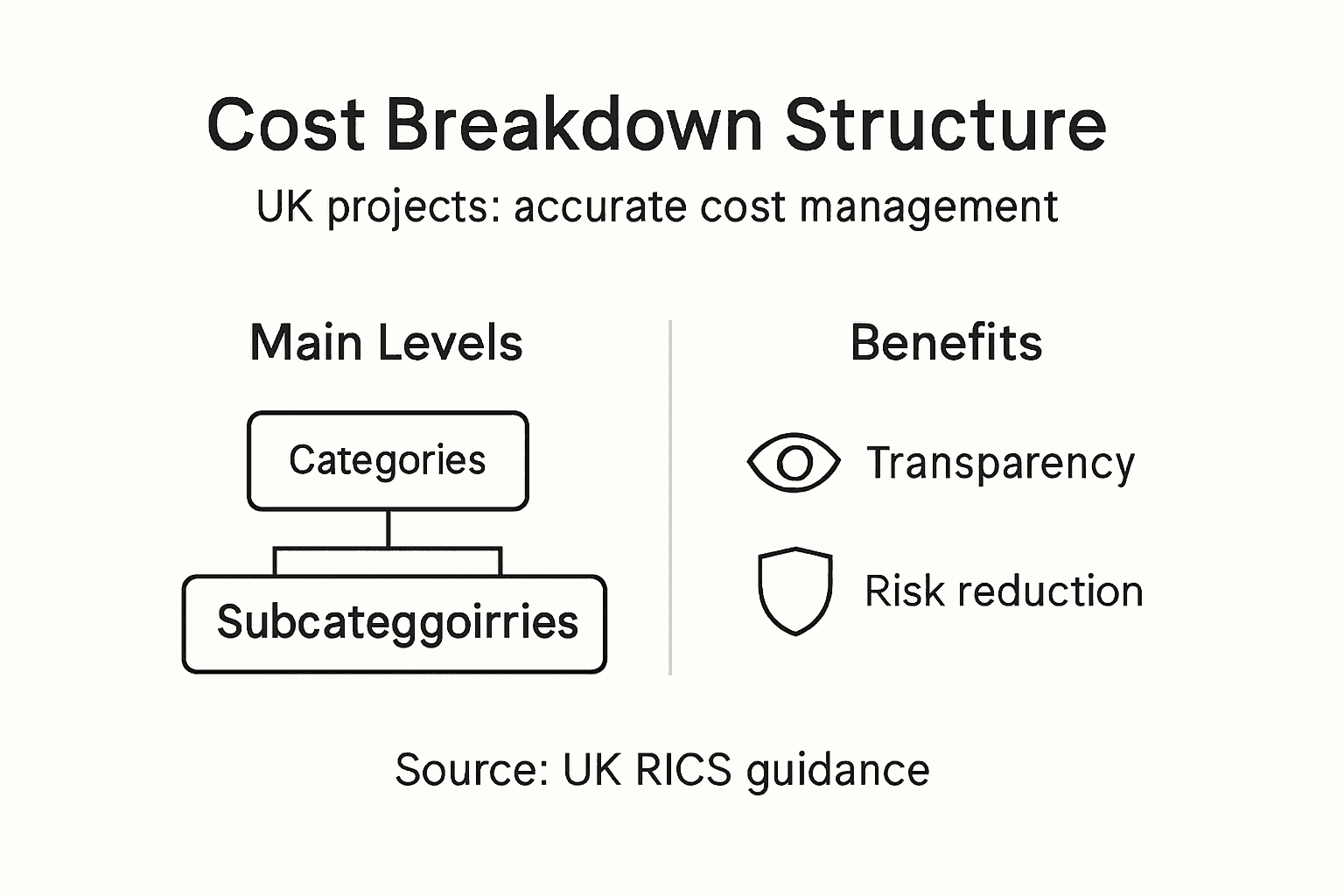
Pro tip: Break down your project costs into granular categories early, enabling more precise financial tracking and reducing unexpected budget overruns.
Major Types of Cost Breakdown Structures
In the complex landscape of construction project management, cost breakdown structures (CBS) serve as critical financial navigation tools. These hierarchical frameworks enable precise cost categorisation and allocation across different project dimensions, helping construction professionals manage budgets with remarkable accuracy.
The Royal Institution of Chartered Surveyors identifies several key types of cost breakdown classifications used in UK construction projects. These primary structures include:
- Elemental Breakdown: Categorising costs by specific construction elements (foundations, walls, roofing)
- Functional Breakdown: Dividing expenses according to project functions (design, procurement, construction)
- Activity-Based Breakdown: Allocating costs based on specific project activities and processes
- Organisational Breakdown: Mapping expenses to different departments or project teams
These classification methods allow construction managers to analyse expenditures from multiple perspectives. Cost breakdown structures integrated with work breakdown systems provide even more granular insights into project financial management, enabling more precise resource allocation and budgetary control.
Here’s a quick comparison of major cost breakdown structure types and their strategic benefits in UK construction projects:
| Structure Type | How Costs Are Categorised | Example Application | Strategic Benefit |
|---|---|---|---|
| Elemental Breakdown | By physical building elements | Foundation, walls, roofing | Detailed element-level budgeting |
| Functional Breakdown | By project function | Design, procurement, build | Clarity in process and management |
| Activity-Based Breakdown | By specific activities | Excavation, installation | Improved process-based tracking |
| Organisational Breakdown | By project team or department | Design team, procurement | Enhanced responsibility allocation |
Each cost breakdown structure offers unique advantages, allowing project managers to select the most appropriate method based on specific project requirements and organisational goals.
Understanding these diverse structures helps construction professionals develop more strategic financial approaches, transforming complex budgetary challenges into manageable, transparent financial frameworks.
Pro tip: Select a cost breakdown structure that aligns closely with your project’s specific complexity and reporting requirements to maximise financial visibility and control.
Core Elements and Data Hierarchies
Constructing a robust cost breakdown structure requires meticulous attention to hierarchical data management. These intricate frameworks transform complex financial information into comprehensible, structured components that enable precise project cost tracking and analysis.
Research from the University of Essex demonstrates how costs are systematically assigned across multiple project levels. The hierarchical approach typically encompasses several critical elements:
- Level 1: Broad project categories (direct/indirect costs)
- Level 2: Specific cost groups (labour, materials, equipment)
- Level 3: Detailed cost elements (individual labour rates, specific material types)
- Level 4: Granular cost sub-elements (worker classifications, material specifications)
Modern construction management increasingly integrates these cost breakdown structures with Building Information Modelling frameworks, creating more dynamic and interconnected financial tracking systems. This integration allows for real-time cost monitoring and more sophisticated predictive financial analysis.
Effective cost hierarchy design transforms raw financial data into strategic insights, enabling proactive project financial management.
By implementing multi-level cost categorisation, construction professionals can achieve unprecedented transparency and control over project expenditures, identifying potential budget variations with remarkable precision.
Pro tip: Document each hierarchical level’s cost parameters meticulously, ensuring consistent classification across all project phases to maintain accurate financial tracking.
Practical Applications for UK Projects
In the dynamic landscape of United Kingdom construction, cost breakdown structures play a pivotal role in transforming complex financial planning into actionable strategic frameworks. These sophisticated tools enable project managers to navigate the intricate financial terrains of modern construction with unprecedented precision and clarity.
The UK Government’s guidance emphasises cost breakdown strategies for infrastructure projects, highlighting their critical applications across various project contexts:
- Residential Development: Tracking expenses across housing projects
- Commercial Construction: Managing multi-phase commercial building initiatives
- Infrastructure Projects: Monitoring large-scale public infrastructure investments
- Renovation and Retrofit: Controlling costs in existing building modifications
Practical implementation involves several key strategic approaches:
- Establish clear cost categories relevant to specific project types
- Create flexible hierarchical structures adaptable to project complexity
- Integrate digital tracking mechanisms for real-time financial monitoring
- Develop standardised reporting templates for consistent analysis
Cost breakdown structures transform raw financial data into strategic insights, enabling proactive management and precise budgetary control.
Construction professionals can leverage these structures to mitigate financial risks, improve stakeholder communication, and ensure more accurate project forecasting. By adopting a systematic approach to cost categorisation, teams can achieve greater transparency and financial discipline.
The following table summarises practical uses of cost breakdown structures for different UK project types:
| Project Type | Typical Financial Focus | Implementation Challenge | Example Strategic Use |
|---|---|---|---|
| Residential Development | Unit cost tracking | Managing multiple phases | Accurate per-residence cost mapping |
| Commercial Construction | Multi-phase costing | Coordinating complex stakeholders | Budget allocation across phases |
| Infrastructure Projects | Public funding management | Handling large contractor teams | Transparent public spending |
| Renovation/Retrofit | Existing asset cost control | Uncovering legacy cost structure | Identifying hidden expenditure |
Pro tip: Regularly update your cost breakdown structure throughout the project lifecycle, ensuring it remains a dynamic tool that reflects evolving project complexities and financial realities.
Common Pitfalls and Oversights to Avoid
Navigating the complex terrain of construction cost management requires vigilance and strategic awareness. Cost breakdown structures can quickly become ineffective when critical oversights compromise their fundamental purpose of financial transparency and control.
The UK Government’s guidance highlights several critical cost estimating challenges that construction professionals must address:
- Inadequate Scope Definition: Failing to comprehensively outline project parameters
- Static Cost Estimates: Not updating financial projections throughout project lifecycle
- Risk Ignorance: Overlooking potential uncertainties and contingencies
- Responsibility Ambiguity: Unclear ownership of cost management processes
Key problematic areas that demand immediate attention include:
- Incomplete data collection and recording
- Inappropriate benchmarking techniques
- Misaligned cost categorisation
- Inconsistent reporting standards
Successful cost management demands continuous review, proactive risk assessment, and meticulous documentation of financial variations.
The Royal Institution of Chartered Surveyors warns that poor data quality and incomplete cost capture can dramatically undermine project financial integrity. By recognising and systematically addressing these potential pitfalls, construction professionals can significantly enhance their financial forecasting and control mechanisms.
Pro tip: Implement a rigorous quarterly review process to validate and recalibrate your cost breakdown structure, ensuring ongoing accuracy and relevance.
Elevate Your UK Construction Project Accuracy with Expert Cost Breakdown Solutions
Struggling with complex cost breakdown structures can lead to budget overruns and unclear financial tracking in your construction projects. This article highlights the importance of detailed categorisation and hierarchical cost tracking to master project expenses and avoid common pitfalls such as inconsistent reporting and risk ignorance. If you aim to enhance transparency and control over your project finances by applying concepts like elemental, functional, and activity-based cost breakdowns, precise, UK market-specific estimates are essential.
At My Project Estimating, we specialise in delivering accurate, transparent, and detailed cost planning tailored for UK projects. Our services support your implementation of structured cost breakdown frameworks with early-stage planning, quantity takeoffs, and comprehensive reporting. Explore practical insights and further enhance your project’s financial management by visiting our Uncategorized Archives where expert tips meet real-world applications. Take control today by connecting with our experienced estimators to secure quick turnaround times and reduce risks with trusted, professional cost forecasting. Start your journey towards financial clarity now at My Project Estimating.
Frequently Asked Questions
What is a cost breakdown structure in construction?
A cost breakdown structure (CBS) is a systematic framework used to categorise and track project expenditures across various construction elements, allowing project managers to understand, allocate, and monitor expenses effectively.
Why is a cost breakdown structure important for project management?
A CBS enhances financial accuracy by dividing costs into hierarchical categories, providing key insights into budget management and enabling project managers to control budgets and monitor actual versus forecasted expenditures effectively.
What are the major types of cost breakdown structures used in construction?
The primary types of cost breakdown structures include Elemental Breakdown, Functional Breakdown, Activity-Based Breakdown, and Organisational Breakdown, each offering unique advantages for managing project costs.
How can I avoid common pitfalls when implementing a cost breakdown structure?
To avoid pitfalls, ensure comprehensive scope definition, regularly update cost estimates, assess risks proactively, and maintain clear ownership of cost management processes throughout the project lifecycle.
Recommended
- Construction Cost Breakdown Explained: Complete Guide – My Project Estimating
- Master the Construction Cost Breakdown Workflow in the UK – My Project Estimating
- Master Construction Estimating Workflow for Accurate Costing – My Project Estimating
- Master Construction Estimating Workflow for Accurate Costing – My Project Estimating