Unexpected costs can quickly turn a dream renovation into a stressful experience for many UK homeowners. Accurate cost estimates are not just about numbers, they support realistic planning and help prevent budget shocks during home projects. By relying on professional cost estimating principles and understanding their evolving nature, you can gain greater control over expenses, make informed choices, and avoid common financial risks during construction.
Table of Contents
- Defining Estimates And Their Essential Role
- Types Of Construction Estimates For Homes
- How Professional Estimates Support Planning
- Financial Implications: Avoiding Overruns And Risk
- Typical Mistakes And Ways To Prevent Them
Key Takeaways
| Point | Details |
|---|---|
| Understanding Cost Estimates | Cost estimates are essential for effective financial planning in construction, helping homeowners anticipate expenses and mitigate risks. |
| Types of Estimates | Homeowners should be aware of different estimation methods, including top-down, bottom-up, and analogous estimates, to make informed budgeting decisions. |
| Risk Management | Identifying financial risks early, such as structural complications and material price fluctuations, is crucial for maintaining project viability. |
| Avoiding Common Mistakes | To prevent budget overruns, homeowners should engage professional quantity surveyors and use multiple estimation techniques to validate their projections. |
Defining Estimates and Their Essential Role
In the world of home construction and renovation, cost estimates represent far more than simple number calculations. They are strategic financial planning tools that help homeowners understand potential project expenses, mitigate risks, and make informed decisions about their building or renovation work. These detailed projections provide a comprehensive overview of anticipated costs, allowing property owners to plan effectively and avoid unexpected financial challenges.
Construction estimates are intricate documents that break down potential project expenses across multiple categories. Cost estimating principles established by UK government guidelines emphasise presenting financial projections as flexible ranges rather than rigid figures. This approach acknowledges the inherent uncertainties in construction projects and provides homeowners with realistic financial expectations.
Key components of a robust construction estimate typically include:
- Labour costs for skilled tradespeople
- Materials and equipment expenses
- Potential structural modifications
- Permit and regulatory compliance fees
- Contingency budgets for unexpected challenges
- Professional service charges
Professional estimates serve multiple critical functions beyond basic budgeting. They help homeowners:
- Understand total project scope
- Identify potential financial risks
- Compare contractor proposals objectively
- Secure appropriate financing
- Plan realistic project timelines
By understanding estimate maturity and their evolving nature, homeowners can approach construction projects with greater confidence and financial preparedness. Estimates are not static documents but dynamic tools that adapt as project details become clearer.
Pro tip: Always request detailed, itemised estimates from multiple contractors and carefully compare their scope, inclusions, and potential hidden costs to make the most informed decision.
Types of Construction Estimates for Homes
Homeowners embarking on construction or renovation projects need to understand the various types of construction estimates available to make informed financial decisions. Cost estimation approaches provide different perspectives on project budgeting, each serving unique purposes throughout the project lifecycle.
Three primary estimation methods help homeowners navigate their financial planning:
- Top-down estimates: Provide rough budget projections based on overall project scope
- Bottom-up estimates: Offer detailed cost breakdowns for individual project components
- Analogous estimates: Use historical data from similar projects to inform current budget predictions
Construction estimates can also be categorised by their level of detail and project stage. Construction estimate classifications typically include:
- Preliminary estimates: Early-stage budget approximations
- Detailed estimates: Comprehensive cost breakdowns of specific work elements
- Definitive estimates: Near-final, highly accurate financial projections
Each estimate type serves a specific purpose in the construction planning process. Preliminary estimates help initial feasibility assessments, detailed estimates support precise budgeting, and definitive estimates provide the most accurate financial blueprint for homeowners.
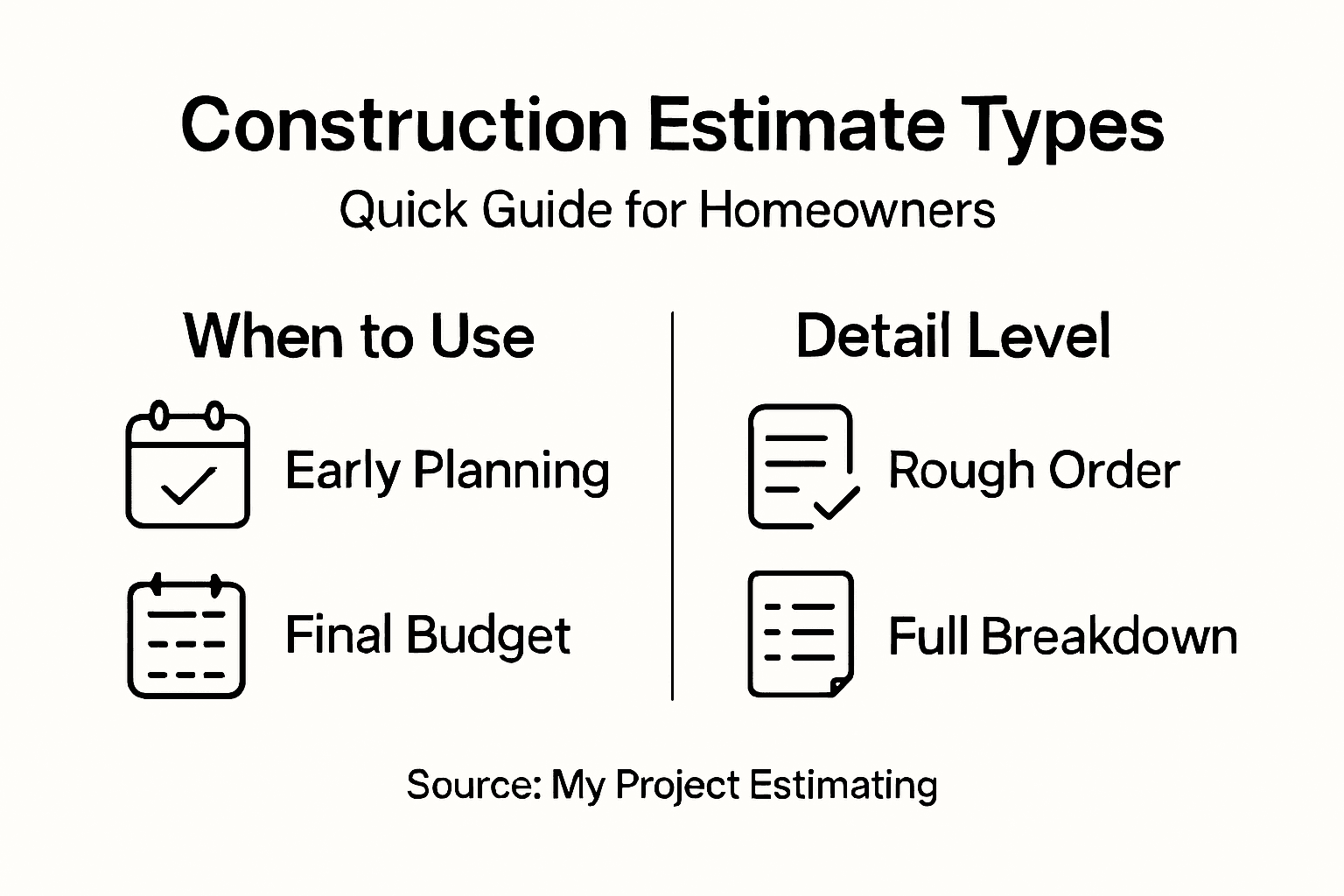
Here’s a comparison of common construction estimate types and their ideal application stage:
| Estimate Type | Level of Detail | Best Used At |
|---|---|---|
| Preliminary | High-level overview | Early project scoping |
| Detailed | Specific breakdown | Budget finalisation |
| Definitive | Fully itemised | Contract agreement |
The complexity of these estimates varies based on project specifics, available information, and the level of financial precision required. Factors influencing estimate accuracy include project complexity, design completeness, and the availability of historical cost data.
The table below highlights key differences between estimation methods for home projects:
| Method | Basis of Calculation | Typical Accuracy |
|---|---|---|
| Top-down | Overall project scope | Moderate |
| Bottom-up | Individual component analysis | High |
| Analogous | Historical project data | Variable |
Pro tip: Request multiple estimate types from professional quantity surveyors to gain a comprehensive understanding of your project’s potential costs and financial risks.
How Professional Estimates Support Planning
Professional construction estimates provide critical support for homeowners by transforming complex financial planning into clear, actionable strategies. Cost estimating methodologies offer transparent frameworks that help reduce uncertainty and enable more informed decision-making throughout a project’s lifecycle.
Key ways professional estimates support project planning include:
- Establishing realistic budget expectations
- Identifying potential financial risks
- Providing granular cost breakdowns
- Enabling accurate resource allocation
- Supporting financial negotiation with contractors
- Creating benchmarks for project progress
Professional estimators use sophisticated techniques to develop comprehensive financial projections that evolve with project development. Structured estimating practices help track progress against financial targets, ensuring that homeowners can make responsive adjustments as project details emerge.
The estimation process typically involves multiple stages of analysis, including:
- Initial scope definition
- Detailed cost investigation
- Risk assessment and contingency planning
- Regular budget monitoring
- Ongoing financial forecasting
By providing a systematic approach to financial planning, professional estimates transform complex construction projects into manageable, predictable endeavours. They offer homeowners a critical tool for understanding potential expenses, managing risks, and maintaining financial control throughout the building or renovation process.
Pro tip: Request a comprehensive estimate that includes not just initial costs, but potential variations and contingency allowances to avoid unexpected financial surprises.
Financial Implications: Avoiding Overruns and Risk
Home construction and renovation projects are inherently complex financial undertakings that demand meticulous planning and risk management. Cost estimating guidance emphasises the critical importance of identifying potential financial risks early to prevent budget overruns and maintain project viability.
Key financial risks that homeowners must carefully navigate include:
- Unexpected structural complications
- Material price fluctuations
- Labour cost variations
- Compliance and regulatory expenses
- Design modification costs
- Unforeseen site preparation requirements
Top-down estimation approaches provide homeowners with a strategic method to incorporate potential risks into initial budget projections. These methods help create more conservative financial frameworks that account for uncertainty and potential scope creep.
Risk mitigation strategies for financial control involve:
- Establishing comprehensive contingency budgets
- Conducting thorough initial site assessments
- Maintaining flexible budget allocations
- Implementing regular financial reviews
- Working with professional quantity surveyors
Understanding and anticipating potential financial risks allows homeowners to develop more resilient project budgets. By incorporating robust estimation techniques and maintaining proactive financial monitoring, individuals can significantly reduce the likelihood of unexpected expenses and project derailments.
Pro tip: Allocate at least 10-15% of your total project budget as a contingency fund to buffer against unexpected costs and maintain financial flexibility.
Typical Mistakes and Ways to Prevent Them
Home construction projects are fraught with potential financial pitfalls that can derail even the most carefully planned initiatives. Cost estimating guidance highlights the critical importance of understanding and preventing common estimation mistakes that can lead to significant budget overruns.
Most frequent estimation mistakes homeowners encounter include:
- Relying on single fixed cost figures
- Underestimating project complexity
- Neglecting comprehensive risk assessments
- Failing to include contingency budgets
- Overlooking potential regulatory compliance costs
- Ignoring historical project data and benchmarks
Estimating maturity models provide structured approaches to mitigate these common errors. These frameworks help homeowners develop more robust and realistic financial projections by systematically addressing potential uncertainties and risks.
Strategies to prevent estimation mistakes involve:
- Conducting thorough initial project assessments
- Engaging professional quantity surveyors
- Using multiple estimation techniques
- Regularly updating and reviewing cost projections
- Maintaining detailed documentation of assumptions
Successful project planning requires a proactive approach to financial management. By understanding potential pitfalls and implementing comprehensive estimation strategies, homeowners can significantly reduce the likelihood of unexpected expenses and project complications.
Pro tip: Always obtain at least three independent cost estimates and compare their methodologies to identify potential discrepancies and hidden risks.
Take Control of Your Home Construction Budget with Expert Estimates
Managing budgets and avoiding costly overruns are major challenges for homeowners, as highlighted in the article on the role of estimates in staying on budget. Precise financial planning, understanding the maturity of different estimate types, and preparing for potential risks like unforeseen structural complications are essential to project success. Key concepts such as contingency budgeting and itemised professional estimates give you the confidence to make informed decisions and maintain financial control throughout your project.
At My Project Estimating, we specialise in delivering detailed, transparent, and accurate construction cost estimates tailored specifically for UK homeowners. Our services include early-stage cost planning, quantity takeoffs, and comprehensive cost reports that help you understand every aspect of your project’s potential expenses. Visit our Uncategorized Archives to explore related insights and learn how structured estimating practices can safeguard your budget. Don’t leave your project to chance: get started today by sharing your drawings and let our experienced UK estimators provide you with a clear financial roadmap. Visit My Project Estimating now and take the first step towards keeping your construction project on budget.
Frequently Asked Questions
What is the purpose of a construction estimate for homeowners?
A construction estimate serves as a strategic financial planning tool, helping homeowners understand potential project expenses, mitigate risks, and make informed decisions regarding their building or renovation work.
What are the common types of construction estimates I should consider?
The common types of construction estimates include preliminary estimates for early-stage budgeting, detailed estimates for comprehensive cost breakdowns, and definitive estimates for highly accurate financial projections before contract agreements.
How can I avoid common mistakes when obtaining cost estimates?
To avoid mistakes, conduct thorough initial project assessments, engage professional quantity surveyors, use multiple estimation techniques, and maintain detailed documentation of assumptions and projections.
What financial risks should I be aware of when planning a home project?
Key financial risks include unexpected structural complications, material price fluctuations, labour cost variations, compliance and regulatory expenses, and unforeseen site preparation requirements.