Cost surprises can jeopardise even the best-laid residential projects, leaving architects and builders questioning the accuracy of original estimates. In the United Kingdom, increasing emphasis on transparent pricing means full clarity on every fee, including all taxes and mandatory charges, to support more predictable budgets and trust between clients and professionals. This overview breaks down the practical meaning of genuine transparency, the common misconceptions that trip up many in construction, and the real benefits for financial planning and compliance.
Table of Contents
- Transparent Pricing: Meaning And Misconceptions
- Key Elements Of Transparent Pricing Methods
- How Transparent Pricing Supports Accurate Estimating
- Uk Regulatory Requirements For Price Clarity
- Common Pitfalls To Avoid In Pricing Disclosure
Key Takeaways
| Point | Details |
|---|---|
| Transparent Pricing Enhances Trust | Providing clear and comprehensive cost breakdowns builds client trust and fosters long-term loyalty. |
| Regulatory Compliance is Essential | Adhering to UK transparency laws prevents legal issues and promotes ethical business practices. |
| Beware of Common Pitfalls | Avoid incremental charge concealment and incomplete fee documentation to maintain financial integrity. |
| Standardised Documentation is Key | Implementing a consistent pricing documentation system ensures clarity and compliance in pricing disclosures. |
Transparent Pricing: Meaning and Misconceptions
Transparent pricing represents a fundamental commitment to clarity and fairness in financial transactions, especially within construction and architectural projects. At its core, this concept demands complete visibility into all potential costs, preventing unexpected financial surprises that could derail project budgets and client relationships.
In the UK construction sector, transparent pricing goes beyond merely listing numbers. It involves comprehensive disclosure of all potential expenses, including materials, labour, potential contingencies, and any additional charges. Price transparency guidelines established by the Competition and Markets Authority provide clear frameworks for businesses to communicate pricing information accurately and ethically.
Common misconceptions about transparent pricing often stem from misunderstandings about what constitutes genuine transparency. Here are key aspects that contractors and architects frequently misinterpret:
- Hidden fees are not acceptable under transparent pricing models
- Full cost breakdown must be provided at the project’s outset
- Variability margins should be clearly communicated and justified
- Pricing should account for potential market fluctuations in material costs
- Contractual agreements must explicitly outline all potential additional expenses
The legal landscape surrounding pricing transparency is continually evolving. Financial regulatory amendments demonstrate an increasing emphasis on fair and clear pricing practices across industries. These regulations aim to protect consumers and ensure businesses maintain high standards of financial communication.
Here is a comparison of transparent pricing versus traditional pricing approaches:
| Aspect | Transparent Pricing | Traditional Pricing |
|---|---|---|
| Visibility | Full cost disclosure | Limited cost breakdown |
| Risk of Hidden Fees | Minimized through full transparency | Higher risk due to vague details |
| Client Trust | Maximises trust and long-term loyalty | Can erode confidence over time |
| Budget Predictability | Highly predictable with documentation | Often unpredictable |
| Regulatory Compliance | Aligns with UK transparency laws | May risk legal compliance issues |
Pro tip: Always request a comprehensive, itemised quote that includes potential variation percentages and explicit explanations for each projected cost to ensure genuine pricing transparency.
Key Elements of Transparent Pricing Methods
Transparent pricing in construction requires a systematic approach that goes beyond simple number-crunching. It demands a comprehensive methodology that provides clients with complete financial visibility and eliminates potential misunderstandings about project costs. Price transparency guidelines establish crucial frameworks for presenting pricing information accurately and ethically.
The fundamental elements of transparent pricing methods encompass several critical components that ensure clarity and build client trust. These methods are designed to provide a detailed, comprehensive view of all potential project expenses, allowing stakeholders to make informed financial decisions with confidence.
Key elements of transparent pricing methods include:
- Comprehensive cost breakdowns that detail every potential expense
- Itemised material and labour costs with precise individual pricing
- Contingency margin explanations clearly outlining potential additional expenses
- Market fluctuation allowances that account for potential price variations
- Explicit fee structures with no hidden or unexpected charges
Standardised pricing documentation plays a crucial role in maintaining transparency. Government procurement guidelines recommend specific evaluation methods that promote fairness and clarity in price submissions. These methods help create consistent, comparable pricing models across different construction projects.
Transparent pricing is not just about revealing numbers, but about building trust through comprehensive, honest financial communication.
Professional estimators must develop pricing methods that are not only accurate but also easily comprehensible to clients. This involves creating documentation that breaks down complex cost structures into clear, digestible information that allows clients to understand exactly where their investment is being allocated.
Pro tip: Develop a standardised pricing template that includes detailed cost categories, potential variation margins, and clear explanations for each projected expense to enhance pricing transparency.
How Transparent Pricing Supports Accurate Estimating
Accurate construction estimating hinges on the fundamental principle of transparent pricing, which provides a comprehensive and reliable framework for budget management. Cost estimating guidance from the UK Infrastructure and Projects Authority emphasises the critical role of clear, evidence-based pricing in reducing project uncertainties and financial risks.

Transparent pricing supports accurate estimating through several key mechanisms that enable construction professionals to develop more precise and trustworthy financial projections. By breaking down complex cost structures and providing granular insights into potential expenses, estimators can create more reliable budgetary frameworks that minimise unexpected financial surprises.
The primary methods by which transparent pricing enhances estimation accuracy include:
- Comprehensive cost documentation that captures every potential expense
- Detailed material and labour breakdowns with precise individual pricing
- Risk assessment and contingency calculations that account for potential variations
- Dynamic pricing models that adapt to market fluctuations
- Systematic review processes that validate cost assumptions
Transparent pricing transforms cost estimating from a guesswork exercise into a precise, data-driven financial planning tool.
Professional estimators leverage systematic construction cost analysis to develop robust pricing strategies. This involves meticulously reviewing bid documents, conducting site assessments, collecting supplier quotes, and implementing comprehensive contingency planning to align budgets with actual project requirements.
Pro tip: Implement a standardised cost-tracking system that documents every pricing assumption, enabling continuous refinement and improvement of your estimation accuracy.
UK Regulatory Requirements for Price Clarity
The landscape of pricing transparency in the United Kingdom is governed by increasingly stringent regulatory frameworks designed to protect businesses and consumers alike. Procurement Regulations 2024 establish comprehensive guidelines that mandate detailed disclosure of pricing information across various sectors, ensuring unprecedented levels of financial accountability and market fairness.
These regulatory requirements are not merely bureaucratic exercises but strategic mechanisms to promote competition, reduce information asymmetry, and enhance overall market integrity. Construction professionals must navigate these complex legal landscapes, understanding that price clarity is now a fundamental obligation rather than an optional practice.
Key regulatory requirements for price clarity include:
- Mandatory digital publication of comprehensive procurement notices
- Detailed supplier information disclosure at all procurement stages
- Transparent contract value reporting
- Systematic price breakdown documentation
- Regular public accessibility of financial information
Price transparency is not just a legal requirement, but a fundamental principle of ethical business conduct in modern UK markets.
Under the Procurement Act 2023 transparency provisions, contracting authorities must implement rigorous mechanisms to publish pricing, contract, and supplier details throughout the procurement lifecycle. This legal framework aims to minimise potential conflicts, promote fair competition, and provide stakeholders with comprehensive financial insights.
Pro tip: Develop a standardised digital documentation system that automatically tracks and publishes pricing information to ensure ongoing compliance with UK regulatory transparency requirements.
To better understand regulatory obligations, here is a summary of key UK transparency requirements:
| Requirement | Business Purpose | Real-World Impact |
|---|---|---|
| Digital procurement disclosure | Ensure open access to tender data | Greater market competition |
| Detailed contract value reporting | Prevent under-reporting of expenditure | Reduces disputes and hidden costs |
| Transparent supplier information | Verify supplier credibility | Enhances project accountability |
| Public pricing accessibility | Foster industry-wide transparency | Levels the playing field |
Common Pitfalls to Avoid in Pricing Disclosure
Navigation of pricing transparency requires meticulous attention to potential disclosure errors that can compromise project credibility and legal compliance. Price transparency guidelines highlight critical areas where construction professionals frequently stumble, creating risks of misrepresentation and potential regulatory penalties.
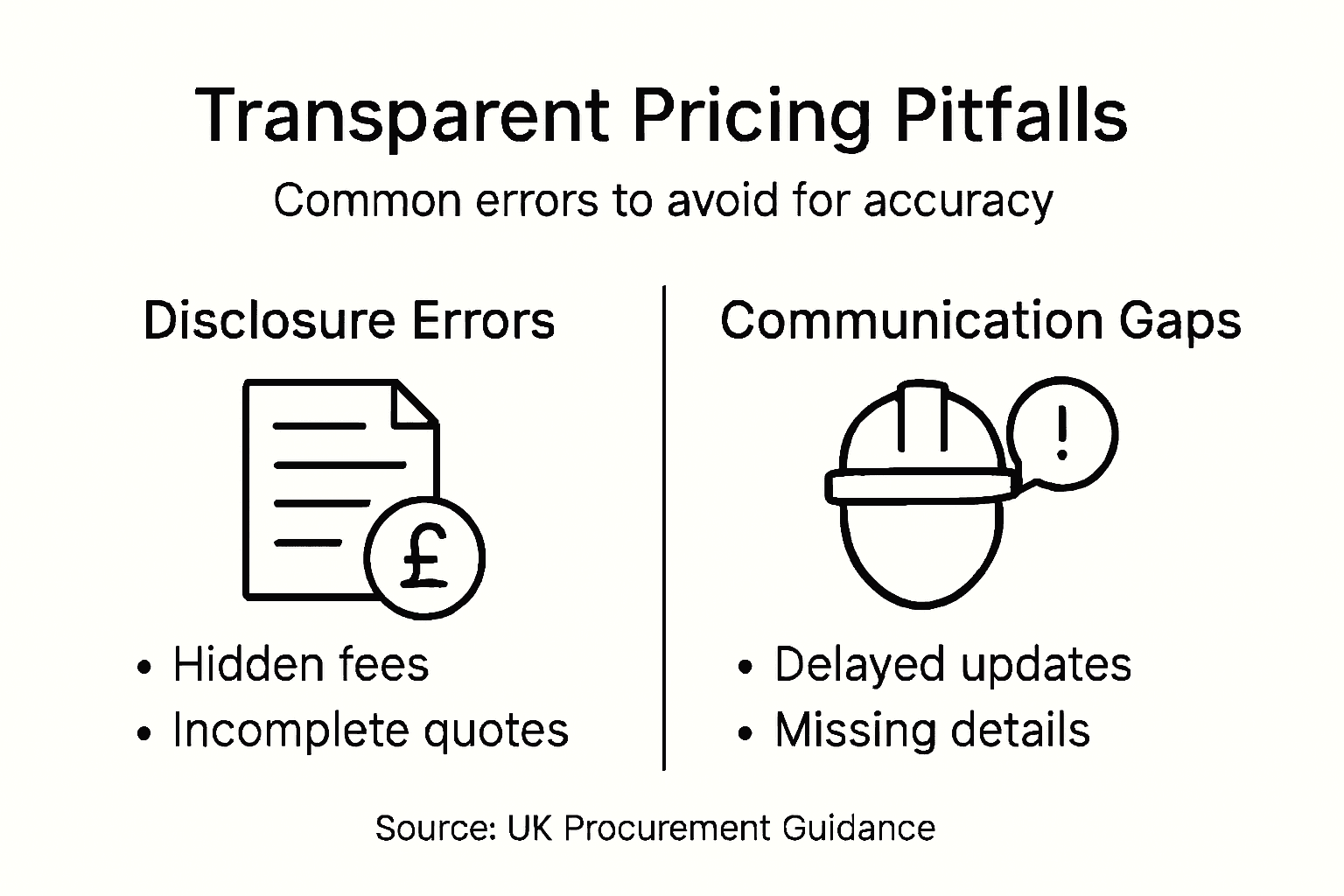
Understanding these common pitfalls is crucial for maintaining financial integrity and protecting both client relationships and organisational reputation. Construction estimators must develop robust strategies to identify and mitigate potential transparency risks before they become significant issues.
Key pricing disclosure pitfalls include:
- Incremental charge concealment where additional costs are revealed gradually
- Incomplete fee documentation lacking comprehensive expense breakdowns
- Ambiguous pricing terminology that creates potential misunderstandings
- Inconsistent pricing across different communication channels
- Failure to disclose potential variability in projected costs
Transparency is not just about revealing numbers, but about building trust through honest and comprehensive financial communication.
According to supplier procurement guidance, contractors must ensure rigorous communication about pricing changes, maintaining clear and upfront disclosures that align with regulatory requirements. This approach minimises potential conflicts and demonstrates professional integrity.
Pro tip: Implement a standardised pricing disclosure checklist that mandates comprehensive documentation of every potential cost before presenting final estimates to clients.
Achieve True Budget Confidence with Transparent Pricing
Understanding the critical need for transparent pricing as outlined in the article, construction professionals and clients alike face challenges such as hidden fees, incomplete cost breakdowns and unpredictable budget variations. These pain points can lead to project delays, mistrust and financial risk. At My Project Estimating, we address these issues head on by providing detailed cost breakdowns, clear contingency margins and UK market-verified data, ensuring your cost estimates are both transparent and accurate.
If you want to overcome common pricing pitfalls and confidently manage your project budgets, explore our approach showcased in the Uncategorized Archives – My Project Estimating. Our streamlined four-step service simplifies your estimating journey from sharing drawings to receiving comprehensive cost reports. Make the smart choice today by visiting My Project Estimating for professional support that truly delivers clarity and trust on your construction projects.
Frequently Asked Questions
What is transparent pricing in construction?
Transparent pricing in construction refers to a clear and comprehensive disclosure of all potential costs associated with a project, including materials, labour, contingencies, and any additional charges, ensuring clients have complete visibility into their financial commitments.
Why is transparent pricing important for budget accuracy?
Transparent pricing is crucial for budget accuracy as it minimises the risk of hidden fees and allows clients to have a detailed understanding of all projected costs. This visibility helps in making informed financial decisions and prevents unexpected financial surprises during a project.
What are common misconceptions about transparent pricing?
Common misconceptions include the acceptance of hidden fees, the perception that cost breakdowns are only provided after the project has begun, and that variability margins do not need clear communication. Genuine transparent pricing requires a full cost breakdown and explicit explanations for any potential additional expenses.
How can contractors ensure compliance with pricing transparency regulations?
Contractors can ensure compliance by familiarising themselves with regulatory requirements concerning price disclosure, providing detailed and systematic pricing documentation, and maintaining clear communication about any potential pricing changes throughout the procurement process.