Every UK project manager has faced the frustration of unexpected budget overruns despite thorough planning. Reliable construction cost databases offer a structured way to capture historical pricing trends and regional variations, helping professionals make informed decisions. By understanding the strengths and limitations of these digital repositories, project managers can achieve greater financial accuracy, reduce risk, and navigate complex projects with confidence.
Table of Contents
- Construction Cost Databases Explained And Key Misconceptions
- Types Of Construction Cost Databases In The UK
- Essential Features And How Databases Operate
- Legal Standards And Compliance For Cost Data Usage
- Financial Risks And Challenges With Construction Databases
- Avoiding Common Mistakes In Database Selection And Use
Key Takeaways
| Point | Details |
|---|---|
| Understanding Database Purpose | Construction cost databases provide structured pricing information essential for accurate financial planning in the UK construction industry. |
| Recognising Limitations | These databases offer historical trends but cannot predict future costs perfectly due to market volatility and project-specific factors. |
| Efficient Cross-Referencing | To enhance estimation accuracy, professionals should consult multiple databases and incorporate local supplier quotes. |
| Legal Compliance | Adhering to GDPR and other regulations is crucial for ethical data usage and maintaining data integrity in the construction sector. |
Construction cost databases explained and key misconceptions
Construction cost databases provide UK project managers with structured historical pricing information critical for accurate financial planning. These comprehensive digital repositories compile detailed cost data across various construction segments, enabling professionals to benchmark and estimate project expenses with greater precision.
At their core, construction cost databases serve multiple strategic purposes:
- Capture historical pricing trends for materials and labour
- Offer regional cost variations across different UK geographical zones
- Enable quick comparison of estimated versus actual project expenditures
- Provide standardised reference points for construction financial modelling
Contrary to common misconceptions, these databases do not replace detailed cost estimating but rather inform cost management strategies. Government-published benchmark data helps identify realistic cost ranges over time, supporting more nuanced financial decision-making.
Understanding the limitations is crucial. Cost databases represent aggregated historical information and cannot perfectly predict future expenses. Factors like material price volatility, regional economic shifts, and unique project complexities mean professionals must view database information as guidance rather than absolute truth.
Key Database Characteristics:
- Regularly updated pricing information
- Granular cost breakdowns by construction type
- Segmentation by project scale and complexity
- Integration with current market indices
Pro tip: Always cross-reference multiple cost databases and supplement digital benchmarks with recent quotes from local suppliers to enhance estimation accuracy.
Types of construction cost databases in the UK
Construction cost databases in the United Kingdom represent a diverse ecosystem of pricing resources designed to support project managers, architects, and developers in making informed financial decisions. These databases range from government-sponsored platforms to commercial solutions, each offering unique insights into construction pricing dynamics.
The primary types of construction cost databases include:
- Public Sector Databases: Managed by government agencies, these repositories provide comprehensive infrastructure cost information
- Commercial Market Databases: Subscription-based platforms offering detailed pricing across multiple construction sectors
- Industry Association Databases: Specialised collections focusing on specific construction segments like residential, commercial, or industrial projects
- Regional Cost Databases: Localised resources capturing geographical pricing variations across different UK regions
One notable example is the Infrastructure and Projects Authority benchmarking service, which offers extensive data covering cost, duration, and carbon metrics for government-led infrastructure projects. These databases complement commercial resources by providing standardised performance data across various project lifecycles.
Each database type serves distinct purposes, with public sector platforms typically focusing on transparency and best practices, while commercial databases offer more granular and frequently updated pricing information. Regional variations play a significant role, with cost databases accounting for nuanced differences in labour, material, and regulatory expenses across different UK geographical zones.
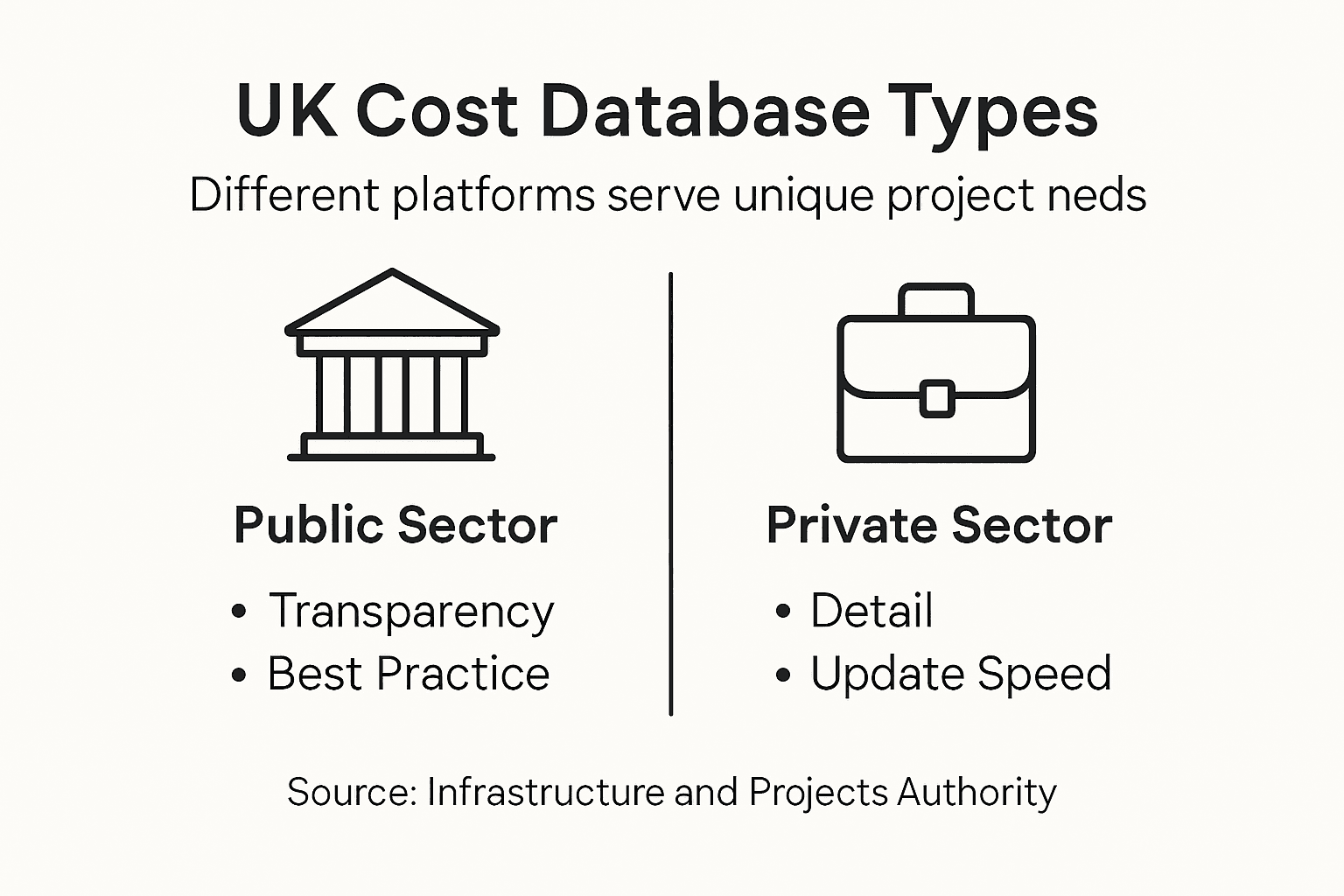
Here is how UK construction cost database types differ by practical uses and strengths:
| Database Type | Main Users | Typical Data Depth | Key Strength |
|---|---|---|---|
| Public Sector | Project managers, government bodies | High-level, broad | Ensures transparency and consistency |
| Commercial Market | Quantity surveyors, contractors | Highly detailed, frequent updates | Precise benchmarking for cost planning |
| Industry Association | Trade bodies, specialists | Sector-specific insights | Focuses on industry best practices |
| Regional | Local authorities, SMEs | Locally focused, granular | Captures local economic variations |
Key Differentiators Across Database Types:
- Scope of coverage (national versus regional)
- Update frequency
- Level of detail in cost breakdowns
- Accessibility and pricing models
- Specialisation by construction sector
Pro tip: Combine multiple database sources to create a comprehensive and accurate cost estimation strategy, ensuring you capture the most current and relevant pricing information.
Essential features and how databases operate
Construction cost databases are sophisticated digital platforms that aggregate and analyse pricing information through complex data collection and validation processes. These sophisticated systems transform raw financial data into actionable insights for construction professionals across the United Kingdom.
The core operational mechanisms of construction cost databases typically involve several critical components:
- Data Collection: Gathering information from multiple sources including:
- Government statistical offices
- Market surveys
- Contractor price submissions
- Material supplier reports
- Data Validation: Cross-referencing multiple sources to ensure accuracy
- Statistical Processing: Applying mathematical models to normalise and interpret pricing trends
- Indexing: Creating comparative metrics that track cost changes over time
Material price indices methodologies play a crucial role in generating comprehensive cost databases. These methodologies combine producer price indices, market surveys, and validated contractor feedback to generate precise cost indices for materials, labour, and plant equipment.

The computational complexity behind these databases involves sophisticated weighting methodologies that reflect actual construction output. These techniques allow databases to adapt dynamically to economic fluctuations, providing project managers with nuanced, contextually relevant pricing information that goes far beyond simple numerical aggregation.
Key Technical Features:
- Real-time data updates
- Multi-sector cost tracking
- Geographical price variation analysis
- Predictive pricing models
- Customisable reporting interfaces
Pro tip: Request sample reports from potential database providers to assess the depth, accuracy, and usability of their cost tracking methodologies before making a subscription commitment.
Legal standards and compliance for cost data usage
Navigating the legal landscape of construction cost data usage requires a comprehensive understanding of the intricate regulations governing information collection, sharing, and application in the United Kingdom. Project managers must be acutely aware of the complex legal frameworks that protect data integrity, privacy, and fair use across the construction industry.
Key legal considerations for construction cost databases encompass several critical domains:
- Data Protection: Compliance with General Data Protection Regulation (GDPR)
- Intellectual Property: Respecting ownership and attribution of cost data
- Confidentiality: Maintaining strict controls on sensitive pricing information
- Transparency: Ensuring clear reporting and ethical data usage
- Professional Standards: Adhering to industry-specific ethical guidelines
Benchmarking data charter principles provide a robust framework for legal and ethical data management. These principles mandate rigorous standards for collecting, processing, and sharing project cost information while maintaining the highest levels of professional integrity and legal compliance.
Public sector construction data collections must navigate a particularly complex regulatory environment. Government regulations require meticulous validation, consistent reporting, and transparent methodologies to ensure that cost databases meet stringent legal and professional standards. This includes comprehensive documentation of data sources, precise attribution, and mechanisms to protect individual and organisational confidentiality.
Compliance Verification Checklist:
- Validate data source credentials
- Confirm GDPR compliance
- Review data usage permissions
- Assess anonymisation protocols
- Document data collection methods
Pro tip: Consult a legal professional specialising in construction and data protection to develop a comprehensive compliance strategy for your cost database usage.
Financial risks and challenges with construction databases
Construction cost databases present a complex landscape of financial risks that can significantly impact project planning and budgeting for UK professionals. These digital repositories, while valuable, are not infallible and require sophisticated interpretation to mitigate potential financial pitfalls.
The primary financial risks associated with construction databases include:
- Data Misinterpretation: Incorrect application of cost benchmarks
- Outdated Pricing: Reliance on non-current market information
- Regional Variations: Overlooking geographical cost differences
- Market Volatility: Rapid changes in material and labour costs
- Contextual Limitations: Failing to account for project-specific variables
Construction cost fluctuations create substantial challenges for maintaining database accuracy. The dynamic nature of material and labour markets means that cost databases require continuous updating and sophisticated adjustment mechanisms to remain reliable.
Professionals must develop nuanced strategies to navigate these financial risks. This involves critically assessing database information, cross-referencing multiple sources, and applying contextual knowledge that goes beyond raw numerical data. Understanding the limitations of cost databases is crucial for preventing potential budget overruns and making informed financial decisions.
The table below clarifies typical financial risks and the most effective mitigation strategies for each:
| Risk Type | Example Scenario | Primary Mitigation Strategy |
|---|---|---|
| Data Misinterpretation | Using average rates for specialist works | Validate against project specifics |
| Outdated Pricing | Relying on last year’s material costs | Check with recent supplier quotes |
| Regional Variations | Using national rates in London | Adjust for local market premiums |
| Market Volatility | Sudden steel price increases | Add flexible contingency allowances |
Risk Mitigation Strategies:
- Regular database validation
- Multiple source cross-referencing
- Incorporating project-specific contextual analysis
- Implementing contingency buffers
- Continuous market intelligence gathering
Pro tip: Develop a dynamic risk assessment framework that treats cost database information as a guide rather than an absolute truth, always supplementing digital insights with expert professional judgment.
Avoiding common mistakes in database selection and use
Selecting and utilising construction cost databases demands a strategic approach that goes beyond simple data retrieval. UK project professionals must develop sophisticated skills to navigate the complex landscape of cost information, recognising that database selection is a critical decision with far-reaching financial implications.
Common mistakes in database usage typically fall into several key categories:
- Uncritical Acceptance: Treating database figures as absolute truth
- Narrow Scope: Relying on a single data source
- Contextual Ignorance: Failing to consider project-specific variables
- Infrequent Updates: Using outdated or stale pricing information
- Insufficient Validation: Neglecting cross-referencing and verification
Benchmarking data usage requires careful alignment with project scope and lifecycle stages. Overreliance on benchmarking data without contextual adjustment can lead to significant misinterpretations and potentially catastrophic financial miscalculations.
Professionals must develop a nuanced approach to database selection, emphasising comprehensive evaluation and continuous critical assessment. This involves understanding each database’s methodological approach, verifying data collection processes, and maintaining a healthy scepticism about presented cost information. Successful database utilisation demands more than passive data consumption—it requires active, intelligent interpretation.
Database Selection Criteria:
- Proven track record of accuracy
- Frequent data updates
- Comprehensive regional coverage
- Transparent methodology
- Flexible reporting capabilities
Pro tip: Implement a rigorous database evaluation protocol that includes testing multiple sources, conducting retrospective accuracy checks, and maintaining a dynamic approach to cost information interpretation.
Enhance Your Project Accuracy with Expert Cost Estimating Support
Navigating the complexities of construction cost databases requires more than just data access it demands expert interpretation and UK-specific market insight. If you find yourself challenged by risks such as outdated pricing, regional variations, or data misinterpretation, there is a reliable solution tailored for your needs. At My Project Estimating, we specialise in delivering accurate, transparent, and timely cost estimates based on verified UK market data. Our professional services include early-stage cost planning, detailed quantity takeoffs, and comprehensive cost reports designed to complement the valuable benchmarks you gather from construction cost databases.
Don’t let financial uncertainties hold your project back. Whether you require detailed cost forecasting or sector-specific insights, discover how our expert estimators can support your decision-making process with precision and speed. Explore our resources at Uncategorized Archives – My Project Estimating and take control of your project costs today by visiting My Project Estimating. Get started now to ensure your project stays within budget and avoids common pitfalls identified in benchmarking practices.
Frequently Asked Questions
What are construction cost databases?
Construction cost databases are structured repositories that compile historical pricing information critical for financial planning in construction projects. They enable project managers to benchmark estimates and track expenses with greater accuracy.
How do I choose the right construction cost database for my project?
When selecting a construction cost database, consider the accuracy of data, update frequency, regional coverage, methodology transparency, and flexible reporting capabilities to ensure it meets your project’s specific needs.
What are the benefits of using construction cost databases?
Using construction cost databases provides benefits such as benchmarking against historical data, understanding regional cost variations, validating project expenses, and informing financial decision-making strategies to enhance overall project accuracy.
What are the limitations of construction cost databases?
Limitations of construction cost databases include their inability to predict future expenses perfectly due to market volatility, project-specific factors, and the need for continuous updates, which means users must treat the data as guidance rather than absolute figures.