Winning a construction contract often comes down to much more than just having the lowest price. With over 120 billion pounds invested annually in UK construction projects, even small errors during the tender process can cost businesses major opportunities. Understanding how the tendering process works is crucial for contractors who want to compete fairly, meet all requirements, and secure profitable contracts. This guide breaks down the key steps, procedures, and strategies that make a difference when bidding for construction work.
Table of Contents
- Defining The Construction Tender Process
- Main Types Of Construction Tenders
- Step-By-Step Tendering Procedures In The UK
- Legal And Regulatory Framework For Tenders
- Key Evaluation Criteria And Decision Factors
- Common Tendering Pitfalls And How To Avoid Them
Key Takeaways
| Point | Details |
|---|---|
| Importance of the Tender Process | The construction tender process ensures transparency and competitive bidding, crucial for selecting the most suitable contractors for projects. |
| Types of Tenders | Understanding the differences between open, restricted, negotiated, and competitive dialogue tenders is essential for effective participation in the construction market. |
| Critical Stages | Key stages include opportunity identification, bid submission, and evaluation, requiring meticulous preparation and documentation to enhance success rates. |
| Evaluation Criteria | Clients assess bids using criteria beyond cost, including technical competence and project understanding, emphasizing the need for comprehensive and tailored submissions. |
Defining the Construction Tender Process
A construction tender process represents the structured method through which construction projects are competitively bid and awarded. According to gov.uk, this process involves multiple critical procedures including open, restricted, and competitive dialogue approaches that determine how construction contracts are ultimately assigned.
The tender process fundamentally serves as a transparent mechanism for selecting the most suitable contractor or supplier for a specific construction project. Typically, it involves several key stages: project invitation, document preparation, bid submission, evaluation, and final contract award. Find Tender provides the official UK government platform where these public sector procurement notices are published, enabling suppliers to search and apply for relevant construction opportunities.
Key components of a standard construction tender process include:
- Invitation to Tender (ITT): A formal document outlining project specifications, requirements, and evaluation criteria
- Specification Documents: Detailed technical descriptions of project expectations
- Bid Submission: Contractors’ comprehensive proposal including technical approaches, pricing, and project methodology
- Evaluation Stage: Rigorous assessment of submitted bids against predefined selection criteria
Successful tender management requires meticulous attention to detail, understanding of regulatory frameworks, and strategic preparation. Contractors must demonstrate not just competitive pricing, but also technical competence, financial stability, and alignment with project-specific requirements to secure construction contracts.
Main Types of Construction Tenders
The construction tendering landscape in the UK encompasses several distinctive procurement methods, each designed to address specific project requirements and market conditions. According to gov.uk, three primary tender procedures dominate the construction sector: open procedure, restricted procedure, and competitive dialogue.
Open Procedure represents the most transparent tendering approach, where any interested contractor can submit a bid. This method allows maximum market participation and provides an equal opportunity for businesses of all sizes. Salford City Council highlights that this procedure is particularly suitable for straightforward projects with clear specifications and minimal complexity.
Key types of construction tenders include:
- Open Tender: Unrestricted bidding process open to all qualified contractors
- Restricted Tender: Limited to pre-qualified or invited contractors
- Negotiated Tender: Direct negotiations between client and selected contractors
- Competitive Dialogue: Complex projects requiring extensive interaction and solution development
The Restricted Procedure offers a more controlled approach, where only pre-qualified contractors are invited to bid. This method allows clients to shortlist contractors based on specific financial, technical, and professional criteria, ensuring a more targeted and potentially higher-quality tender pool. By using construction estimating services, contractors can enhance their bid preparation and increase their chances of successfully navigating these competitive tendering processes.

Step-By-Step Tendering Procedures in the UK
The construction tendering process in the United Kingdom follows a structured approach designed to ensure transparency, fairness, and competitive bidding. According to gov.uk, the tendering journey encompasses multiple critical stages that contractors must navigate carefully.
The comprehensive tendering procedure typically involves the following sequential steps:
- Opportunity Identification: Locating relevant construction tender opportunities through official platforms
- Pre-Qualification Stage: Assessing and meeting initial contractor selection criteria
- Tender Documentation Preparation: Developing comprehensive bid documents and proposals
- Bid Submission: Formally presenting detailed project proposals
- Evaluation and Assessment: Rigorous review of submitted bids
- Contract Negotiation: Finalizing terms with selected contractor
APUC Scotland emphasizes that thorough preparation is crucial during each stage. Contractors must meticulously prepare documentation, demonstrating technical competence, financial stability, and precise understanding of project requirements. To enhance bid success, many contractors leverage quantity takeoff services to provide accurate, detailed project costings that strengthen their competitive position.
The final stages involve comprehensive bid evaluation, where clients assess submissions based on predetermined criteria including price, technical capability, project understanding, and overall value proposition.
Successful tenderers must not only offer competitive pricing but also showcase their ability to deliver high-quality results within specified timelines and budgetary constraints.
Legal and Regulatory Framework for Tenders
The UK construction tendering landscape is governed by a comprehensive legal framework designed to ensure fairness, transparency, and competitive integrity. According to gov.uk, the recently introduced Procurement Act 2023 provides a robust set of regulations that define how tenders are assessed, awarded, and managed across various sectors.
Key regulatory principles established by the legal framework include:
- Equal Treatment: Ensuring all potential contractors receive fair and non-discriminatory consideration
- Transparency: Mandating clear, accessible tender documentation and evaluation processes
- Proportionality: Requiring tender requirements to be reasonable and aligned with project complexity
- Mutual Recognition: Acknowledging qualifications and certifications from different jurisdictions
- Competition: Promoting open and fair competitive bidding environments
Find Tender highlights that the Procurement Act 2023 introduces multiple procurement procedures, including open, competitive flexible, and direct award approaches. These procedures provide structured mechanisms for public sector procurement, ensuring that cost planning for developers can navigate complex regulatory landscapes with greater confidence and clarity.
The legal framework also establishes stringent guidelines for tender evaluation, focusing on criteria beyond mere price. Contractors must demonstrate technical competence, financial stability, environmental considerations, and social value. This holistic approach ensures that successful tenders represent not just the most economically advantageous option, but also align with broader societal and sustainability objectives.
Key Evaluation Criteria and Decision Factors
Constructing a successful tender requires understanding the complex evaluation criteria that clients use to assess potential contractors. According to gov.uk, the evaluation process extends far beyond simple price comparisons, encompassing a holistic assessment of a contractor’s capabilities and project approach.
The primary evaluation criteria typically include:
- Technical Competence: Demonstrating specialist skills and project-specific expertise
- Financial Stability: Proving robust financial health and resource capacity
- Price Competitiveness: Offering value for money without compromising quality
- Project Understanding: Showing comprehensive comprehension of project requirements
- Delivery Capability: Evidencing ability to meet timelines and performance standards
- Risk Management: Presenting clear strategies for mitigating potential project risks
Gov.uk emphasizes that contractors must meticulously address each specification and requirement in their tender response. To enhance their competitive position, many contractors leverage Bill of Quantities services to provide precise, detailed documentation that demonstrates their technical and financial capabilities.
Decision-making ultimately hinges on the Most Economically Advantageous Tender (MEAT) principle, which balances cost considerations with qualitative factors.
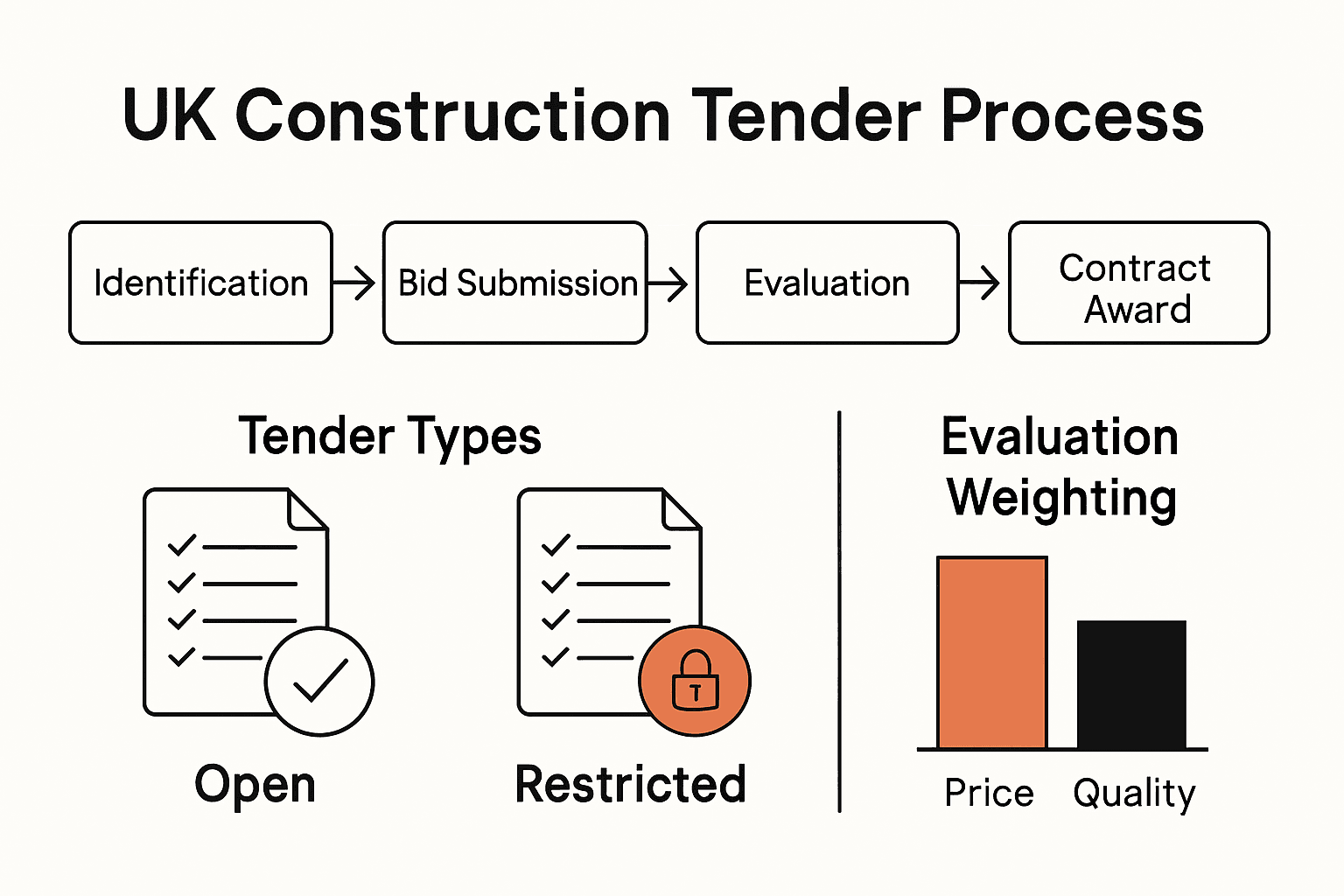 This approach ensures that the selected contractor not only offers competitive pricing but also demonstrates the highest potential for delivering a successful project, meeting both technical specifications and broader strategic objectives.
Common Tendering Pitfalls and How to Avoid Them
The construction tendering landscape is fraught with potential challenges that can derail even the most promising bid. According to gov.uk, many contractors inadvertently compromise their tender submissions by overlooking critical details and procedural requirements.
Most frequent tendering pitfalls include:
- Incomplete Documentation: Failing to provide comprehensive and precise tender documentation
- Missed Deadlines: Submitting bids after specified cut-off times
- Pricing Errors: Miscalculating project costs or providing unrealistic pricing
- Non-Compliance: Overlooking specific tender requirements or specifications
- Poor Risk Assessment: Inadequate identification and mitigation of project risks
- Lack of Differentiation: Submitting generic bids that fail to highlight unique capabilities
The Competition and Markets Authority warns against unethical practices like collusive tendering or bid-rigging, which can result in severe legal consequences. To mitigate these risks, contractors can leverage professional construction estimating services to ensure accuracy, compliance, and competitive positioning.
Successful tender preparation demands meticulous attention to detail, strategic planning, and a comprehensive understanding of client requirements. Contractors must go beyond mere compliance, developing bids that demonstrate technical expertise, financial robustness, and a genuine commitment to delivering exceptional project outcomes.
Take Control of Your Construction Tenders with Expert Cost Estimating
Understanding the intricate construction tender process can be daunting, especially when you need to meet strict evaluation criteria and regulatory requirements. Key challenges like preparing accurate bids, managing risk, and demonstrating financial stability are common hurdles that can determine your success in securing contracts. Whether you are preparing detailed quantity takeoffs or drafting a Bill of Quantities, precision and transparency are essential to stand out in competitive tenders.
My Project Estimating specialises in providing fast and reliable cost planning services tailored to UK construction projects. Our experienced estimators offer clear, detailed reports with verified UK market data so you can confidently address the requirements discussed in this guide. Explore how our services in quantity takeoff and Bill of Quantities preparation can strengthen your bids. Don’t let uncertainties or pricing errors hold you back. Visit My Project Estimating now to start reducing risks and improve your chances of tender success with transparent, professional cost estimates delivered within days.
Frequently Asked Questions
What are the main stages of the construction tender process?
The main stages of the construction tender process include opportunity identification, pre-qualification, tender documentation preparation, bid submission, evaluation, and contract negotiation.
What types of construction tenders exist?
The main types of construction tenders include open tender, restricted tender, negotiated tender, and competitive dialogue, each suited for different project complexities and requirements.
What criteria are used to evaluate construction tenders?
Evaluation criteria typically include technical competence, financial stability, price competitiveness, project understanding, delivery capability, and risk management strategies.
What common pitfalls should contractors avoid during the tendering process?
Contractors should avoid common pitfalls such as incomplete documentation, missed deadlines, pricing errors, non-compliance with specifications, poor risk assessment, and lack of differentiation in their bids.