Every successful construction project in the British market depends on precise cost predictions and financial control. Over 80 percent of failed projects cite budgeting errors as the root cause, highlighting just how vital professional estimators really are. Whether you are navigating tight deadlines or adapting to shifting material prices, understanding what an estimator does can turn uncertainty into confidence and protect your investment from unexpected setbacks.
Table of Contents
- What Is An Estimator In Construction?
- Types Of Estimating Services Available
- How Professional Estimators Add Value
- Risks Of Inaccurate Cost Estimation
- Comparing Estimators Versus In-House Calculations
Key Takeaways
| Point | Details |
|---|---|
| Estimator’s Role | Estimators are essential in construction, providing accurate financial strategies and cost analysis to ensure project viability. |
| Types of Estimating Services | Various estimating services such as conceptual, detailed, and parametric estimating deliver tailored financial insights throughout project phases. |
| Value of Professional Estimators | They add significant value by identifying risks, optimising costs, and ensuring compliance with industry standards, thus enhancing project success. |
| Risk of Inaccurate Estimations | Inaccurate cost estimates can lead to budget overruns, project delays, and reputational damage, making precision a priority in financial forecasting. |
What Is an Estimator in Construction?
An estimator is a critical professional in construction who serves as the financial strategist and budgetary architect of building projects. These specialists provide comprehensive cost analysis and financial forecasting, ensuring projects remain economically viable from conception to completion. By meticulously producing accurate costing predictions, estimators play a fundamental role in transforming architectural designs into financially feasible realities.
Construction estimators engage in detailed analytical work that goes far beyond simple number crunching. They carefully examine architectural drawings, technical specifications, and supplier quotations to determine precise expenses across multiple categories. Their responsibilities include calculating material costs, labour expenses, equipment requirements, and potential overhead charges. Estimators work closely with engineers, architects, and project managers to develop comprehensive cost lists that encompass every aspect of project completion.
The core skills of a successful construction estimator include advanced mathematical proficiency, exceptional attention to detail, and strong analytical capabilities. They must possess:
- Advanced knowledge of construction materials and pricing trends
- Proficiency in digital estimation software and spreadsheet tools
- Understanding of complex project planning methodologies
- Ability to interpret technical architectural and engineering drawings
- Strong communication skills for negotiating with suppliers and contractors
By providing accurate financial projections, estimators fundamentally protect both project investors and construction teams from unexpected financial risks. Their strategic insights help organisations make informed decisions, optimise resource allocation, and maintain budgetary control throughout the construction process.
Types of Estimating Services Available
Construction estimating services encompass several specialised approaches designed to support different stages of project planning and development. Conceptual cost estimating provides crucial preliminary financial insights during initial project phases, offering rough estimates based on comparable past projects, square footage, and basic specifications. This early-stage estimation helps stakeholders conduct feasibility studies, assess potential risks, and secure initial project approvals or financing.
Estimators utilise various mathematical and analytical techniques to generate precise cost predictions. Cost estimation models employ sophisticated parametric equations and algorithmic approaches to calculate potential project expenses across multiple sectors, including construction, manufacturing, and product development. These models integrate complex input parameters to generate comprehensive financial forecasts that guide strategic decision-making.
Typically, construction estimating services can be categorised into the following primary types:
- Conceptual Estimating: Preliminary cost projections during early planning stages
- Detailed Estimating: Comprehensive, line-item cost breakdowns with precise calculations
- Parametric Estimating: Statistical modelling based on historical project data
- Comparative Estimating: Cost predictions derived from similar previous projects
- Design-Phase Estimating: Ongoing cost analysis throughout architectural design development
Professional estimating services provide strategic financial guidance that extends beyond simple number-crunching. By delivering nuanced, data-driven insights, these services help construction professionals mitigate financial risks, optimise resource allocation, and maintain rigorous budget control throughout project lifecycles.

How Professional Estimators Add Value
Professional estimators are strategic financial experts who deliver exceptional value by meticulously determining project costs and resource requirements. Their comprehensive approach goes far beyond simple number-crunching, encompassing detailed analysis of construction techniques, materials, equipment, and potential project risks. By leveraging their specialised knowledge, estimators help organisations make informed decisions that directly impact project financial performance and overall success.
Construction estimators create detailed material lists and comprehensive pricing strategies that transform abstract project plans into financially viable blueprints. They systematically assign precise values to materials, labour, equipment, and overhead expenses, producing nuanced proposals that include critical work inclusions, potential exclusions, and alternative approaches. This meticulous process ensures transparent financial planning and helps stakeholders understand the complete economic landscape of their construction projects.
The key value-adding capabilities of professional estimators include:
- Risk Mitigation: Identifying potential financial vulnerabilities before project commencement
- Cost Optimisation: Developing strategies to maximise resource efficiency
- Competitive Pricing: Creating accurate tender submissions that balance profitability and competitiveness
- Strategic Planning: Providing comprehensive financial forecasts that support long-term project decision-making
- Compliance Assurance: Ensuring financial estimates align with industry standards and regulatory requirements
By bridging technical expertise with financial acumen, professional estimators transform complex construction challenges into manageable, economically sound opportunities. Their strategic insights enable organisations to navigate financial uncertainties, control project expenditures, and achieve sustainable economic outcomes in an increasingly competitive construction landscape.
Risks of Inaccurate Cost Estimation
Inaccurate cost estimation presents significant financial and operational risks that can fundamentally compromise construction project success. Mathematical cost estimation models are crucial for mitigating potential economic vulnerabilities, helping organisations prevent catastrophic budget overruns, project delays, and resource misallocation. When estimation processes lack precision, construction teams expose themselves to substantial financial uncertainty and potential project failure.
The cascading consequences of imprecise cost estimation extend far beyond initial budget miscalculations. Inaccurate projections can trigger a domino effect of complications, including delayed project timelines, compromised quality, strained stakeholder relationships, and potential legal disputes. Operational bills and comprehensive tendering documents play a critical role in reducing estimation risks by enhancing communication between design and production teams and enabling more realistic pricing strategies.
Potential risks associated with inaccurate cost estimation include:
- Budget Overruns: Unexpected expenses exceeding initial financial projections
- Project Delays: Timeline extensions caused by financial constraints
- Resource Mismanagement: Inefficient allocation of labour, materials, and equipment
- Contractual Disputes: Legal challenges arising from financial discrepancies
- Reputation Damage: Loss of credibility among clients and industry partners
- Reduced Profitability: Diminished financial margins due to unforeseen expenses
Professional estimators serve as critical safeguards against these potential pitfalls, employing sophisticated analytical techniques and industry expertise to develop robust, reliable financial forecasts. Their strategic approach transforms potential economic risks into manageable, predictable project parameters, ensuring organisations can navigate complex construction challenges with confidence and financial prudence.
Comparing Estimators Versus In-House Calculations
Professional cost estimation services offer significantly more sophisticated approaches compared to traditional in-house calculation methods. While internal teams might rely on historical data and manual spreadsheets, professional estimators leverage advanced technological tools, comprehensive industry databases, and standardised methodological frameworks to generate remarkably precise financial projections. The fundamental difference lies not just in computational accuracy, but in the depth and breadth of analytical expertise applied to construction cost forecasting.
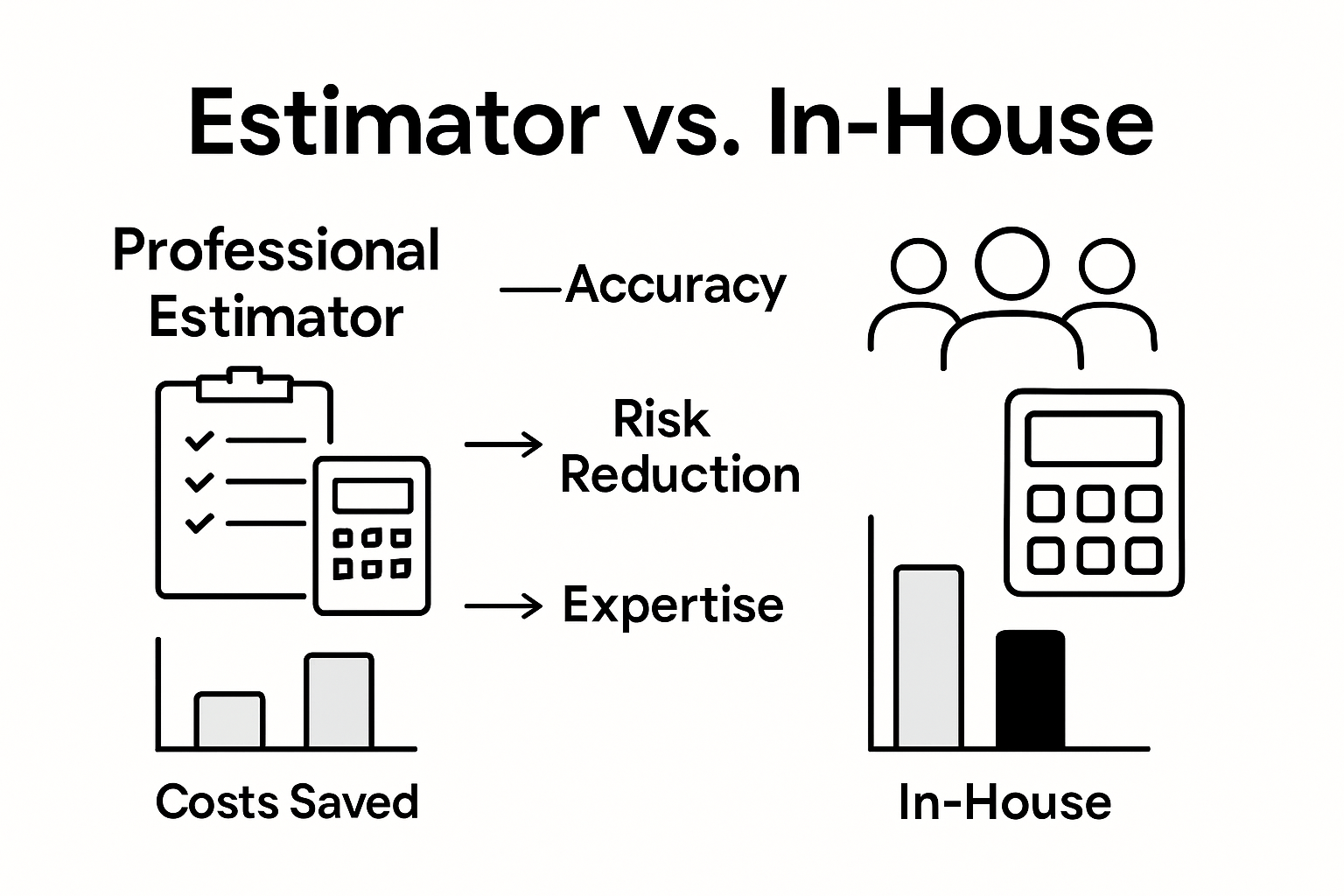
Cost estimation models utilise mathematical algorithms and parametric equations that transform raw data into nuanced financial insights, a capability rarely matched by internal calculation processes. Professional estimators bring specialised knowledge that extends beyond simple number-crunching, incorporating complex variables such as market fluctuations, regional pricing trends, material availability, and potential risk factors that in-house teams might overlook.
Key comparative differences between professional estimators and in-house calculations include:
- Technological Capabilities: Advanced software and modelling tools versus basic spreadsheet calculations
- Data Comprehensiveness: Extensive industry databases versus limited organisational historical records
- Analytical Depth: Multi-variable risk assessment versus linear cost projections
- Expertise Level: Specialised industry professionals versus generalist internal staff
- Objectivity: Unbiased external perspective versus potentially skewed internal viewpoints
- Precision: Statistically refined estimates versus approximation-based calculations
Ultimately, professional estimators represent a strategic investment in financial accuracy and risk management. Their comprehensive approach transforms cost estimation from a mundane administrative task into a powerful strategic tool, enabling organisations to make more informed, confident decisions throughout their construction project lifecycles.
Secure Your Construction Budget with Expert Estimating Support
When budgets waver and financial risks threaten your construction project, precision in cost forecasting becomes your strongest defence. The article highlights common challenges such as budget overruns, resource mismanagement, and the pitfalls of inaccurate cost estimation. It is clear that enlisting a professional estimator is not merely about numbers but about protecting your investment through detailed, transparent, and accurate cost analysis. Concepts like risk mitigation and cost optimisation show how vital expert estimators are in transforming complex plans into feasible, financially sound strategies.
My Project Estimating offers UK-focused construction estimating services that directly address these critical needs. With quick turnaround times and verified market data, our platform supports architects, builders, and developers in navigating cost uncertainties confidently. To explore how professional estimator insights can safeguard your budget, visit our Uncategorized Archives – My Project Estimating. Start your journey by sharing your project drawings and see how our detailed cost planning optimises your build.
Do not let financial risks derail your construction ambitions. Act now to access reliable, speedy, and transparent cost estimates by visiting My Project Estimating. Your project’s budget deserves expert protection at every stage.
Frequently Asked Questions
What does a construction estimator do?
A construction estimator is responsible for providing detailed cost analysis and financial forecasting for building projects, ensuring they are economically viable from start to finish. They analyse architectural designs, material costs, labour expenses, and equipment requirements to produce accurate budgets.
Why is accurate cost estimation important in construction projects?
Accurate cost estimation is crucial as it helps prevent budget overruns, project delays, and resource mismanagement. Inaccurate estimates can lead to serious financial risks, such as unexpected expenses and possible legal disputes, affecting overall project success.
How can hiring a professional estimator save money?
Hiring a professional estimator can save money by identifying potential financial vulnerabilities early, optimising resource allocation, and providing accurate tender submissions. Their specialised knowledge allows for greater precision in budgeting, which helps avoid costly mistakes.
What are the different types of estimating services available?
Different types of estimating services include conceptual estimating, detailed estimating, parametric estimating, comparative estimating, and design-phase estimating. Each service addresses various stages of project planning, providing tailored financial insights essential for effective decision-making.