Missed or outdated construction estimates can quickly unravel even the most carefully planned UK residential projects. For architects and builders, getting to grips with budget accuracy is more than just number crunching. Regularly reviewing estimates provides confidence in spending, helps avoid unpleasant surprises, and supports smart decision-making from design through build. This guide highlights the vital steps behind maintaining clear, reliable financial forecasts and why ongoing checks protect your project from unnecessary financial risks.
Table of Contents
- Defining Construction Estimates And Their Value
- Main Types Of Construction Estimates In The UK
- How And When To Review Estimates
- Risks Of Unreviewed Or Outdated Cost Forecasts
- Legal Duties And Client Responsibilities
- Common Pitfalls During Estimate Reviews
Key Takeaways
| Point | Details |
|---|---|
| Importance of Construction Estimates | Construction estimates are critical for budget management and strategic decision-making throughout a project. |
| Types of Estimation Methods | Utilise top-down, bottom-up, and analogous methods to improve estimation accuracy depending on project needs. |
| Regular Review of Estimates | Continuous review of estimates is essential to address market changes and maintain financial accuracy. |
| Risks of Unreviewed Estimates | Unaddressed estimates can lead to budget overruns and stakeholder distrust, jeopardising project success. |
Defining Construction Estimates and Their Value
Construction estimates represent sophisticated financial projections that form the critical backbone of project planning and budgetary management in the United Kingdom’s building sector. These precise calculations provide professionals with a comprehensive prediction of potential project expenditures, enabling strategic decision-making from project inception through completion. Construction estimating methods encompass a range of sophisticated techniques designed to forecast anticipated costs with increasing levels of accuracy.
At their core, construction estimates serve multiple strategic purposes beyond simple number-crunching. They act as dynamic financial blueprints that help architects, builders, and developers understand potential monetary requirements, risk factors, and resource allocations. By breaking down projected expenses into granular categories such as labour, materials, equipment, and overhead costs, these estimates provide a nuanced view of a project’s financial landscape. Construction output measurements from the Office for National Statistics further validate the critical role these financial projections play in understanding broader economic performance.
The value of construction estimates extends far beyond simple cost prediction. They represent strategic tools that facilitate risk management, resource allocation, and competitive bidding. Professional estimators utilise advanced methodologies including parametric, analogous, and bottom-up approaches to generate increasingly sophisticated projections. These methods allow for nuanced understanding of potential financial scenarios, helping professionals anticipate challenges, mitigate risks, and create more robust project plans that align with budgetary constraints and client expectations.
Pro tip: Always request detailed, itemised construction estimates that break down costs into specific categories to gain maximum transparency and understanding of potential project expenses.
Main Types of Construction Estimates in the UK
In the United Kingdom’s construction industry, professionals utilise several primary estimation approaches to predict project costs with precision and reliability. Construction cost estimation methods typically fall into three fundamental categories: top-down, bottom-up, and analogous estimating, each offering unique advantages depending on project complexity and available information. These methodologies provide construction professionals with flexible tools to generate accurate financial projections across various project stages and scales.
Top-down estimates represent high-level financial predictions that offer quick preliminary insights, typically used during early project planning phases. These estimates incorporate broad project parameters and include contingency allowances for potential risks and scope variations. In contrast, bottom-up estimates provide granular, detailed cost breakdowns by meticulously examining individual project components, tasks, and resources. This approach requires comprehensive project documentation and is particularly valuable when securing stakeholder approvals or developing precise budget allocations.
The third primary estimation technique, analogous estimating, draws comparisons with similar previous projects to generate rapid cost predictions. Construction sector classifications demonstrate how different project types – such as private commercial, public housing, infrastructure, and new work versus repair and maintenance – significantly influence estimation strategies. Professional estimators carefully select comparable historical projects, adjusting for factors like inflation, technological changes, and specific project nuances to create accurate financial forecasts.
Here is a comparison of the main construction estimating methods used in the UK:
| Estimating Method | Detail Level | Typical Use Stage | Key Advantage |
|---|---|---|---|
| Top-down | High-level | Early planning | Quick overview of total costs |
| Bottom-up | Granular | Later, detailed budgeting | Accurate, itemised component costs |
| Analogous | Moderate | Any, when data is limited | Faster estimates using past projects |
Pro tip: Combine multiple estimation methods to cross-validate your cost predictions and increase overall financial accuracy for construction projects.
How and When to Review Estimates
Reviewing construction estimates is a critical process that requires strategic timing and meticulous attention to detail throughout a project’s lifecycle. Construction project regulations mandate specific review points that help professionals maintain financial accuracy and regulatory compliance. The review process is not a one-time event but a continuous method of monitoring and adjusting cost projections to reflect the dynamic nature of construction projects.
The key stages for estimate review typically align with significant project milestones. During project initiation, preliminary estimates provide a broad financial framework, offering initial insights into potential costs. As the design develops, these estimates must be refined to incorporate more detailed information, moving from high-level predictions to more granular financial forecasts. Critical review points include pre-procurement stages, design development phases, and periodic assessments during active construction. Cost estimation lifecycle analysis demonstrates that each project stage introduces new variables that can significantly impact financial projections.
Effective estimate reviews should account for multiple external and internal factors. Market conditions, material price fluctuations, labour cost changes, and unexpected site challenges can all necessitate estimate adjustments. Professional estimators recommend comprehensive reviews that examine direct costs, indirect expenses, contingency allowances, and potential risk factors. This holistic approach ensures that estimates remain adaptive and realistic, providing stakeholders with the most accurate financial understanding possible throughout the project duration.
Pro tip: Create a standardised estimate review checklist that includes market conditions, design changes, and potential risk factors to ensure consistent and thorough financial assessments.
Risks of Unreviewed or Outdated Cost Forecasts
Budget overruns represent the most significant financial threat emerging from unreviewed construction estimates. Infrastructure cost management research demonstrates that neglecting regular estimate reviews can lead to substantial financial discrepancies, potentially compromising entire project viability. These unaddressed variations can transform modest initial uncertainties into dramatic budget escalations, creating substantial economic risks for construction professionals.
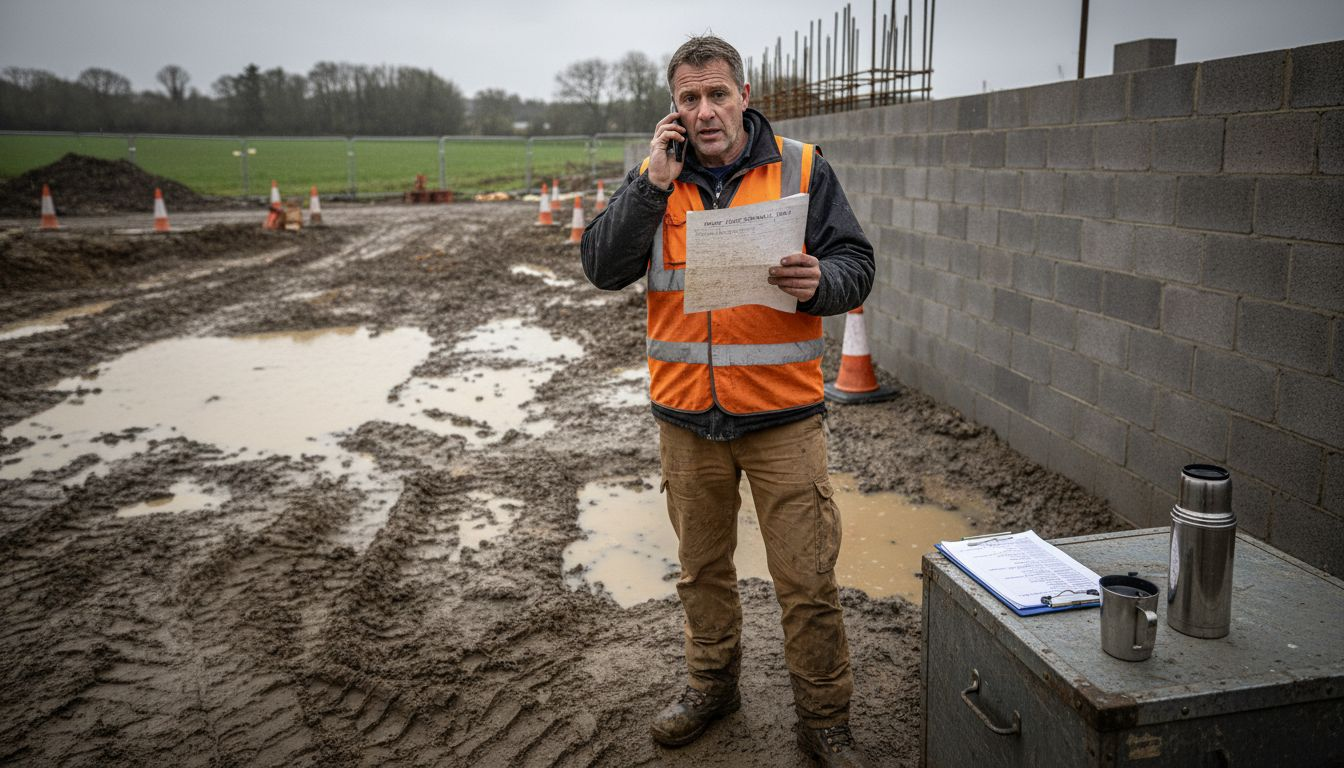
The consequences of outdated cost forecasts extend far beyond immediate financial implications. Unrevised estimates create cascading challenges that impact project planning, resource allocation, stakeholder confidence, and organisational reputation. Economic fluctuations, material price changes, labour market shifts, and technological developments can rapidly render initial cost projections obsolete. Professional estimators understand that static financial forecasts become increasingly inaccurate with each passing month, necessitating a dynamic approach to cost management.
Project cost risk management highlights several critical risks associated with unreviewed estimates. These include potential contractual disputes, reduced competitive bidding capabilities, compromised project financing, and increased likelihood of project abandonment. Stakeholders rely on accurate financial projections to make informed decisions, and outdated estimates can erode trust, create unrealistic expectations, and ultimately jeopardise project success. The financial exposure increases exponentially with project complexity and duration, making comprehensive and frequent estimate reviews an essential risk mitigation strategy.
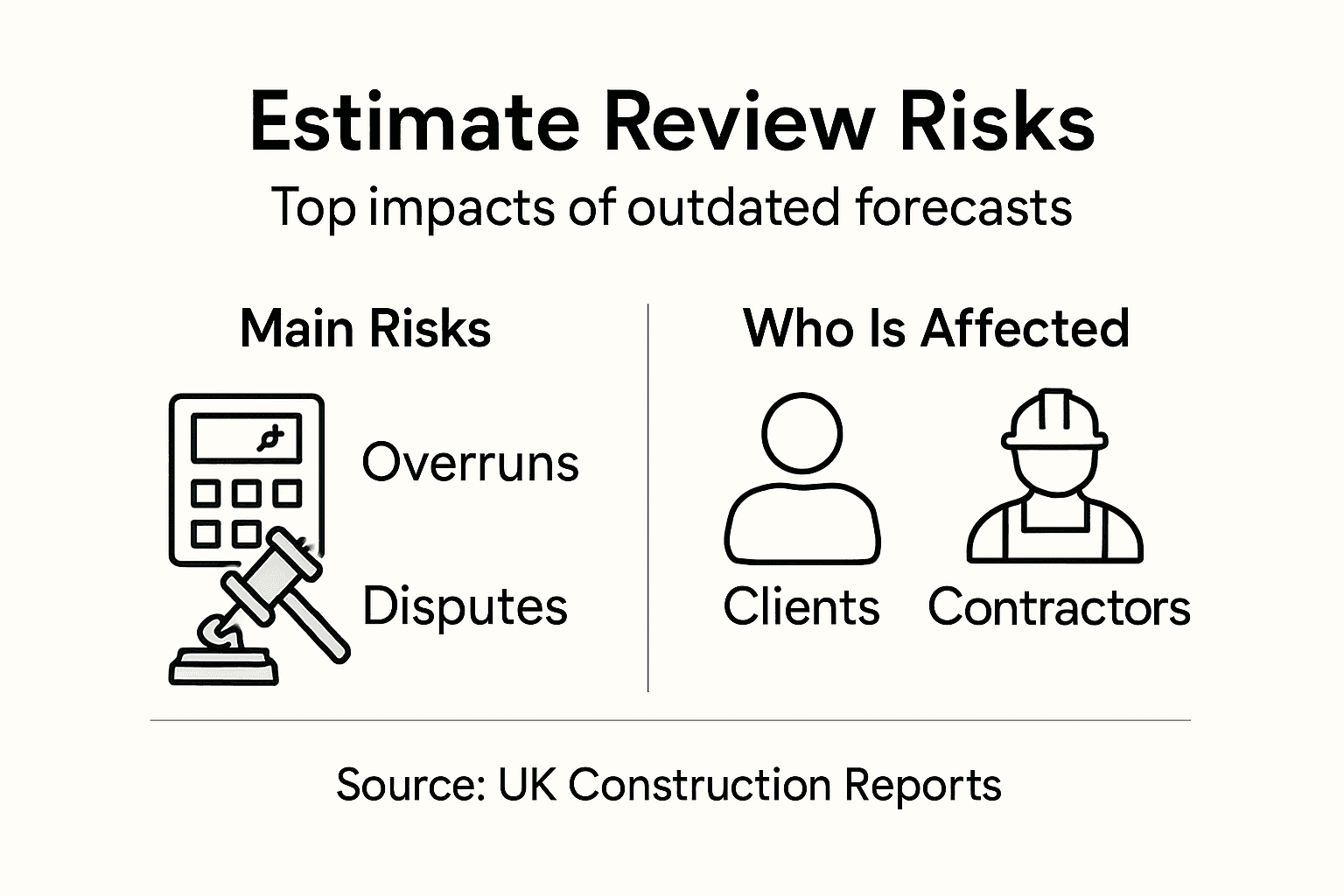
The following table summarises common risks of unreviewed construction estimates and their main impacts:
| Risk Type | Potential Impact | Who Is Affected |
|---|---|---|
| Budget Overruns | Loss of project profitability | Contractors, clients |
| Inaccurate Cost Forecasts | Poor resource allocation | Project managers |
| Outdated Market Assumptions | Contracts and bids become unviable | Developers, stakeholders |
| Regulatory Non-compliance | Legal action and financial penalties | All industry participants |
Pro tip: Implement a quarterly estimate review process that systematically compares initial projections against current market conditions and project progress to identify and address potential financial discrepancies early.
Legal Duties and Client Responsibilities
Legal compliance forms the cornerstone of responsible construction project management in the United Kingdom. Construction Design and Management Regulations establish comprehensive legal frameworks that define precise client responsibilities, ensuring safety, accountability, and professional standards throughout construction projects. These regulations transform client obligations from mere administrative tasks into critical risk management protocols that protect workers, stakeholders, and the broader public.
Commercial clients bear significant legal responsibilities that extend well beyond traditional project management expectations. These duties include meticulously selecting competent design and construction teams, developing robust project communication channels, and maintaining comprehensive documentation of risk assessments and safety protocols. Commercial client obligations mandate proactive engagement in health and safety management, requiring clients to facilitate transparent information sharing, ensure proper project planning, and actively participate in risk mitigation strategies.
The legal landscape surrounding construction projects demands a holistic approach to risk management and regulatory compliance. Clients must navigate complex requirements including appointing competent project dutyholders, ensuring appropriate project notifications, providing comprehensive project information, and maintaining ongoing review processes. Failure to meet these legal obligations can result in significant financial penalties, potential legal actions, and reputational damage that could compromise future business opportunities in the construction sector.
Pro tip: Develop a comprehensive compliance checklist that tracks all legal requirements throughout the project lifecycle to ensure consistent adherence to Construction Design and Management Regulations.
Common Pitfalls During Estimate Reviews
Estimate accuracy requires meticulous attention to detail and a comprehensive understanding of potential systematic failures. Infrastructure project estimation challenges reveal that construction professionals frequently encounter critical pitfalls that can dramatically undermine financial projections. The most significant risk involves relying on overly optimistic assumptions that fail to account for real-world complexity and inherent project uncertainties.
One fundamental mistake during estimate reviews is the tendency to focus exclusively on upfront costs rather than considering whole-life project value. This narrow perspective can lead to short-sighted decision-making that ultimately increases long-term expenses. Professional estimators must critically examine not just initial expenditures, but potential future maintenance costs, potential scope changes, and emerging technological or regulatory requirements that could impact overall project economics.
Cost estimation technique limitations demonstrate that inappropriate estimation methods can introduce substantial inaccuracies. Common errors include misunderstanding estimate maturity, applying unsuitable estimation techniques at different project stages, and underestimating inherent uncertainties. Stakeholders often make the critical mistake of treating early-stage estimates as firm financial commitments, when in reality these initial projections represent preliminary indicators subject to significant potential variation.
Pro tip: Implement a multi-stage review process that systematically cross-references estimates against historical project data, current market conditions, and potential risk factors to minimise projection inaccuracies.
Secure Your UK Construction Budgets with Precise Estimate Reviews
Accurate and regularly reviewed construction estimates are vital to prevent budget overruns and ensure project success in the United Kingdom’s dynamic construction sector. This article highlights the risks of unreviewed or outdated cost forecasts and stresses the importance of meticulous cost planning, risk management, and transparent financial communication. If you are seeking to avoid common pitfalls such as inaccurate cost forecasts or regulatory non-compliance, it is essential to implement thorough review processes that incorporate realistic market data and detailed itemised costs.
At My Project Estimating, we understand these challenges and offer professional construction estimating services tailored for UK projects. Whether you require early-stage cost planning, detailed quantity takeoffs, or comprehensive cost reports, our experienced estimators deliver transparent and accurate estimates within quick turnaround times. Explore our insights and solutions in the Uncategorized Archives – My Project Estimating to enhance your cost forecasting strategies. Start protecting your project budget today by visiting https://myprojectestimating.co.uk and take the next step towards confident financial control in your construction endeavours.
Frequently Asked Questions
What is the purpose of reviewing construction estimates?
Reviewing construction estimates ensures that financial projections remain accurate and reflective of current market conditions. This process helps prevent budget overruns, enables effective resource allocation, and maintains stakeholder confidence throughout the project lifecycle.
How often should construction estimates be reviewed?
Construction estimates should be reviewed regularly throughout the project. Key review points include project initiation, design development phases, and before procurement stages. A quarterly review process is recommended to keep estimates aligned with evolving project dynamics and market conditions.
What are the risks of not reviewing construction estimates?
Failing to review estimates can lead to budget overruns, contract disputes, and financial penalties. Outdated estimates can compromise project viability, stakeholder trust, and overall project success, especially as market conditions change.
What factors should be considered during an estimate review?
During an estimate review, consider market conditions, material price fluctuations, labour costs, design changes, and potential risk factors. A comprehensive review ensures that estimates remain adaptive and realistic, reflecting the dynamic nature of construction projects.