More than sixty percent of British construction projects experience budget overruns without regular cost estimate reviews. As deadlines draw near, unchecked forecasts can derail even the best-planned designs, risking client trust and profit margins. For UK-based architects and builders, mastering the review process means staying ahead of financial surprises and protecting project outcomes with greater accuracy and confidence.
Table of Contents
- What Is a Cost Estimate in Construction?
- Types of Cost Estimates Used in the UK
- Review Process – How and When It Works
- Risks of Unchecked or Outdated Estimates
- Legal Duties and Client Responsibilities
- Avoiding Missteps: Common Review Pitfalls
Key Takeaways
| Point | Details |
|---|---|
| Understanding Cost Estimates | A comprehensive cost estimate is essential for establishing a realistic project budget and understanding all potential expenses. |
| Types of Estimates | Different types of estimates (preliminary, intermediate, definitive) provide varying levels of accuracy depending on project stages. |
| Importance of Reviews | Regular review processes are vital to maintaining financial integrity and adapting to changing project conditions. |
| Legal Responsibilities | Clients in the UK must adhere to legal obligations, ensuring accurate cost estimations and comprehensive risk assessments to avoid potential legal issues. |
What Is a Cost Estimate in Construction?
A cost estimate in construction represents a systematic prediction of the financial resources required to complete a specific building or infrastructure project. This detailed financial projection helps architects, developers, and contractors establish a realistic budget and understand potential expenditure across all project stages. Cost estimation involves predicting quantities and costs of resources needed to transform architectural plans into tangible structures.
At its core, a construction cost estimate breaks down projected expenses into multiple categories, including materials, labour, equipment, permits, and potential contingencies. Professional estimators analyse project blueprints, assess current market prices, evaluate site conditions, and consider complex variables that could impact overall project expenses. These comprehensive calculations provide stakeholders with a realistic financial roadmap, helping prevent unexpected budget overruns and ensuring financial feasibility.
The estimation process typically involves several critical components: quantifying material requirements, calculating labour hours and rates, factoring in equipment and machinery costs, assessing subcontractor pricing, and incorporating overhead expenses. Sophisticated estimation techniques may also include risk assessments and potential fluctuation margins to provide a more robust financial projection. By creating a detailed and accurate cost estimate, construction professionals can make informed decisions, secure appropriate financing, and establish clear financial expectations from project inception.
Pro tip: Always include a 10-15% contingency buffer in your initial cost estimates to account for unexpected challenges or market price fluctuations.
Types of Cost Estimates Used in the UK
In the United Kingdom’s construction industry, professionals utilise several distinct types of cost estimates to manage project financial planning effectively. Different cost estimate approaches are strategically selected based on project complexity, risk allocation, and contractual requirements. These estimates provide critical financial frameworks that guide decision-making throughout the construction process.
The primary types of cost estimates used in UK construction include preliminary estimates, intermediate estimates, and definitive estimates. Preliminary estimates are typically generated during the early project conceptual phase, offering a broad overview of potential costs with approximately 30% accuracy. Intermediate estimates provide more refined projections, developed as project details become clearer, usually achieving around 50-70% accuracy. Definitive estimates represent the most precise financial projections, created when comprehensive project details are available and can approach 90-95% accuracy.
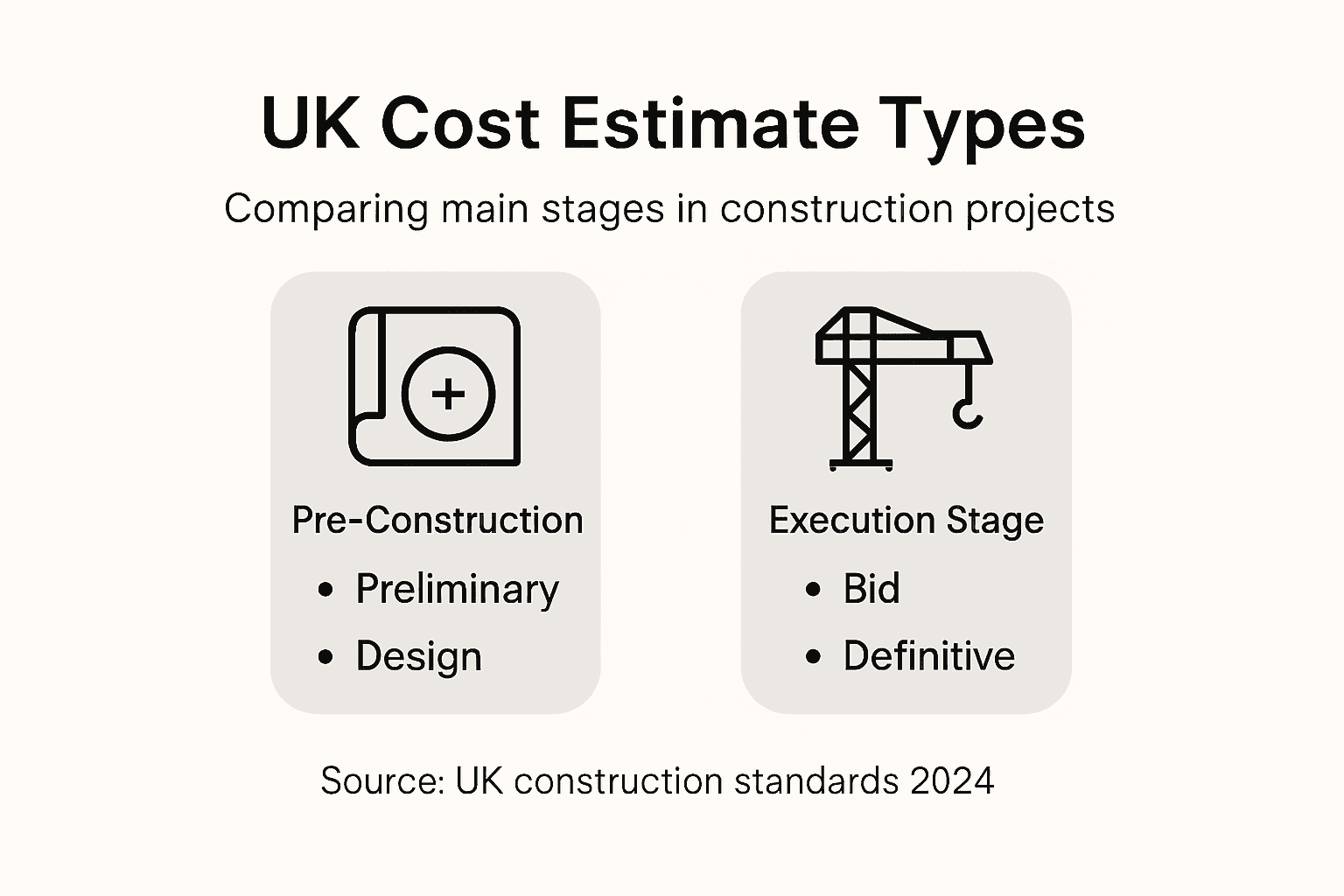
Additionally, UK construction professionals distinguish between specific estimate categories such as design estimates, bid estimates, and control estimates. Design estimates help architects and engineers understand potential financial implications during the planning stage. Bid estimates are crucial for contractors preparing competitive tender proposals, while control estimates enable ongoing financial monitoring and management throughout the project lifecycle. Each estimate type serves a unique purpose, allowing stakeholders to make informed decisions and maintain financial discipline.
Pro tip: Maintain a comprehensive documentation trail for each cost estimate, recording all assumptions, variables, and calculation methodologies to support future project transparency and analysis.
The following table contrasts the main types of cost estimates used in UK construction projects:
| Estimate Type | Typical Accuracy | Common Project Stage | Main Use Case |
|---|---|---|---|
| Preliminary Estimate | Approx. ±30% | Conceptual/Early Phase | Early feasibility assessment |
| Intermediate Estimate | ±15% to ±30% | Design Development | Refined budgeting decisions |
| Definitive Estimate | ±5% to ±10% | Tender/Contract Award | Final cost planning |
| Control Estimate | Within approved margin | Project Execution/Ongoing | Financial monitoring |
Review Process – How and When It Works
The cost estimate review process is a critical mechanism for maintaining financial integrity throughout construction projects in the United Kingdom. Construction adjudication provides timely dispute resolution mechanisms that help stakeholders address potential budget discrepancies quickly and effectively. This systematic approach ensures that financial projections remain accurate and aligned with project objectives.
Typically, the review process involves multiple stages of scrutiny across different project phases. Initial reviews occur during the preliminary estimate stage, where project teams critically examine initial cost projections for potential inaccuracies or unrealistic assumptions. Intermediate reviews happen as more project details emerge, allowing for refinement of cost estimates. Critical review points include pre-tender stages, contract award periods, and significant project milestones where financial reassessment becomes crucial. These reviews enable proactive identification of potential budget risks, providing opportunities to adjust financial strategies before minor discrepancies escalate into substantial financial challenges.
Professional construction teams in the UK employ structured methodologies to conduct comprehensive cost estimate reviews. These typically involve cross-functional assessments where quantity surveyors, project managers, and financial experts collaborate to validate cost projections. Key review components include comparing initial estimates against current market rates, assessing material and labour cost fluctuations, evaluating potential risk factors, and benchmarking against similar completed projects. By implementing rigorous review processes, construction professionals can significantly reduce the likelihood of unexpected budget overruns and maintain financial predictability throughout project lifecycles.
Pro tip: Implement a standardised checklist for cost estimate reviews, ensuring consistent evaluation across all project stages and minimising the potential for overlooked financial discrepancies.
Risks of Unchecked or Outdated Estimates
Unchecked and outdated cost estimates pose significant financial risks for construction projects across the United Kingdom. Construction project disputes frequently arise from inadequate financial planning and poor estimate management. These risks can transform seemingly manageable projects into potential financial catastrophes, threatening the entire project’s viability and stakeholder relationships.
The primary risks associated with unchecked estimates include substantial budget overruns, delayed project timelines, and potential legal disputes. When initial cost projections remain unreviewed, they quickly become disconnected from real-world market conditions. Material price fluctuations, labour market changes, and unexpected regulatory requirements can rapidly render original estimates obsolete. Financial discrepancies can accumulate silently, creating compounding problems that become exponentially more challenging to rectify as the project progresses. Construction professionals might find themselves facing significant unexpected expenses, potentially compromising project completion or requiring desperate cost-cutting measures that impact overall quality.
Moreover, unchecked estimates expose projects to broader operational and safety risks. Ongoing risk management remains critical for maintaining project integrity and financial predictability. Inaccurate financial projections can lead to inadequate resource allocation, potentially compromising worker safety, project quality, and regulatory compliance. The cascading effects of poor estimate management can include reduced contractor confidence, increased insurance costs, potential litigation, and long-term reputational damage for project managers and construction firms.
Pro tip: Develop a quarterly cost estimate review protocol that incorporates current market data, tracks potential variations, and establishes clear escalation procedures for significant financial discrepancies.
Legal Duties and Client Responsibilities
In the United Kingdom, construction project clients bear significant legal responsibilities that extend far beyond simple project initiation. Construction design and management regulations impose comprehensive obligations to ensure projects are planned, executed, and managed with rigorous safety and financial standards. These legal requirements mandate proactive engagement throughout the project lifecycle, compelling clients to take an active role in cost estimation, risk management, and overall project governance.
Under the Construction (Design and Management) Regulations 2015 (CDM 2015), clients must demonstrate due diligence in several critical areas. Key legal responsibilities include conducting thorough risk assessments, ensuring accurate cost estimations, maintaining transparent communication with contractors, and implementing robust financial monitoring systems. Clients are legally required to provide comprehensive project information, identify potential hazards, and establish clear protocols for managing financial and safety risks. Failure to meet these obligations can result in significant legal repercussions, including potential fines, project delays, and personal liability for negligence.
Legal cost recovery frameworks further underscore the importance of meticulous financial management in construction projects. Clients must navigate complex legal landscapes that govern cost disputes, contractual obligations, and potential litigation scenarios. This requires maintaining detailed documentation, implementing transparent cost review processes, and establishing clear contractual mechanisms for addressing financial discrepancies. Professional clients must understand that their legal responsibilities extend beyond mere project completion, encompassing ongoing financial accountability and risk mitigation strategies.
Pro tip: Engage a specialised construction legal consultant to review your project’s cost estimation and risk management protocols, ensuring comprehensive compliance with current UK regulatory requirements.
Below is a summary of key legal duties of UK construction clients and their practical importance:
| Legal Duty | Practical Impact | Risk if Neglected |
|---|---|---|
| Ensure accurate cost estimation | Reduces chance of budget overruns | Project delays and extra costs |
| Conduct risk assessments | Safeguards project and worker safety | Legal action and fines |
| Maintain transparent documentation | Enables dispute defence and auditing | Poor accountability, legal issues |
| Establish financial review protocols | Flags issues quickly for resolution | Escalating disputes and claims |
Avoiding Missteps: Common Review Pitfalls
Construction cost estimate reviews are fraught with potential errors that can significantly compromise project financial integrity. The most prevalent missteps often emerge from seemingly minor oversights that can cascade into substantial financial risks. Understanding these common pitfalls is crucial for UK construction professionals seeking to maintain robust and accurate project budgeting.
One of the most critical errors involves inadequate data verification and reliance on outdated or incomplete information sources. Many project teams fall into the trap of using historical pricing data without considering current market fluctuations, material cost changes, and regional economic variations. This approach can lead to wildly inaccurate estimates that diverge dramatically from actual project costs. Additional common missteps include insufficient contingency planning, poor communication between stakeholders, and a failure to incorporate comprehensive risk assessments that account for potential unexpected challenges.
Strategic initiative review processes highlight the importance of disciplined pre-commitment checks and transparent decision-making. Construction professionals frequently encounter pitfalls such as confirmation bias, where they unconsciously seek information that confirms existing beliefs rather than objectively evaluating cost projections. Other significant missteps include neglecting to consult multiple expert perspectives, failing to benchmark against similar projects, and inadequately documenting the rationale behind cost estimate assumptions. These errors can create substantial financial vulnerabilities that compromise project viability and stakeholder confidence.
Pro tip: Implement a mandatory peer review process where at least two independent experts critically examine cost estimates, challenging assumptions and identifying potential blind spots before final approval.
Secure Your UK Project Budget with Expert Cost Estimate Reviews
The article highlights how unchecked or outdated cost estimates can lead to serious budget overruns, project delays, and legal risks in UK construction projects. Managing these risks requires accurate financial forecasts and continuous review processes to keep projects on track. If you are overwhelmed by fluctuating material prices or uncertain labour costs, precise and transparent cost planning is essential to safeguard your investments.
At My Project Estimating, we specialise in delivering detailed and verified UK market-based cost estimates that support effective financial decision-making from the earliest design phases through to project execution. Our tailored services, including cost planning and comprehensive quantity takeoffs, help architects, builders, developers, and homeowners minimise financial surprises and maintain full control over their budgets. Discover how our quick turnaround times and transparent pricing can empower you to avoid common pitfalls by visiting our Uncategorized Archives or explore our main page for full service details. Take action now to build your project on a foundation of accuracy and confidence.
Frequently Asked Questions
What is the importance of reviewing cost estimates in construction projects?
Reviewing cost estimates is crucial for maintaining financial integrity and preventing budget overruns throughout the construction process. It allows for the early identification of discrepancies, ensuring that project costs remain aligned with actual market conditions.
What are the key steps involved in the cost estimate review process?
The review process typically includes verifying initial estimates, refining projections as project details emerge, and conducting assessments at critical milestones to identify budget risks and adjust financial strategies as needed.
How can outdated cost estimates impact construction projects?
Outdated cost estimates can lead to significant budget overruns, delays in project timelines, and potential legal disputes. They can create financial discrepancies that escalate over time, jeopardising the success and viability of the project.
What common pitfalls should be avoided during the cost estimate review?
Common pitfalls include inadequate data verification, reliance on outdated information, insufficient contingency planning, and poor communication among stakeholders. Neglecting to consult multiple expert perspectives can also lead to significant financial vulnerabilities.
Recommended
- Cost Planning Guide UK for Accurate Project Budgets
- 7 Top Construction Budgeting Tips for UK Project Managers
- 7 Essential Steps for a Construction Budget Checklist UK – My Project Estimating
- Master the Construction Project Budgeting Workflow for Success
- Hva påvirker byggekostnader – Slik planlegger du smart – Huvila Seppälä
- Timelapse e controllo budget: efficienza nei cantieri