Most british construction projects risk significant budget overruns without robust cost planning tools. For project managers and quantity surveyors, accurate documentation and reliable market data are essential to meet United Kingdom regulations and client expectations. This guide reveals practical steps and professional tips that help you create clear, compliant budgets while reducing financial uncertainty for every stage of your project.
Table of Contents
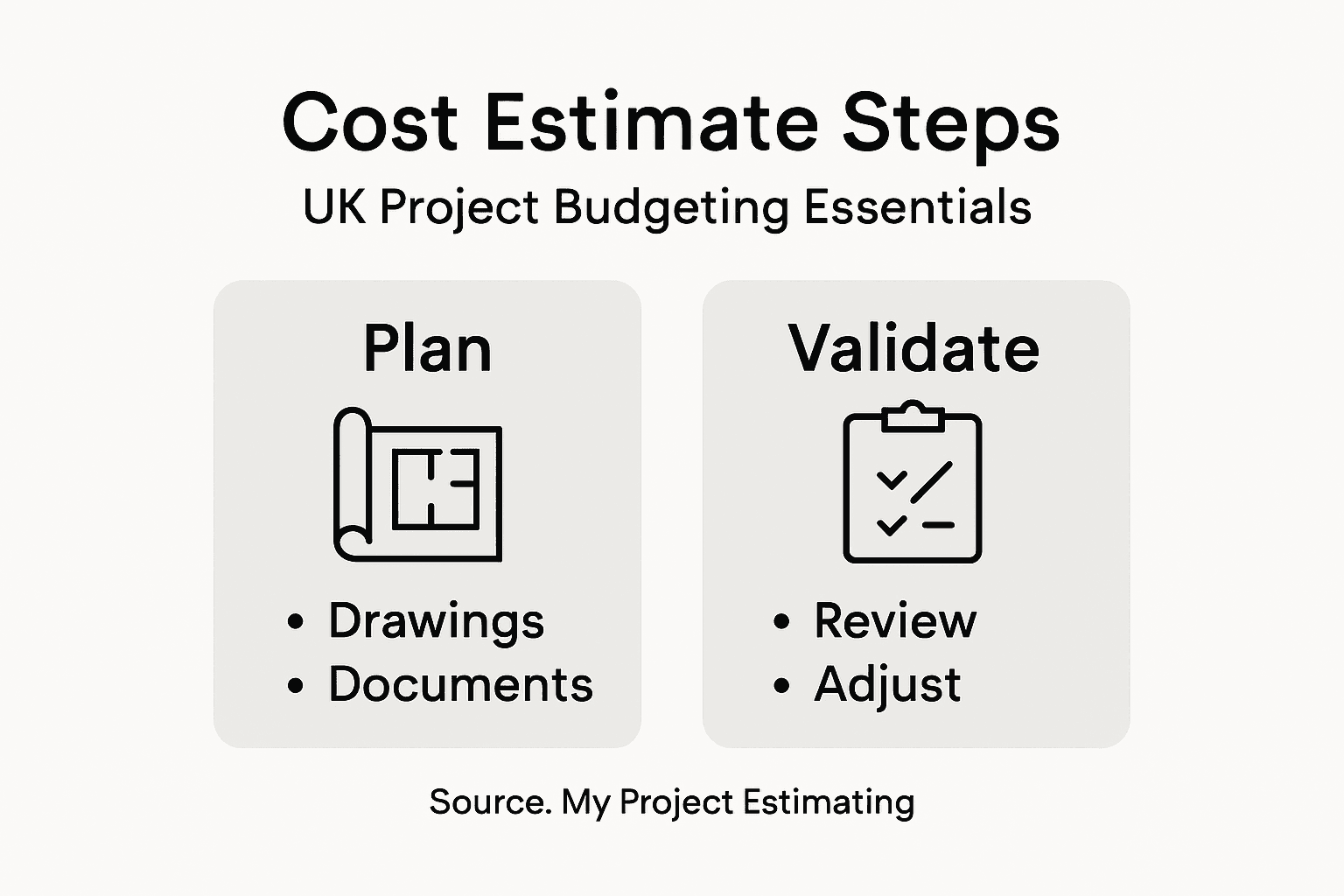
- Step 1: Prepare Essential Project Drawings And Documentation
- Step 2: Gather Verified UK Market Costs And Rates
- Step 3: Develop A Transparent Cost Estimate For Your Project
- Step 4: Review And Validate Your Budget With Stakeholders
- Step 5: Deliver Professional Cost Reports In Your Chosen Format
Quick Summary
| Key Insight | Explanation |
|---|---|
| 1. Prepare Detailed Drawings | Comprehensive architectural drawings are vital for clear communication among all project stakeholders. |
| 2. Research Accurate Costs | Gathering verified market rates ensures your budget reflects realistic construction expenses. |
| 3. Develop Transparent Estimates | A detailed cost estimate provides insight into expected expenses and financial risks for stakeholders. |
| 4. Engage Stakeholders in Budgeting | Collaborating with stakeholders during budget reviews fosters transparency and shared financial responsibility. |
| 5. Deliver Professional Reports | Clear and professional cost reports enable stakeholders to easily understand the project’s financial status. |
Step 1: Prepare essential project drawings and documentation
Preparing comprehensive project drawings and documentation is fundamental for successful construction planning. Your drawings will serve as the blueprint for every subsequent stage of the project, communicating precise technical details to contractors, architects, and stakeholders.
To begin, gather all initial project specifications and create detailed architectural drawings that capture both internal and external project components. These drawings should include floor plans, elevations, sections, and comprehensive schedules. Professional architects typically use Computer Aided Design (CAD) systems to produce accurate graphical representations to scale, ensuring clarity and precision. When developing your drawings, focus on including measurements, material specifications, structural details, and any unique design elements that contractors will need to understand your vision completely.
Ensure all documentation follows standard UK construction conventions, includes clear annotations, and provides unambiguous instructions. Double check every drawing for consistency, completeness, and accuracy before submission.
Practical Tip: Always maintain digital and physical backup copies of your project drawings to prevent potential loss or damage during the construction process.
Step 2: Gather verified UK market costs and rates
Accurate cost planning requires comprehensive research into current market rates and pricing trends specific to the UK construction industry. Your goal is to collect reliable data that reflects real world construction expenses across different project types and regions.

Begin by leveraging comprehensive research databases to access the most recent market cost information. These resources provide detailed insights into current material prices, labour rates, equipment costs, and regional variations across the United Kingdom. Look for specialised construction cost databases that break down expenses by project type residential, commercial, industrial and provide granular details on everything from raw material pricing to specialist labour charges. Pay special attention to regional differences market rates can fluctuate significantly between London metropolitan areas and rural regions.
Cross reference multiple sources to validate your cost data and create a robust pricing model. Consider consulting recent industry reports, professional quantity surveyor associations, and government construction cost indices to triangulate your market research. Ensure you are using the most recent data available documenting the date of your sources and updating your cost references regularly.
Practical Tip: Subscribe to industry publications and professional networks that provide real time updates on construction market rates to maintain the most current pricing information.
Step 3: Develop a transparent cost estimate for your project
Creating a transparent cost estimate is crucial for successful project planning, ensuring all stakeholders understand the financial framework and potential variations in your construction budget. Your estimate must provide clear, detailed insights into expected expenses and potential risks.
Begin by adopting comprehensive estimating methodologies that allow for multiple evaluation approaches. Professional estimators typically use techniques like top-down, bottom-up, analogy, and parametric methods to build a robust financial model. Break down your project into discrete components, calculating costs for materials, labour, equipment, and overhead expenses with meticulous attention to detail. Include precise documentation that explains the rationale behind each cost projection, highlighting assumptions, potential variables, and risk factors that might impact your final budget.
Integrate contingency allowances and risk assessments into your estimate to provide a transparent view of potential financial fluctuations. Consider regional variations, current market rates, and potential economic factors that could influence project costs. Collaborate with quantity surveyors and industry professionals to validate your estimates and ensure comprehensive coverage of potential expenses.
Practical Tip: Maintain a detailed audit trail for each cost estimate, recording all calculations and assumptions to demonstrate transparency and support future financial decision making.
Here is a comparison of common cost estimating methodologies used in UK construction projects:
| Methodology | Description | Typical Use Case | Accuracy Level |
|---|---|---|---|
| Top-down | Estimation based on overall project | Early budgeting, feasibility | Moderate |
| Bottom-up | Detailed cost by each component | Final budgeting, tendering | Very high |
| Parametric | Uses statistical cost relationships | Complex/build projects, modelling | High |
| Analogy | Reference to similar past projects | Preliminary planning, benchmarking | Low to moderate |
Step 4: Review and validate your budget with stakeholders
Successful project budgeting requires collaborative engagement with all key stakeholders to ensure comprehensive understanding and agreement on financial parameters. Your goal is to create a transparent and mutually accepted budget that aligns with everyone’s expectations and project objectives.
Begin by implementing strategic stakeholder engagement techniques that foster open communication and trust. Invite key stakeholders including project managers, financial controllers, architects, and client representatives to a detailed budget review session. Prepare comprehensive documentation that breaks down each cost element, explaining the rationale behind individual line items and highlighting potential risk factors. Present your budget estimate with clear visualisations, graphs, and narrative explanations that make complex financial information accessible and understandable to all participants.
Encourage active dialogue during the review process, allowing stakeholders to ask questions, challenge assumptions, and provide additional insights that might refine your cost estimates. Be prepared to make adjustments based on expert input, while maintaining the overall financial integrity of the project. Document all discussions, feedback, and agreed modifications to create a transparent audit trail that demonstrates collaborative decision making and shared financial responsibility.
Practical Tip: Schedule follow up review sessions at key project milestones to ensure ongoing budget alignment and maintain transparent communication with all stakeholders.
Step 5: Deliver professional cost reports in your chosen format
Preparing and delivering comprehensive cost reports is a critical final step in your project budgeting process. Your report must communicate complex financial information clearly and professionally to ensure stakeholders can easily understand the project’s financial landscape.
Design your report with best practice reporting principles that emphasise transparency and clarity. Choose a format that suits your stakeholders requirements whether that is a detailed spreadsheet, graphical presentation, or narrative financial summary. Include essential components such as total project costs, breakdown of expense categories, risk assessments, contingency allocations, and comparative analyses. Use visual elements like charts, graphs, and infographics to make financial data more digestible, ensuring each graphic provides meaningful insight into the project’s financial structure.
Tailor your report’s complexity to your audience. For technical stakeholders, provide granular financial details with precise calculations. For executive level reviews, focus on high level summaries that highlight key financial indicators, potential risks, and overall project financial health. Include an executive summary that captures the most critical financial insights in a concise, compelling narrative.
Practical Tip: Always include a version control and date stamp on your financial reports to ensure stakeholders are referencing the most recent and accurate financial information.
Below is a summary of essential components to include in a professional UK construction cost report:
| Component | Purpose | Business Impact |
|---|---|---|
| Total Project Cost | Summarises entire project budget | Enables informed decisions |
| Expense Category Breakdown | Identifies detailed cost areas | Highlights major cost drivers |
| Risk Assessment | Evaluates potential project risks | Supports risk mitigation |
| Contingency Allowances | Accounts for financial uncertainties | Protects against cost overruns |
Streamline Your UK Construction Cost Planning with Expert Support
Accurately forecasting construction budgets is a challenge faced by many UK architects, builders, and developers. This detailed Cost Planning Guide UK highlights the importance of transparent cost estimates, verified market data, and collaborative stakeholder review to avoid unexpected expenses and ensure project success. If you find yourself navigating complex project drawings, regional cost variations, and the need for clear financial reporting, it is vital to access reliable and efficient estimating services tailored to the UK market.
At My Project Estimating, our professional team specialises in delivering precise cost planning solutions including quantity takeoffs, Bill of Quantities preparation, and comprehensive cost reports. We understand the pressure to meet tight deadlines which is why our experienced estimators provide transparent estimates with quick turnaround times. Explore how our services can transform your budgeting process by visiting our Uncategorized Archives – My Project Estimating for insights and examples. Take control of your project finances today by starting your detailed cost estimate with us at My Project Estimating. Your next project deserves clarity and confidence in budgeting.
Frequently Asked Questions
How can I prepare essential project drawings for accurate budgeting?
To prepare essential project drawings, gather all initial project specifications and create detailed architectural drawings. Include components like floor plans, elevations, and measurements, and ensure all documentation follows standard UK construction conventions.
What are the best methods for gathering verified UK market costs?
To gather verified UK market costs, leverage comprehensive research databases to access current material prices, labour rates, and equipment costs. Cross-reference multiple sources and consult recent industry reports to validate your cost data, ensuring accuracy in your budgeting process.
How do I develop a transparent cost estimate for my project?
Develop a transparent cost estimate by breaking down the project into discrete components and calculating costs for materials, labour, and overhead. Include clear documentation explaining the rationale behind each cost projection, and integrate contingency allowances to account for potential financial fluctuations.
What steps should I take to review and validate my budget with stakeholders?
To review and validate your budget, engage key stakeholders in a detailed budget review session where you present comprehensive documentation of each cost element. Encourage open dialogue to challenge assumptions and adjust estimates based on their input for better alignment with project expectations.
How can I create professional cost reports for my project?
To create professional cost reports, design your report using best practice reporting principles, including essential components like total project costs and risk assessments. Use visual elements such as charts and graphs to present financial information clearly and ensure stakeholders can easily understand the budgetary landscape.
Recommended
- 7 Essential Steps for a Construction Budget Checklist UK – My Project Estimating
- Construction Cost Planning Explained: UK Guide – My Project Estimating
- What Is Cost Planning? Complete UK Construction Guide – My Project Estimating
- Construction Estimating Guide 2025: Accurate UK Cost Plans – My Project Estimating
- The Real Cost of Working with AEC Daily, RedVector & CEU Events – CEU Builder
- Top 7 Construction Lead Generation Platforms – Expert Comparison 2025 – BoxBuild