Every residential project carries more than creative ambition—it places architects at the centre of financial planning and client trust. Budget management shapes how British architects safeguard a project’s viability, navigate regulatory demands, and clarify costs for homeowners. This guide focuses on comprehensive budget oversight as a foundation for accurate cost estimation and transparent communication, offering practical tools to make financial planning as robust and reliable as your architectural designs.
Table of Contents
- Defining Architects’ Role In Budgeting
- Key Budgeting Methods In Residential Design
- Integrating Cost Planning Throughout Project Stages
- Legal And Regulatory Duties For UK Architects
- Managing Client Expectations And Budget Risks
- Avoiding Common Mistakes In Residential Budgeting
Key Takeaways
| Point | Details |
|---|---|
| Architects as Financial Managers | Architects must integrate financial management into their practice, ensuring project designs are economically viable and adhere to budget constraints. |
| Effective Budgeting Methods | Employ varying budgeting techniques such as incremental and zero-based methods to tailor financial strategies to each project’s needs. |
| Collaborative Cost Planning | Engage with quantity surveyors and contractors throughout all stages to refine cost estimates and enhance financial transparency. |
| Client Communication | Maintain clear communication with clients about budgeting, using visual tools to illustrate financial implications of design choices and manage expectations effectively. |
Defining Architects’ Role in Budgeting
Architects play a critical role in financial planning and cost management for residential construction projects. Beyond creative design, they serve as strategic financial architects who translate vision into viable, economically responsible blueprints. Their responsibilities extend far beyond aesthetic considerations, encompassing comprehensive budget oversight and financial risk management.
The Architects Registration Board emphasises that architects must ensure projects are not only visually compelling but financially sustainable. This means developing detailed cost strategies, understanding material pricing dynamics, and creating designs that balance aesthetic aspirations with budgetary constraints. Architects must continuously evaluate design choices against potential financial implications, making strategic compromises that maintain project quality while controlling expenditure.
Successful architectural budgeting involves multiple interconnected skills. Architects must accurately estimate construction costs, anticipate potential overruns, understand market pricing for materials and labour, and develop contingency plans. They act as financial translators, converting complex design concepts into tangible budget projections that clients can understand and investors can support. Their expertise lies in creating holistic financial frameworks that align architectural creativity with economic practicality.
Pro tip: Develop comprehensive spreadsheet templates that allow instant cost tracking and scenario modelling for each design element, enabling real-time financial decision-making throughout the project lifecycle.
Key Budgeting Methods in Residential Design
Architects employ various strategic budgeting methods to ensure financial effectiveness and project success in residential design. Common budgeting approaches range from traditional incremental techniques to more sophisticated value-driven strategies, each offering unique advantages in managing complex architectural projects.

Incremental budgeting represents a conventional method where previous project budgets serve as baseline references, with modest adjustments made to accommodate current project requirements. In contrast, zero-based budgeting demands a more rigorous approach, requiring architects to justify every expense from scratch. This method proves particularly valuable in residential design, where project scopes can dramatically vary between different client specifications and site constraints.
Moreover, residential design budgeting must comprehensively account for multiple cost components. These include design fees, material expenses, labour costs, permit charges, and critical contingency funds. Architects must strategically prioritise spending, leveraging techniques like value engineering to maintain design quality while controlling overall project expenditure. Successful budgeting involves creating flexible financial frameworks that can adapt to unexpected challenges without compromising the project’s fundamental design vision.
Here’s how the main residential budgeting methods compare in effectiveness and approach:
| Method | Approach Summary | Best Use Case | Key Limitation |
|---|---|---|---|
| Incremental Budgeting | Adjusts previous budgets progressively | Established projects with minor updates | May overlook hidden inefficiencies |
| Zero-based Budgeting | Justifies all costs from zero | Unique projects with varying scope | Can be time-consuming |
| Value Engineering | Optimises value for each spend | Design-driven but cost-sensitive work | May require design compromises |
Pro tip: Develop a dynamic budget tracking spreadsheet with colour-coded expense categories and real-time percentage allocation alerts to maintain instant financial visibility throughout the residential design process.
Integrating Cost Planning Throughout Project Stages
Integrating cost planning effectively requires architects to develop a comprehensive, strategic approach that spans the entire residential design project lifecycle. Cost management strategies must be dynamic and adaptable, allowing for continuous financial assessment and refinement from initial concept through final construction.
During the preliminary design stage, architects must conduct thorough initial cost assessments, establishing baseline budgetary parameters that align with client expectations and project constraints. This involves detailed site analysis, preliminary material selections, and comprehensive feasibility studies that provide early insights into potential financial challenges. Architects should create flexible financial models that can accommodate design iterations while maintaining overall budget integrity, using sophisticated cost-tracking mechanisms to monitor potential variations.
As the project progresses through design development and detailed planning stages, cost planning becomes increasingly granular and precise. Architects must collaborate closely with quantity surveyors, contractors, and financial consultants to validate cost projections, identify potential savings opportunities, and develop robust contingency strategies. This collaborative approach ensures that every design decision is evaluated not just for aesthetic and functional merit, but also for its financial implications, creating a holistic approach to residential project development that balances creative vision with fiscal responsibility.
Pro tip: Implement a colour-coded digital dashboard that tracks real-time budget allocations across design stages, enabling instant visual comprehension of financial progress and potential risk areas.
Legal and Regulatory Duties for UK Architects
UK architects operate within a complex legal framework that demands rigorous compliance with national building regulations and professional standards. Building regulations impose strict requirements on residential design, mandating architects ensure comprehensive safety, accessibility, sustainability, and structural integrity across every project they undertake.
The Architects Registration Board’s Code of Conduct establishes critical professional standards that govern architects’ legal and ethical responsibilities. These standards extend beyond mere technical compliance, requiring architects to demonstrate honesty, professional competence, and transparent communication throughout project development. Specifically, architects must maintain meticulous documentation, provide accurate cost estimations, and ensure all design proposals meet current building safety legislation, particularly for residential structures classified as higher-risk buildings.
Legal obligations encompass multiple dimensions of professional practice, including maintaining professional indemnity insurance, adhering to contractual commitments, and protecting client interests through comprehensive risk management. Architects must continuously update their knowledge of evolving building regulations, demonstrate professional competence through ongoing training, and proactively manage potential legal risks associated with design decisions. This requires a holistic approach that balances creative design aspirations with strict regulatory compliance, ensuring every residential project meets the highest standards of safety, functionality, and legal accountability.
Pro tip: Develop a comprehensive compliance checklist that maps design elements against current building regulations, enabling systematic verification of legal requirements throughout the project lifecycle.
Managing Client Expectations and Budget Risks
Successful architectural practice hinges on effectively managing client expectations and navigating potential budget risks through proactive communication and strategic planning. Managing client expectations requires architects to establish transparent, realistic frameworks that align creative vision with financial constraints, preventing potential disputes and project complications.
Architects must deploy sophisticated communication strategies that transform complex financial information into digestible insights for clients. This involves utilising visual tools like detailed 3D models, comprehensive cost breakdowns, and scenario-based projections that help clients understand the intricate relationship between design choices and budgetary implications. By educating clients about budget constraints, architects can preemptively address potential misunderstandings, demonstrating how design modifications impact overall project economics.
Implementing structured change management protocols is crucial for mitigating budget risks. Architects should develop clear documentation processes that track design iterations, cost implications, and client approvals. This systematic approach enables real-time budget tracking, facilitates informed decision-making, and creates a transparent audit trail that protects both the architectural practice and the client’s interests. By establishing these robust communication channels, architects can transform potential budget conflicts into collaborative problem-solving opportunities.
Pro tip: Create a standardised client communication template with predefined budget variance thresholds, enabling immediate, structured discussions when financial projections deviate from initial estimates.
Avoiding Common Mistakes in Residential Budgeting
Residential budgeting requires meticulous attention to detail and strategic financial planning to prevent costly errors that can derail entire projects. Common budget mistakes often stem from inadequate early-stage planning, unrealistic expectations, and failure to anticipate comprehensive project expenses beyond basic construction costs.
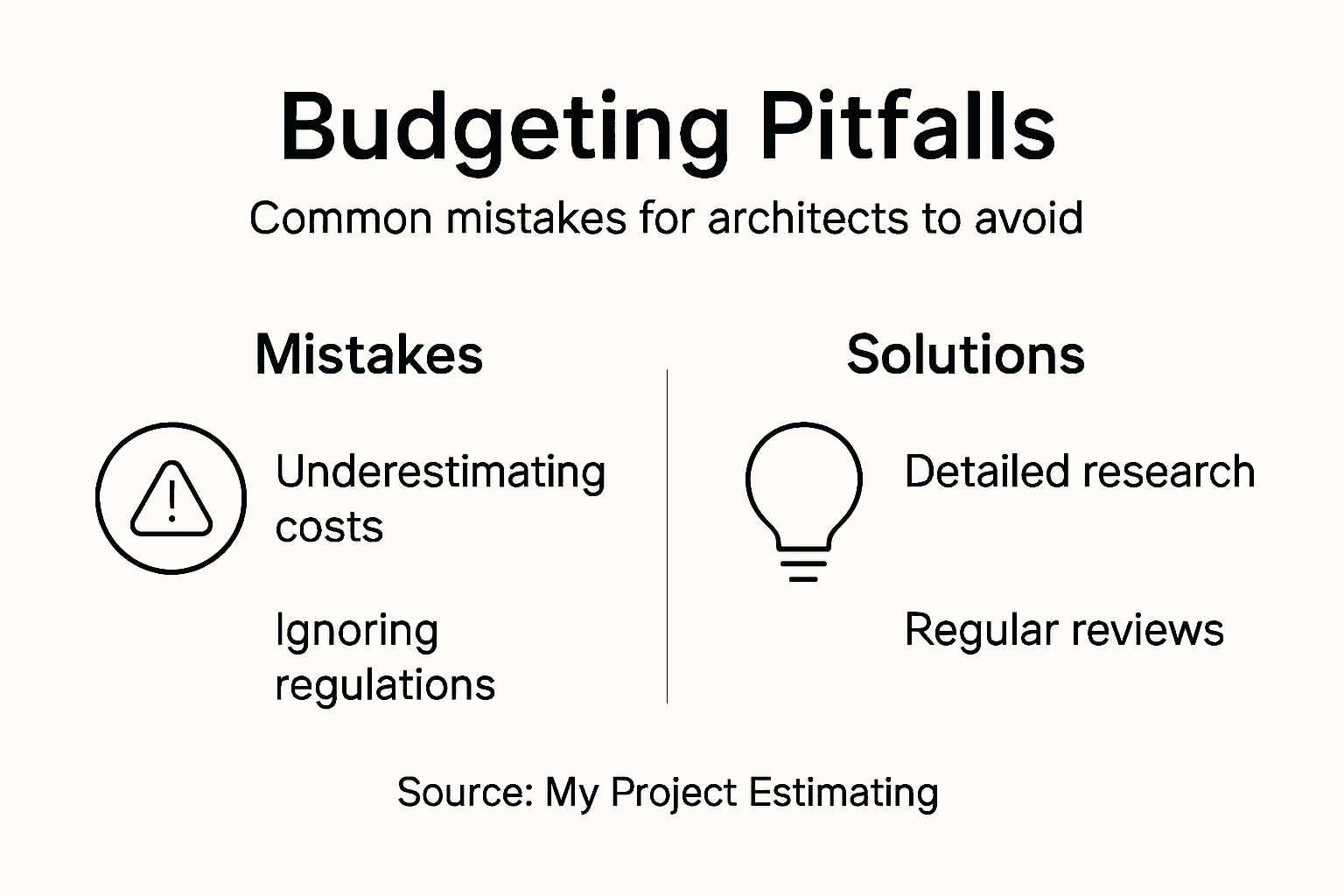
Architects must be vigilant about identifying and mitigating potential financial pitfalls throughout the design process. Unexpected expenses and hidden costs can include professional fees, VAT, groundworks, permit charges, and essential maintenance considerations that are frequently overlooked. Comprehensive budget strategies involve developing robust contingency funds, typically ranging between 10-20% of the total project budget, to provide financial resilience against unforeseen circumstances and design modifications.
Successful budget management demands a holistic approach that integrates thorough research, transparent communication, and proactive financial tracking. Architects should implement detailed documentation processes, use sophisticated cost-tracking tools, and maintain open dialogues with clients about potential budget variations. This approach helps prevent scope creep, manages client expectations, and ensures that design aspirations remain aligned with financial realities throughout the project lifecycle.
Below is a summary of frequent residential budgeting mistakes and their consequences:
| Common Mistake | Resulting Issue | Prevention Strategy |
|---|---|---|
| Inadequate cost research | Underestimated project expenditure | Conduct thorough early investigation |
| Overlooking hidden expenses | Budget overruns or delays | Include all fees and regulatory charges |
| Poor contingency planning | No resilience to surprises | Allocate 10-20% contingency fund |
| Weak change documentation | Scope creep and disputes | Track design changes and approvals |
Pro tip: Create a comprehensive financial dashboard that tracks real-time budget allocations, generates automated variance alerts, and provides visual representations of potential cost impacts for each design decision.
Empower Your Residential Projects with Expert Budgeting Support
The challenge architects face in aligning creative design with precise budgeting is complex yet critical. From managing cost risks to integrating detailed cost planning at every project stage, architects must navigate multiple financial pressures while keeping client expectations realistic. This article highlights the need for accurate cost estimates, transparent budgeting methods like zero-based budgeting or value engineering, and ongoing budget tracking to avoid common pitfalls in residential design.
At My Project Estimating, we understand these challenges and offer tailored solutions designed to support architects throughout your budgeting journey. With UK-specific data and quick turnaround times, our detailed cost plans and quantity takeoffs help you balance design ambition with strict financial controls. Explore how our services can help you implement effective budgeting methods and maintain seamless communication with clients by browsing our Uncategorized Archives for insightful resources related to your needs.
Take control of your residential project budgets today. Visit My Project Estimating to access professional cost planning tools that empower you to make informed decisions, reduce financial risks, and keep your projects on track from concept to completion.
Frequently Asked Questions
What is the role of architects in budgeting for residential projects?
Architects play a crucial role in budgeting by developing detailed cost strategies, understanding material pricing dynamics, and creating designs that balance aesthetics with budget constraints. They also estimate construction costs and manage financial risks throughout the project’s lifecycle.
What are the common budgeting methods used in residential design?
Architects commonly use methods like incremental budgeting, which is based on previous budgets, zero-based budgeting, which justifies all costs from scratch, and value engineering, which optimises value for each spend while maintaining design quality.
How can architects effectively manage client expectations regarding budget?
Architects can manage client expectations by establishing transparent communication, utilising visual tools like 3D models, and providing detailed cost breakdowns that illustrate how design choices impact the budget. Regular updates and structured change management protocols also help mitigate risks.
What are some common mistakes architects should avoid in residential budgeting?
Common mistakes include inadequate cost research, overlooking hidden expenses, poor contingency planning, and weak change documentation. These can lead to budget overruns and project delays; hence, thorough planning and tracking are essential.