Over 80 percent of british residential projects experience cost changes before completion. Managing budgets in this environment can feel overwhelming, especially as evolving regulations and economic shifts impact every decision. Understanding residential cost planning is vital for anyone involved in UK property development, offering practical strategies to keep expenditures under control and reduce unexpected financial surprises throughout a project’s lifecycle.
Table of Contents
- Defining Residential Cost Planning In The UK Context
- Key Stages And Processes In Cost Planning
- Popular Estimating Methods And Tools
- Risks, Pitfalls, And Cost Overruns To Avoid
- Impact Of UK Standards And Regulations
Key Takeaways
| Point | Details |
|---|---|
| Importance of Residential Cost Planning | Strategic financial management is essential for successfully navigating property development projects in the UK. |
| Key Stages in Cost Planning | A structured approach includes preliminary assessments, ongoing monitoring, and final reconciliations to ensure financial viability. |
| Estimating Methods and Tools | Utilising modern computational techniques enhances accuracy in financial projections and reduces errors in cost estimation. |
| Navigating Regulatory Challenges | Understanding and proactively planning for compliance with UK regulations is crucial to avoid unexpected costs and project delays. |
Defining Residential Cost Planning in the UK Context
Residential cost planning represents a strategic financial approach critical for successful property development projects. At its core, this process involves comprehensive financial forecasting and systematic budgetary management specifically tailored to residential construction initiatives. Cost management techniques enable developers and homeowners to anticipate, track, and control expenditures throughout a project’s lifecycle.
The fundamental objective of residential cost planning centres on establishing precise financial parameters that balance project aspirations with economic realities. By meticulously analysing potential expenses, from initial design stages through completion, professionals can create robust financial frameworks that minimise unexpected monetary challenges. Strategic cost planning processes typically involve detailed assessments that consider multiple variables such as material costs, labour expenses, regulatory compliance requirements, and potential contingency provisions.
Within the United Kingdom’s construction landscape, residential cost planning has evolved into a sophisticated discipline requiring specialised expertise. Practitioners must navigate complex regulatory environments, understand localised market dynamics, and implement granular financial tracking mechanisms. Key components of effective residential cost planning include:
- Comprehensive initial budget development
- Ongoing financial performance monitoring
- Risk assessment and mitigation strategies
- Regular cost variance analysis
- Precise documentation of financial projections
Successful implementation demands a multidisciplinary approach, integrating insights from quantity surveyors, architects, financial analysts, and project managers to create holistic, accurate financial roadmaps for residential development projects.
Key Stages and Processes in Cost Planning
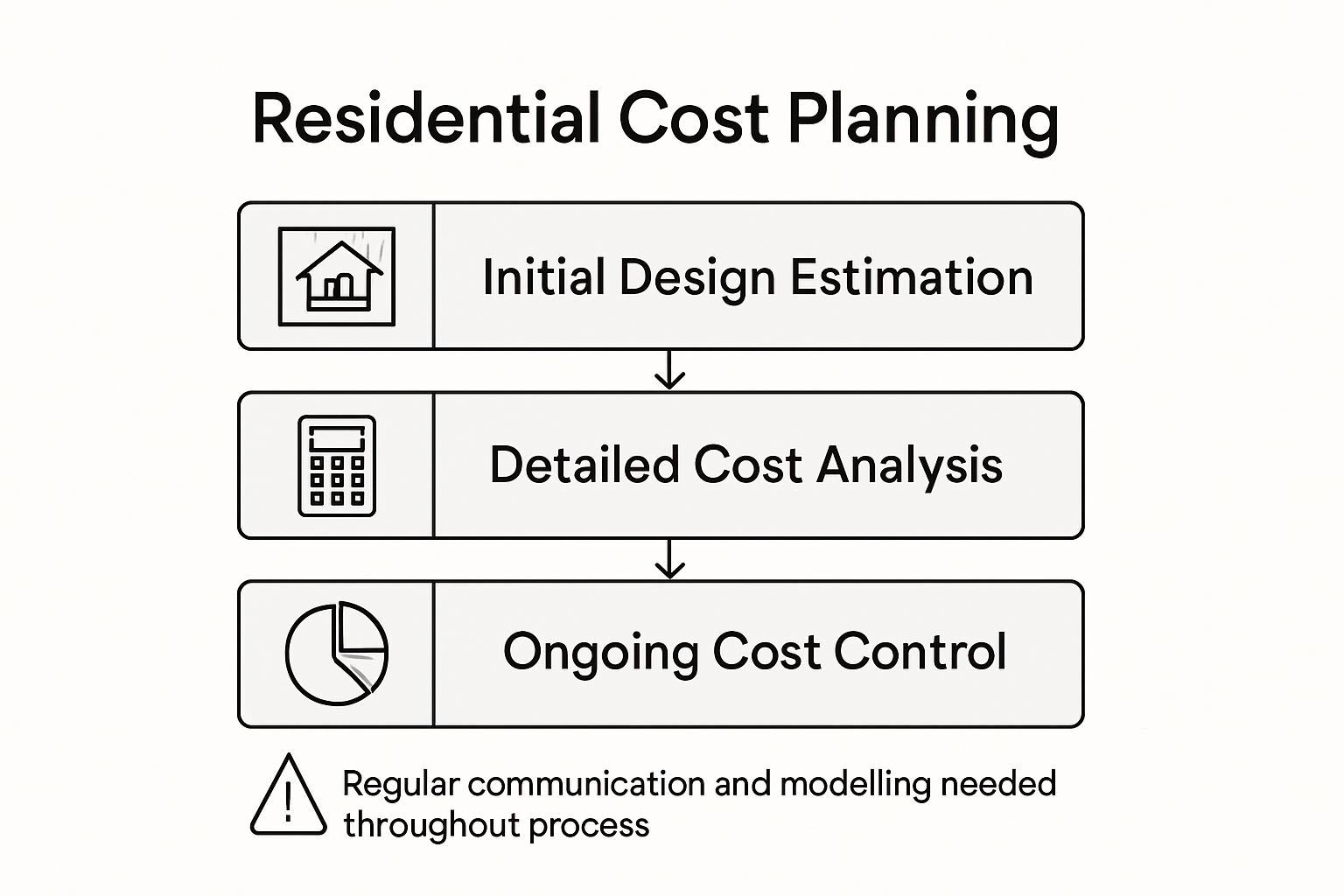
Residential cost planning unfolds through a structured sequence of intricate stages designed to transform architectural vision into financially viable projects. Comprehensive cost management processes typically commence during the earliest conceptual design phases, where initial financial frameworks are established. These preliminary assessments involve detailed economic modelling that considers material specifications, projected labour expenses, and potential regulatory compliance requirements.

The cost planning journey encompasses multiple interconnected stages that demand meticulous attention to financial details. Construction cost breakdown workflows facilitate systematic financial tracking, enabling developers to create granular expense projections. According to research from E3S Web of Conferences, the cost management process comprises interconnected procedures including precise cost estimation, strategic planning, and continuous financial control mechanisms that align closely with project delivery phases.
Key stages in residential cost planning generally include:
- Preliminary Cost Assessment
- Initial project scope definition
- Rough budget estimation
- High-level financial feasibility analysis
- Detailed Design Cost Planning
- Comprehensive expense breakdown
- Material and labour cost projections
- Specific design element costings
- Ongoing Cost Monitoring
- Regular financial performance tracking
- Variance analysis
- Budget adjustment strategies
- Final Cost Reconciliation
- Complete project expense evaluation
- Comparative analysis with initial projections
- Lessons learned documentation
Successful implementation requires sophisticated financial modelling, continuous communication between stakeholders, and adaptive strategies that respond dynamically to emerging project complexities.
Popular Estimating Methods and Tools
Residential cost estimation has evolved significantly, with modern practitioners leveraging sophisticated computational techniques to generate precise financial projections. Construction estimating best practices have transformed traditional manual calculation methods into data-driven, technology-enabled approaches that minimise human error and enhance predictive accuracy.
Professional estimators employ a diverse range of methodological approaches to residential project costing. When calculating potential construction expenses, professionals typically utilise methods such as area and parametric estimating, which allow for nuanced financial modelling based on specific project characteristics. Professional estimating tools enable detailed cost breakdowns that consider complex variables like material specifications, labour rates, regional price variations, and potential regulatory compliance expenses.
Key estimating methods in residential cost planning include:
-
Elemental Cost Analysis
- Breakdown of costs by building elements
- Precise tracking of individual component expenses
- Enables granular financial understanding
-
Comparative Cost Estimating
- Benchmarking against similar completed projects
- Utilises historical pricing data
- Accounts for regional and market variations
-
Parametric Estimating
- Mathematical modelling of cost relationships
- Uses statistical correlations
- Predicts expenses based on project parameters
-
Probabilistic Estimating
- Incorporates risk and uncertainty
- Generates multiple potential cost scenarios
- Provides range-based financial projections
Advanced digital tools now enable real-time cost tracking, allowing developers to maintain financial control throughout project lifecycles. These sophisticated platforms integrate machine learning algorithms, enabling more accurate and dynamic cost predictions that adapt to changing market conditions.
Risks, Pitfalls, and Cost Overruns to Avoid
Residential construction projects frequently encounter significant financial challenges that can dramatically undermine project profitability and feasibility. Cost forecasting techniques have become increasingly critical in identifying and mitigating potential financial risks before they escalate into substantial budgetary problems.
The United Kingdom’s complex regulatory landscape presents unique challenges for residential development projects. Research highlights how restrictive planning systems contribute to housing market complexities that can trigger unexpected cost overruns. These systemic constraints often create unpredictable financial environments where developers must navigate intricate regulatory requirements while maintaining strict budgetary control.
Common risks and potential cost overrun scenarios include:
-
Regulatory Compliance Challenges
- Unexpected planning permission delays
- Additional compliance modification costs
- Potential legal consultation expenses
-
Material Price Fluctuations
- Sudden market price increases
- Supply chain disruption impacts
- Currency exchange rate variations
-
Labour Market Volatility
- Skilled workforce shortages
- Wage rate unpredictability
- Contractor availability constraints
-
Design and Scope Creep
- Uncontrolled project specification changes
- Incremental design modifications
- Expanding project requirements
Successful risk mitigation demands proactive financial planning, comprehensive contingency budgeting, and maintaining flexible project parameters. Developers must implement robust monitoring systems that enable rapid response to emerging financial challenges, ensuring project viability remains paramount throughout the construction lifecycle.
Impact of UK Standards and Regulations
UK residential construction projects operate within a complex regulatory environment that significantly influences cost planning and project feasibility. Construction budget guidelines must meticulously account for the intricate web of national and local regulations that govern residential development, creating both challenges and opportunities for developers and homeowners.
The regulatory landscape fundamentally shapes residential project economics. Planning fee structures directly impact project costs, with proposed increases in local authority planning fees potentially adding substantial financial burden to development initiatives. These regulatory mechanisms aim to streamline planning processes while generating resources for more efficient local governance.
Key regulatory considerations affecting residential cost planning include:
-
Building Regulation Compliance
- Mandatory structural safety standards
- Energy efficiency requirements
- Accessibility and adaptation specifications
-
Planning Permission Frameworks
- Detailed site-specific development restrictions
- Conservation area limitations
- Height and design constraint protocols
-
Environmental Standards
- Sustainable construction mandates
- Carbon emissions reduction targets
- Waste management and recycling requirements
-
Affordable Housing Provisions
- Mandatory percentage of affordable units
- Mixed-tenure development expectations
- Social housing integration requirements
Successful navigation of these regulatory frameworks demands comprehensive understanding, proactive planning, and flexible financial strategies. Developers must anticipate potential regulatory complexities and build sufficient contingency into project budgets to mitigate compliance-related financial risks.
Maximise Your Residential Project Value with Expert Cost Planning
Managing unexpected expenses and navigating the complexities of UK residential construction can feel overwhelming. This article highlights critical challenges like material price fluctuations, regulatory compliance, and design changes that often lead to costly overruns. Understanding terms such as financial forecasting, cost variance analysis, and probabilistic estimating is essential for controlling budgets and making your project financially viable.
At My Project Estimating, we specialise in delivering precise, UK-specific cost planning solutions tailored to your project needs. Our experienced estimators provide clear and transparent cost reports designed to help architects, developers, and homeowners avoid budget risks and make informed decisions from concept to completion. Ready to take control of your project’s financial future? Discover how our Uncategorized Archives offer insights and tools that align perfectly with your cost management goals. Visit My Project Estimating now to start your seamless journey to accurate, timely cost planning and ensure your residential project maximises value without surprises.
Frequently Asked Questions
What is residential cost planning?
Residential cost planning is a strategic financial approach used in property development that involves comprehensive forecasting and systematic management of budgets specific to residential construction projects.
Why is ongoing cost monitoring important in residential projects?
Ongoing cost monitoring is crucial because it allows developers to track financial performance regularly, identify variances from the budget, and make timely adjustments to their resource allocation, ensuring the project remains financially viable.
What are some common risks associated with residential construction projects?
Common risks include regulatory compliance challenges, material price fluctuations, labour market volatility, and design scope creep, which can lead to unexpected costs and delays if not managed proactively.
How can developers mitigate cost overruns in residential construction?
Developers can mitigate cost overruns by implementing robust financial planning, maintaining flexible project parameters, building contingency budgets, and utilising continuous monitoring systems to quickly respond to emerging financial challenges.