Managing a residential project in the United Kingdom often means facing frustrating delays, unclear roles, and spiralling costs. For construction project managers determined to streamline workflows and improve accuracy, understanding the fundamentals of design and build is essential. This approach unites design and construction teams under a single contract, providing clearer risk allocation, more consistent communication, and the opportunity to deliver higher quality outcomes on time and within budget.
Table of Contents
- Design And Build Fundamentals In UK Projects
- Key Contract Types And Procurement Routes
- How The Design And Build Process Works
- Legal Duties And Regulatory Requirements
- Cost, Risk And Common UK Mistakes
Key Takeaways
| Point | Details |
|---|---|
| Design and Build Integration | Consolidating design and construction under one contractor promotes efficient collaboration and mitigates risks throughout the project lifecycle. |
| Double Diamond Framework | Applying this structured design process enhances project outcomes by ensuring clear understanding and iterative refinement of solutions. |
| Regulatory Compliance | Adhering to building regulations and safety standards is crucial to avoid legal challenges and ensure project success. |
| Proactive Risk Management | Establishing a comprehensive risk register and clear communication among stakeholders helps mitigate financial challenges and project delays. |
Design and build fundamentals in UK projects
Design and build represents a pivotal procurement method in modern United Kingdom construction projects, fundamentally transforming how architectural and engineering teams collaborate. By consolidating design and construction responsibilities under a single contract, this approach addresses traditional fragmentation in project management, creating more integrated and efficient delivery mechanisms.
The core principle of design and build centres on combining architectural design and construction expertise within one primary contractor’s remit. This method emerged in response to complex project challenges, aiming to streamline communication, reduce potential disputes, and enhance overall project quality. Unlike traditional procurement routes where architects and builders operate separately, design and build ensures a more cohesive workflow, with financial and strategic risks more strategically distributed across the project lifecycle.
Understanding the design process through the Double Diamond framework provides crucial insights into successful implementation. This methodology breaks project development into four critical phases: Discover (problem understanding), Define (challenge clarification), Develop (solution exploration), and Deliver (implementation and testing). By adopting this structured approach, construction professionals can systematically navigate project complexities, ensuring more predictable and high-quality outcomes.
Pro tip: When initiating a design and build project, invest significant time in the initial discovery and definition stages to minimise potential misunderstandings and reduce the likelihood of costly redesigns later in the process.
Key contract types and procurement routes
The United Kingdom construction industry encompasses a diverse range of procurement routes and contract types that fundamentally shape project delivery and risk management. These procurement methods are not one-size-fits-all solutions, but carefully tailored approaches designed to meet specific project requirements, client expectations, and strategic objectives.
Four primary procurement routes dominate the UK construction landscape: traditional general contracting, design and build, construction management, and partnering frameworks. Each method offers distinct advantages and challenges. Traditional general contracting separates design and construction responsibilities, providing clear delineation of roles. Design and build consolidates these functions under a single contractor, potentially streamlining communication and reducing potential conflicts. Construction management introduces a management layer that coordinates multiple specialist contractors, while partnering frameworks emphasise collaborative relationships and shared risk mitigation.
Recent developments in UK construction procurement have been significantly influenced by evolving policy landscapes and technological advancements. Framework agreements have emerged as a strategic approach enabling organisations to pre-negotiate terms with multiple providers, creating more efficient and flexible procurement processes. These frameworks align with the Procurement Act 2023, facilitating enhanced risk management, improved cost control, and more sophisticated supplier engagement strategies. The trend increasingly favours collaborative approaches that prioritise sustainability, offsite manufacturing, and integrated project delivery.
Here’s a comparison of major UK construction procurement routes and their typical strengths:
| Procurement Route | Strengths | Risk Profile | Suitable For |
|---|---|---|---|
| Traditional General Contracting | Clear role separation | Risk concentrated on client | Simple, well-defined projects |
| Design and Build | Integrated delivery workflow | Balanced risk sharing | Complex, time-sensitive projects |
| Construction Management | Specialist coordination | Shared risk among contractors | Large, fast-track projects |
| Partnering Frameworks | Collaborative relationships | Risk shared across partners | Long-term public sector works |
Pro tip: When selecting a procurement route, conduct a comprehensive project risk assessment and stakeholder analysis to determine the most appropriate contract type that balances cost, time, quality, and risk management objectives.
How the design and build process works
The design and build process represents a sophisticated, integrated approach to construction project management that consolidates design and construction responsibilities under a single contractor’s remit. This method fundamentally transforms traditional project delivery by creating a unified workflow where design and construction teams collaborate seamlessly from project inception through completion.
Following the Design Council’s Double Diamond framework, the design and build process unfolds across four critical stages: Discover, Define, Develop, and Deliver. During the Discovery phase, project teams conduct comprehensive research to understand client requirements, site constraints, and potential challenges. The Define stage involves crystallising these insights into a clear, actionable project brief. In the Develop stage, multiple design solutions are generated and evaluated, with iterative refinement ensuring optimal outcomes. The final Deliver stage focuses on precise implementation, testing, and quality assurance.

Early contractor engagement distinguishes the design and build approach from traditional procurement methods. By involving the primary contractor during concept and feasibility stages, organisations can leverage integrated expertise to mitigate risks, streamline decision-making, and potentially reduce time and cost overruns. This approach provides clients with a single point of accountability, with the contractor assuming responsibility for both design integrity and construction execution. Strategic risk management becomes inherent in the process, as the contractor must carefully balance design innovation with practical constructability.
The following table summarises the four phases of the Double Diamond framework and their significance in project delivery:
| Phase | Description | Impact on Project Outcome |
|---|---|---|
| Discover | Define problem, research | Sets direction, reduces errors |
| Define | Clarify challenges | Improves focus, minimises delays |
| Develop | Explore and refine solutions | Enhances creativity, checks feasibility |
| Deliver | Implementation, testing | Ensures quality and client satisfaction |
Pro tip: Establish clear communication protocols and regular collaborative checkpoints between design and construction teams to ensure seamless knowledge transfer and minimise potential misunderstandings throughout the project lifecycle.
Legal duties and regulatory requirements
Design and build projects in the United Kingdom are subject to rigorous building regulations and legal compliance requirements, which mandate comprehensive safety and performance standards across all construction activities. These regulations serve as critical safeguards, ensuring that construction projects meet essential criteria related to structural integrity, fire safety, electrical systems, and energy efficiency.
The Construction (Design and Management) Regulations 2015 impose specific legal obligations on all project stakeholders, fundamentally transforming risk management and safety protocols. These regulations require clients to appoint a Principal Designer and Principal Contractor for projects involving multiple contractors, creating a structured approach to health and safety management. Key responsibilities include early risk identification, comprehensive safety information coordination, and ensuring collaborative approaches that prioritise worker protection and project success.
Noncompliance with building regulations can result in severe consequences, including substantial financial penalties, mandatory remediation works, and potential legal challenges. Certification becomes crucial, as buildings without proper regulatory approval can face significant challenges during property transactions. This regulatory framework extends beyond mere box-ticking, representing a sophisticated approach to ensuring construction quality, worker safety, and long-term building performance across residential, commercial, and industrial projects.
Pro tip: Maintain comprehensive documentation of all regulatory compliance measures and engage certified building control professionals throughout the project to proactively address potential regulatory challenges.
Cost, risk and common UK mistakes
Design and build projects in the United Kingdom face complex financial challenges, with critical risk management strategies being essential to project success. Insufficient early risk identification and inadequate contractual provisions can rapidly escalate project costs, creating significant financial vulnerabilities that undermine overall project performance and client satisfaction.
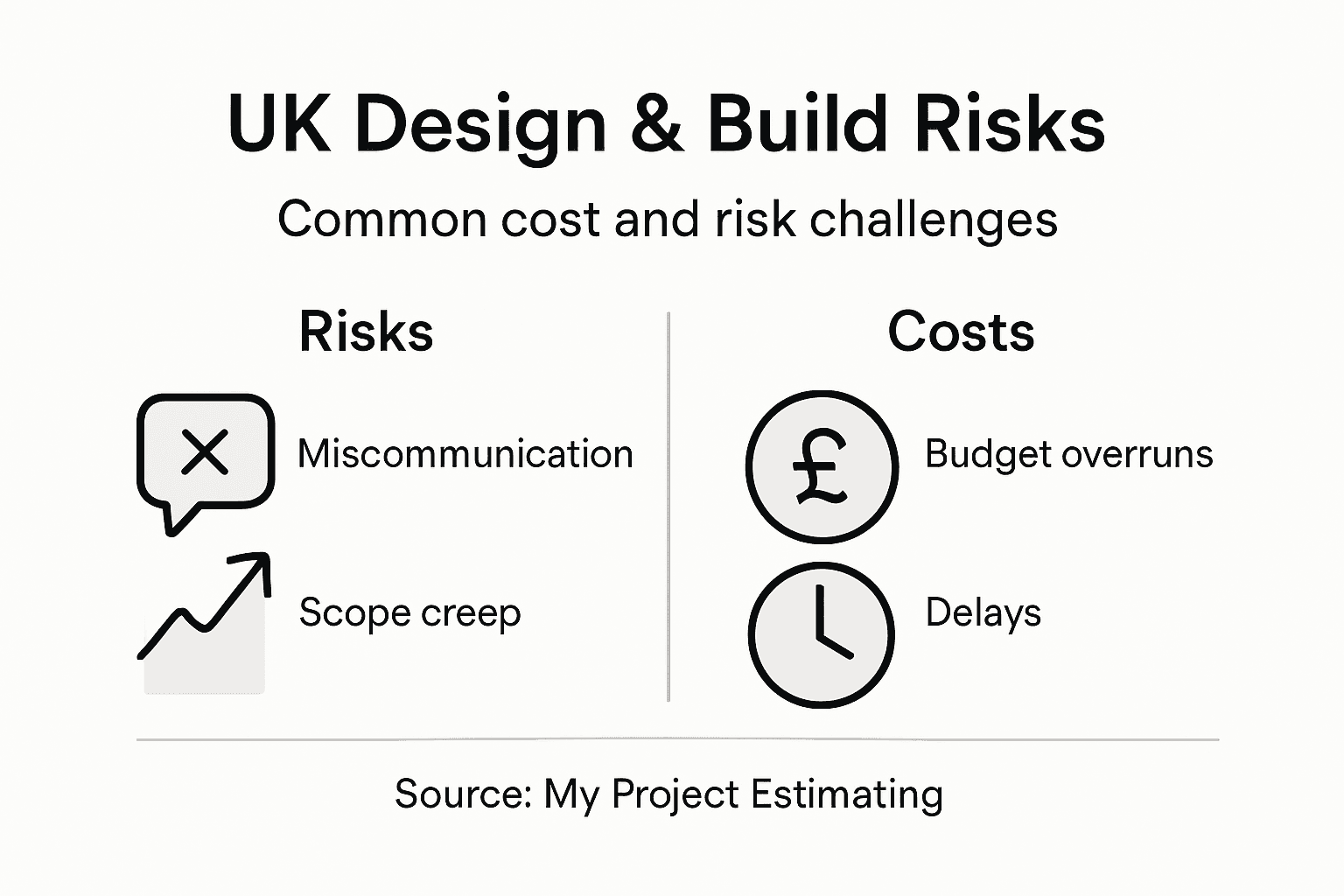
The most prevalent mistakes in UK construction projects stem from misaligned risk allocation and poor communication between stakeholders. Common pitfalls include unrealistic budget expectations, inadequate contingency planning, and failure to integrate comprehensive design risk management approaches that anticipate potential challenges. Contractors frequently underestimate the complexity of integrating design and construction responsibilities, leading to unexpected cost overruns and project delays.
Successful risk mitigation requires a proactive and transparent approach to project management. This involves establishing clear contractual frameworks that equitably distribute risks, implementing robust communication channels, and developing detailed contingency plans that account for potential variations in design, material costs, and regulatory requirements. By adopting a collaborative approach that prioritises early problem identification and strategic risk management, construction teams can significantly reduce the likelihood of financial surprises and project disruptions.
Pro tip: Develop a comprehensive risk register at project inception, documenting potential financial and operational risks with specific mitigation strategies and regularly update this document throughout the project lifecycle.
Enhance Your Design and Build Projects with Accurate UK Cost Estimating
The complexities in design and build projects across the United Kingdom demand precise cost planning to ensure projects stay on track and within budget. As the article highlights, effective risk management and clear communication during early stages are essential to avoid costly redesigns and delays. The challenge many face is balancing integrated design and construction workflows alongside unpredictable financial risks and regulatory compliance. This is where detailed, transparent, and UK-specific cost estimates become invaluable.
At My Project Estimating, we specialise in delivering expert cost planning tailored for design and build procurement routes. Our services offer fast turnaround on comprehensive reports that support your Discover and Define phases by providing realistic budgets and risk-aware pricing. Whether you are an architect, builder, or developer striving to streamline your project from concept to completion, our solutions empower you to make confident financial decisions. Explore our professional offerings at the Uncategorized Archives and start reducing budgeting uncertainties today. Don’t let unexpected costs derail your project – visit My Project Estimating now and take the first step towards reliable cost certainty.
Frequently Asked Questions
What is the design and build procurement method?
The design and build procurement method consolidates design and construction responsibilities under a single contractor, promoting integrated workflows and reducing potential disputes in construction projects.
How does the Double Diamond framework enhance the design and build process?
The Double Diamond framework divides the design process into four phases: Discover, Define, Develop, and Deliver, which helps construction professionals systematically navigate project complexities and improve overall quality and outcomes.
What are the main advantages of using a design and build approach?
Design and build approaches streamline communication, balance risk sharing, ensure a single point of accountability, and facilitate quicker project delivery, making them suitable for complex or time-sensitive projects.
What legal obligations must be met in design and build projects?
Design and build projects must comply with building regulations and the Construction (Design and Management) Regulations 2015, which require safety standards, risk management, and the appointment of Principal Designers and Contractors for projects involving multiple contractors.
Recommended
- Construction Takeoffs: Ensuring Accurate UK Project Costs
- Construction Estimating Guide 2025: Accurate UK Cost Plans – My Project Estimating
- 7 Key Construction Estimating Best Practices for Accuracy – My Project Estimating
- Master Construction Estimating Workflow for Accurate Costing – My Project Estimating