Managing a UK construction project can quickly become overwhelming when workflows lack structure or clarity. For project managers and quantity surveyors, aligning every phase with legal standards like the Construction (Design and Management) Regulations 2015 is more than compliance—it means delivering safer, more predictable, and cost-effective results. This guide explains the systematic project workflow essential for successful delivery, supporting you in enhancing efficiency, collaboration, and financial accuracy across residential and commercial builds.
Table of Contents
- What Is Construction Project Workflow?
- Key Phases Shaping UK Construction
- Core Roles and Collaborative Responsibilities
- Cost Management and Legal Compliance Essentials
- Major Risks and Common Workflow Pitfalls
Key Takeaways
| Point | Details |
|---|---|
| Construction Project Workflow | A structured workflow is essential for successfully executing construction projects, ensuring regulatory compliance and optimal resource utilisation. |
| Key Project Phases | Understanding the five critical phases—Initiation, Planning, Design, Execution, and Closure—ensures systematic progression and effective management of project complexities. |
| Collaboration and Roles | Defining roles and fostering collaboration among all stakeholders is crucial for minimising risks and enhancing project efficiency. |
| Risk Management | Proactive identification and mitigation of workflow risks are vital to maintaining project timelines, budget integrity, and safety standards. |
What Is Construction Project Workflow?
A construction project workflow is a systematic approach that details the sequential steps and processes required to successfully execute a construction project from initial conception through to final completion. The workflow serves as a strategic roadmap, guiding project teams through complex interactions, decision-making processes, and critical milestones while ensuring regulatory compliance and efficient resource management.
In the United Kingdom, construction project workflows are governed by specific legal and professional standards, including the Construction (Design and Management) Regulations 2015, which establish clear frameworks for managing health, safety, and collaboration throughout a project’s lifecycle. These regulations require meticulous planning, transparent communication between duty holders, and a comprehensive understanding of each stage’s requirements and potential risks.
Typically, a construction project workflow encompasses several key stages that ensure systematic progression and risk management:
- Initiation: Project definition, feasibility studies, and initial scope determination
- Planning: Detailed design development, resource allocation, and schedule creation
- Execution: Physical construction activities, ongoing monitoring, and quality control
- Monitoring: Performance tracking, progress evaluation, and adjustment of project parameters
- Closure: Final inspections, handover processes, and project documentation
The workflow is not merely a linear progression but a dynamic, interconnected system that requires continuous communication, adaptive strategies, and proactive problem-solving. By implementing a robust construction project workflow, organisations can minimise uncertainties, optimise resource utilisation, and deliver projects that meet technical specifications, budgetary constraints, and client expectations.
Pro tip: Invest in comprehensive digital project management tools that enable real-time collaboration and transparent workflow tracking to enhance overall project efficiency and communication.
Key Phases Shaping UK Construction
UK construction projects follow a structured approach that encompasses multiple critical phases, each designed to ensure systematic progression and successful project delivery. Project management processes in the construction sector are strategically organised to manage complexity, mitigate risks, and maintain high standards of quality and efficiency.
The typical construction project lifecycle in the United Kingdom generally comprises five fundamental phases that provide a comprehensive framework for project execution:
- Initiation Phase
- Project concept development
- Feasibility studies
- Initial stakeholder engagement
- Preliminary budget estimation
- Planning Phase
- Detailed project scoping
- Resource allocation
- Comprehensive risk assessment
- Scheduling and timeline development
- Design Phase
- Architectural and engineering design
- Technical specifications preparation
- Regulatory compliance verification
- Detailed cost modelling
- Execution Phase
- Physical construction activities
- Quality control implementation
- Ongoing performance monitoring
- Procurement and resource management
- Closure Phase
- Final inspections
- Project handover
- Performance evaluation
- Documentation and lessons learned compilation
Understanding these phases is crucial for construction professionals, as they provide a structured approach to managing project complexities. The project lifecycle can be linear, iterative, or hybrid, allowing flexibility based on specific project requirements and industry standards. This adaptability ensures that construction projects can navigate unique challenges while maintaining a systematic approach to delivery.
Here is a summary of how each construction phase shapes project outcomes in the UK:
| Phase | Primary Objective | Typical Outcome |
|---|---|---|
| Initiation | Define project scope and viability | Stakeholder alignment and approval |
| Planning | Detail plans and scheduling | Clear project roadmap |
| Design | Develop technical specifications | Regulatory approvals secured |
| Execution | Build and manage worksite | Quality construction progress |
| Closure | Finalise and handover | Successful completion and sign-off |
Pro tip: Develop a comprehensive digital project management dashboard that tracks progress across all project phases, enabling real-time insights and proactive decision-making.
Core Roles and Collaborative Responsibilities
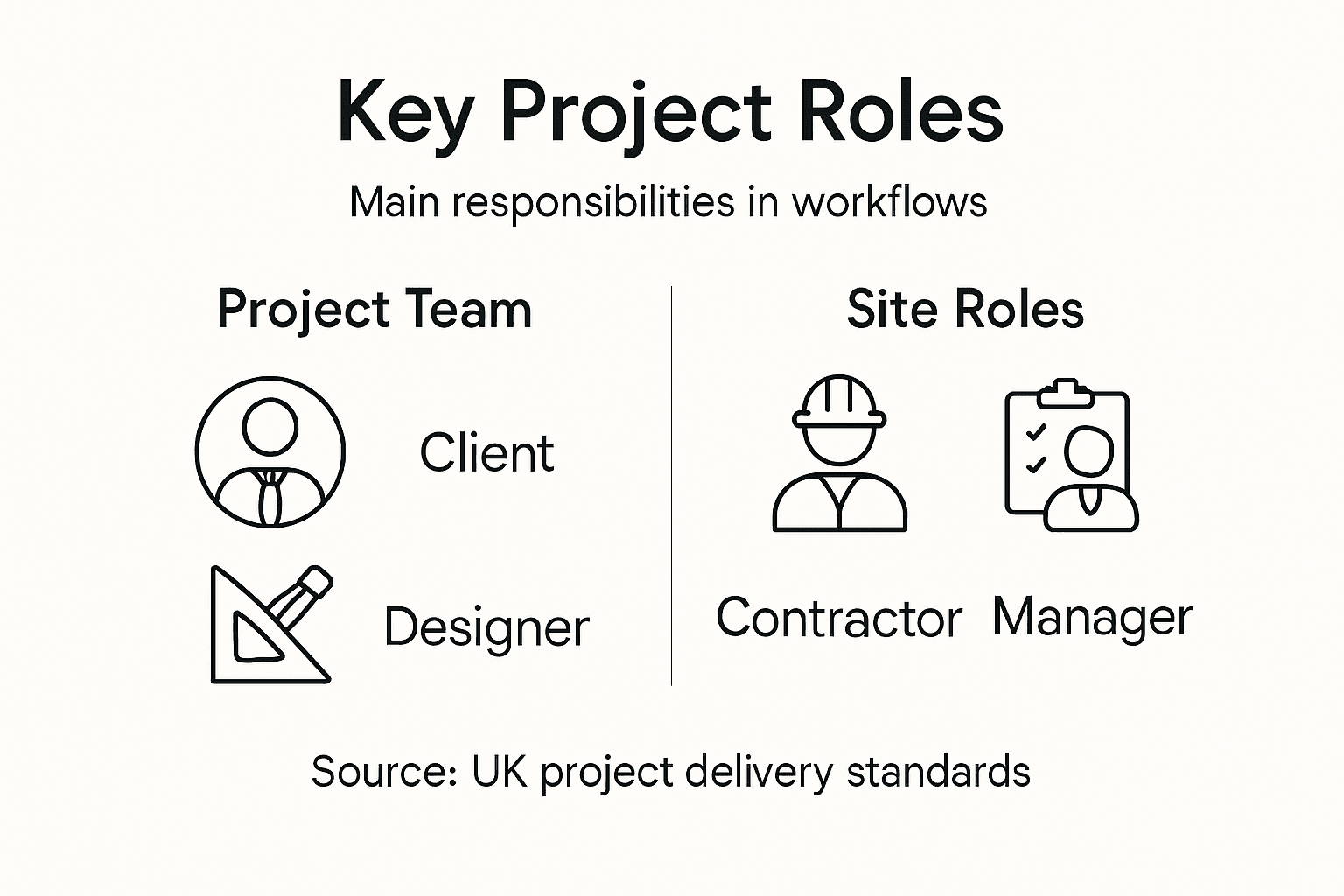
Successful construction projects in the United Kingdom rely on a complex network of interconnected roles, each with distinct responsibilities and critical contributions. CDM 2015 regulations provide a comprehensive framework that defines these key roles, ensuring systematic collaboration and risk management throughout the project lifecycle.
The primary roles in UK construction projects include:
-
Client
- Initiates and funds the project
- Appoints competent duty holders
- Ensures adequate resources and time for project completion
- Manages overall project strategy
-
Principal Designer
- Coordinates design phase health and safety
- Manages design risk assessments
- Ensures regulatory compliance
- Integrates safety considerations into design processes
-
Principal Contractor
- Manages construction phase health and safety
- Develops and implements site safety protocols
- Coordinates multiple contractors and subcontractors
- Ensures compliance with project specifications
-
Designers
- Create technical and architectural designs
- Develop detailed project specifications
- Identify and mitigate potential design-related risks
- Collaborate with other project stakeholders
-
Contractors and Workers
- Execute physical construction activities
- Implement safety protocols
- Report potential hazards
- Maintain quality standards
Collaborative communication strategies are fundamental to effective project delivery. Each role must proactively share information, anticipate potential challenges, and work together to minimise risks from project inception through completion. This collaborative approach ensures that safety, efficiency, and quality remain paramount throughout the construction process.
Pro tip: Implement a digital collaboration platform that enables real-time communication and transparent information sharing across all project duty holders.
Cost Management and Legal Compliance Essentials
Construction projects in the United Kingdom operate within a complex landscape of legal requirements and financial constraints, where precise cost management and strict regulatory adherence are paramount. Legal compliance in construction demands a comprehensive approach that integrates financial planning with statutory obligations, ensuring projects remain both economically viable and legally sound.
Key elements of effective cost management and legal compliance include:
-
Regulatory Framework Alignment
- Understanding CDM 2015 regulations
- Implementing health and safety standards
- Ensuring proper project notifications
- Documenting compliance measures
-
Financial Risk Mitigation
- Developing detailed budget forecasts
- Identifying potential cost overrun risks
- Creating contingency financial reserves
- Tracking expenditure against projected budgets
-
Procurement Strategy Development
- Selecting appropriate contracting methods
- Evaluating supplier compliance credentials
- Implementing transparent selection processes
- Negotiating favourable contractual terms
-
Legal Documentation Management
- Maintaining comprehensive project records
- Preparing detailed contractual agreements
- Ensuring transparency in financial transactions
- Managing potential dispute resolution mechanisms
Procurement strategies and contracting methods play a crucial role in balancing legal compliance with cost-effective project delivery. Collaborative approaches, such as early contractor involvement and strategic supply chain management, can significantly optimise whole-life project costs while maintaining rigorous legal standards.

Successful cost management requires a proactive, integrated approach that views legal compliance not as a burden, but as a strategic opportunity to enhance project efficiency and reduce long-term financial risks.
Pro tip: Develop a comprehensive digital compliance and cost tracking system that provides real-time insights into both financial performance and regulatory adherence.
Major Risks and Common Workflow Pitfalls
Construction projects inherently involve complex risks that can derail project success if not meticulously managed. Construction workflow risks encompass multiple dimensions that demand proactive identification, strategic planning, and robust mitigation strategies.
The primary categories of workflow risks include:
-
Health and Safety Risks
- Inadequate safety protocol implementation
- Poor personal protective equipment compliance
- Insufficient worker training
- Lack of site-specific risk assessments
-
Communication and Coordination Risks
- Fragmented inter-team communication
- Unclear role definitions
- Delayed information transmission
- Misaligned project expectations
-
Financial and Scheduling Risks
- Unrealistic project timelines
- Budget underestimation
- Unexpected material cost fluctuations
- Resource allocation inefficiencies
-
Technical and Regulatory Risks
- Non-compliance with CDM 2015 regulations
- Inadequate design specifications
- Insufficient technical documentation
- Incomplete regulatory submissions
Quantifying project risks requires developing comprehensive risk registers that systematically evaluate potential challenges. These registers should not only identify risks but also assess their potential impact, likelihood of occurrence, and develop targeted mitigation strategies that can be dynamically updated throughout the project lifecycle.
Successful risk management demands a holistic approach that integrates proactive planning, continuous monitoring, and adaptive response mechanisms. Construction professionals must view risk not as an unavoidable challenge, but as an opportunity to demonstrate strategic foresight and operational excellence.
Pro tip: Develop a dynamic digital risk management dashboard that provides real-time risk assessment, enabling immediate identification and strategic intervention.
The following table highlights key digital tools that optimise UK construction workflows and their main advantages:
| Digital Tool Type | Main Benefit | Impact on Workflow |
|---|---|---|
| Project Management Software | Real-time progress tracking | Faster issue resolution |
| Collaboration Platforms | Immediate team communication | Fewer delays and confusion |
| Compliance Tracking Systems | Automated regulatory monitoring | Lower risk of violations |
| Digital Risk Dashboards | Ongoing risk visibility | Proactive mitigation steps |
Streamline Your Construction Project Workflow with Expert Cost Planning
Managing a construction project workflow in the UK demands precision in cost estimation and risk management to avoid unexpected delays and budget overruns. This article highlights the complexity of phases like initiation, planning, execution, and closure, along with the importance of legal compliance and collaborative responsibilities. If you find yourself challenged by unclear cost forecasts or cumbersome budgeting processes, it is essential to access professional support tailored to UK standards.
At My Project Estimating, we specialise in delivering accurate and transparent construction cost estimates that align perfectly with your workflow stages. Whether you need early-stage cost planning, detailed quantity takeoffs, or comprehensive cost reports, our trusted UK-based estimating team ensures your project stays within budget and meets regulatory requirements. Explore our Uncategorized Archives to discover resources that complement your project management approach. Do not let budget uncertainties slow your project progress. Visit My Project Estimating today to get a clear, reliable cost evaluation and take confident control of your construction project workflow.
Frequently Asked Questions
What is a construction project workflow?
A construction project workflow is a systematic approach outlining the sequential steps needed to execute a construction project, from conception to completion, ensuring efficient resource management and regulatory compliance.
What are the key phases of a construction project in the UK?
The key phases typically include Initiation, Planning, Design, Execution, and Closure, each designed to ensure systematic progression and successful project delivery.
How do collaborative roles contribute to a construction project workflow?
Each role, such as the Client, Principal Designer, and Principal Contractor, has specific responsibilities that ensure effective communication, risk management, and adherence to safety standards throughout the project lifecycle.
What are the common risks associated with construction project workflows?
Common risks include health and safety risks, communication and coordination issues, financial and scheduling concerns, and technical or regulatory compliance risks, all of which require proactive management and mitigation strategies.