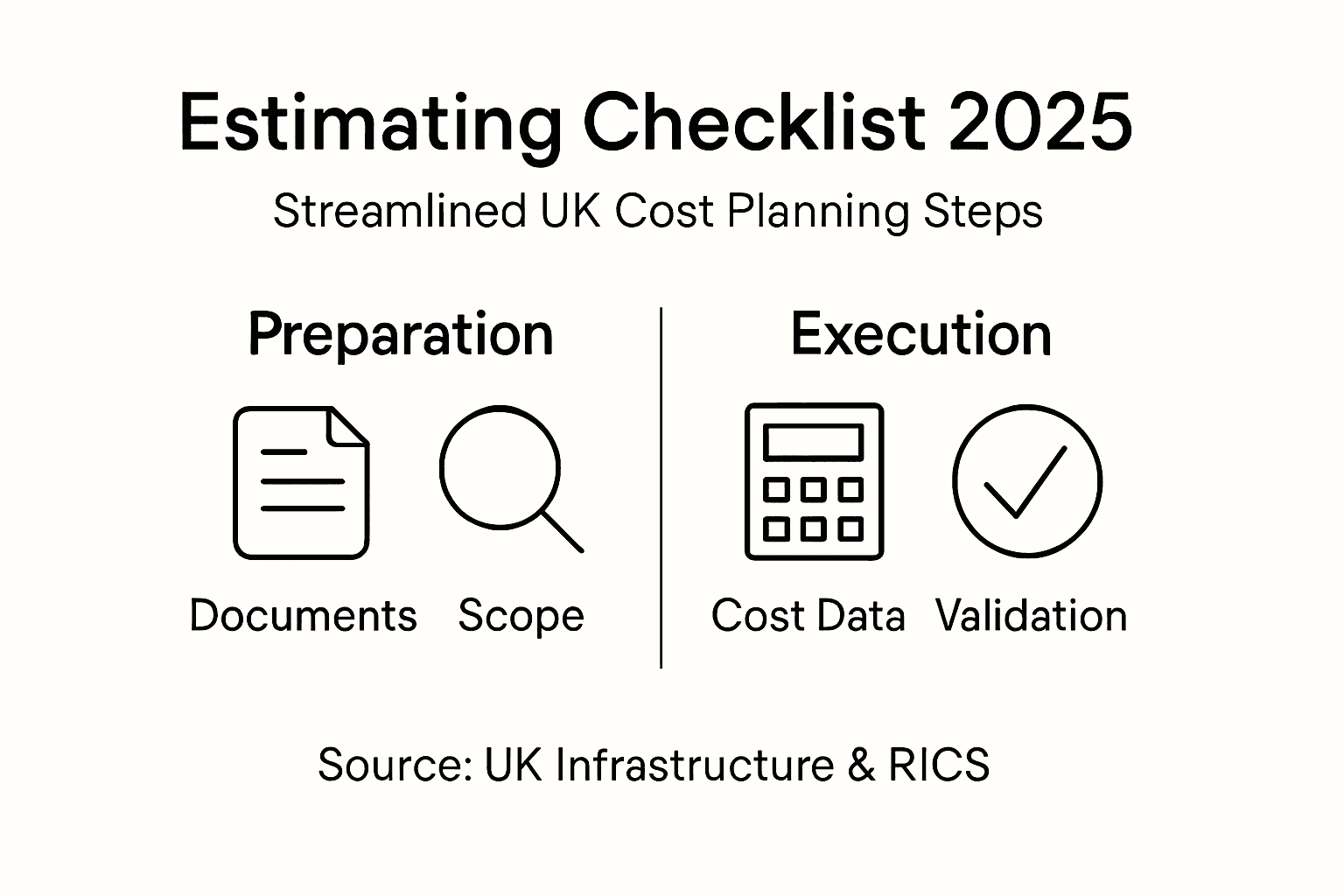
Facing a new project, construction managers and cost estimators across the United Kingdom know that early decisions shape the success of every build. Clear, thorough documentation is the bedrock for every accurate estimate, with the UK Infrastructure and Projects Authority highlighting its role in supporting cost certainty and informed decision-making. This article breaks down proven steps that help you gather critical data, set precise scope, apply verified UK cost benchmarks, and present transparent financial reports, all tailored to keep your next project’s budget on track.
Table of Contents
- Step 1: Gather Essential Project Documentation
- Step 2: Define Detailed Scope and Measurement Criteria
- Step 3: Apply Verified UK Cost Data to Estimates
- Step 4: Review and Validate Estimate Accuracy
- Step 5: Present Comprehensive Report in Preferred Format
Quick Summary
| Key Insight | Explanation |
|---|---|
| 1. Gather essential documents | Comprehensive project documentation mitigates risks and supports accurate budgeting. Ensures no critical information is overlooked. |
| 2. Define a clear project scope | Establish measurable boundaries that guide financial decisions, preventing misunderstandings and potential budget overruns. |
| 3. Use verified UK cost data | Leveraging accurate, current cost data ensures your estimates reflect market conditions, minimising risks of budget discrepancies. |
| 4. Validate estimate accuracy | Systematic review of estimates through expert validation and risk analysis enhances financial reliability and stakeholder confidence. |
| 5. Present a professional report | A clear, structured cost report enhances communication and supports effective decision-making among stakeholders. |
Step 1: Gather essential project documentation
Successful project estimating begins with comprehensive documentation collection. The initial phase of your cost planning journey requires meticulous gathering of all relevant project materials to establish a solid foundation for accurate budgeting.
To create a robust project documentation package, you’ll need to systematically collect several critical documents:
- Architectural drawings including site plans, floor plans, and elevation sketches
- Structural engineering reports detailing building specifications
- Detailed site surveys indicating terrain, boundary conditions, and potential challenges
- Planning permissions and local council documentation
- Soil and environmental assessment reports
- Utility connection diagrams
The UK Infrastructure and Projects Authority emphasises the importance of establishing comprehensive project documentation as a cornerstone of accurate cost estimation. Gathering these documents ensures transparency and supports precise risk analysis throughout your project lifecycle.
Each document provides critical insights that will directly impact your cost estimating accuracy. Incomplete or missing documentation can lead to significant budget miscalculations, potential legal complications, and unexpected project delays.
The following table summarises the potential risks of inadequate documentation and their consequences for project delivery:
| Missing Document Type | Potential Risk | Likely Consequence |
|---|---|---|
| Architectural drawings | Misaligned designs | Costly redesigns |
| Engineering reports | Undetected flaws | Structural failures |
| Planning permissions | Legal non-compliance | Fines or forced project halt |
| Site surveys | Unknown challenges | Unexpected site delays |
| Utility diagrams | Service confusion | Service connection disruptions |
| Soil/environmental assessments | Missed conditions | Remedial costs and delays |
Top tip: Create a digital folder system with clearly labelled subfolders for each document type to maintain organisation and easy retrieval.
Step 2: Define detailed scope and measurement criteria
Defining a precise project scope is fundamental to creating an accurate cost estimate. Your goal in this stage is to establish clear, measurable boundaries that will guide every subsequent financial decision throughout the project lifecycle.
To develop a comprehensive scope, you’ll need to break down your project into specific, quantifiable components:
- Quantitative measurements for each project element
- Specific performance requirements
- Detailed material specifications
- Functional boundaries of the project
- Exclusions and limitations
- Potential variations and contingencies
The Infrastructure and Projects Authority recommends linking cost estimates to project scopes that evolve as design matures. This approach ensures your measurement criteria remain flexible yet controlled, allowing for strategic adjustments without compromising overall project financial integrity.
Each measurement criterion should align with industry standards like the New Rules of Measurement (NRM), providing a structured framework for quantifying project elements. By establishing clear, unambiguous scope definitions, you minimise the risk of misunderstandings, scope creep, and unexpected cost overruns.

Top tip: Create a detailed scope register that tracks every defined element, enabling precise tracking and management of project boundaries.
Step 3: Apply verified UK cost data to estimates
Applying precise, verified cost data is crucial for developing accurate project estimates. In this critical stage, you’ll transform raw data into a comprehensive financial blueprint that reflects the current UK construction market realities.
To ensure robust cost estimation, focus on these key data sources:
- Regional construction cost indices
- Material price databases
- Labour rate benchmarks
- Specialised industry pricing guides
- Recent project cost comparisons
- Location-specific cost variations
The Royal Institution of Chartered Surveyors emphasises the importance of consistent cost data benchmarking for reliable project financial planning. By leveraging verified market rates, you create estimates that accurately reflect current economic conditions and regional price fluctuations.
Integrate multiple data sources to cross-reference and validate your cost estimates, ensuring a comprehensive and nuanced financial perspective. This approach minimises the risk of unexpected budget overruns and provides stakeholders with a transparent, well-researched financial projection.
Here is a comparison of key project cost data sources and their distinct roles in UK construction estimating:
| Data Source | Main Use | Example Output |
|---|---|---|
| Regional cost indices | Adjusting for location effects | City cost multipliers |
| Material price databases | Pricing current resources | Up-to-date steel or timber prices |
| Labour rate benchmarks | Calculating manpower expenses | Standard hourly trade wage rates |
| Industry pricing guides | Reference for itemised rates | Model rates for groundwork |
| Recent project comparisons | Validating estimates | Cost patterns from completed builds |
Top tip: Regularly update your cost databases to maintain accuracy, as construction market prices can change rapidly within short timeframes.
Step 4: Review and validate estimate accuracy
Validating your project estimate is a critical quality control process that ensures financial reliability and reduces potential budget risks. This systematic review transforms your initial calculations into a robust, defensible financial blueprint for your construction project.
Implement a comprehensive validation approach through these key strategies:
- Cross-reference multiple cost sources
- Challenge underlying assumptions
- Perform sensitivity analysis
- Compare against industry benchmarks
- Identify potential risk contingencies
- Document all review findings
The UK Infrastructure and Projects Authority recommends rigorous cost estimate validation involving multi-disciplinary expert review. This approach ensures that your estimates are not only mathematically accurate but also reflect realistic market conditions and project-specific complexities.
Each validation step should produce clear, transparent documentation that demonstrates how you arrived at your final cost projections. By maintaining meticulous review records, you create a credible narrative that supports stakeholder confidence and provides a clear audit trail for future reference.
Top tip: Engage independent reviewers who can provide an objective perspective and challenge your initial estimating assumptions.
Step 5: Present comprehensive report in preferred format
The final stage of project estimating involves crafting a professional, transparent cost report that communicates your financial analysis clearly and compellingly to stakeholders. Your goal is to create a document that not only presents numbers but tells a comprehensive narrative about your project’s financial landscape.
Ensure your report includes these critical components:
- Executive summary highlighting key financial insights
- Detailed cost breakdown by project phase
- Methodology explanation
- Risk assessment and contingency analysis
- Comparative benchmark data
- Graphical visualisations of cost projections
The UK government’s cost estimating standards recommend structured cost estimate reporting that emphasises transparency and enables effective decision-making. Your report should clearly articulate the scope, underlying assumptions, potential uncertainties, and precise calculation methodologies.
Professional presentation goes beyond mere numbers. Craft your report to be a strategic communication tool that builds stakeholder confidence through clarity, precision, and comprehensive financial storytelling.
Top tip: Use consistent formatting, professional design, and clear data visualisations to transform complex financial data into an easily digestible narrative.
Streamline Your Project Estimating with Expert UK Cost Planning Solutions
If you find yourself overwhelmed by the challenge of gathering detailed project documentation or applying verified UK cost data, you are not alone. Many professionals struggle with defining precise scope and validating estimate accuracy as highlighted in the Project Estimating Checklist 2025 for Accurate UK Cost Planning. Achieving transparency and control over budget forecasts can feel daunting without the right tools and expertise.
My Project Estimating offers tailored support designed specifically for construction projects across the UK. From early-stage cost planning to comprehensive cost reports based on up-to-date market data, our experienced estimators help you eliminate budget risks and deliver accurate, transparent financial insights quickly. Discover how our services align with the step-by-step process outlined in this checklist by exploring our Uncategorized Archives – My Project Estimating and see how streamlined project estimating can protect your investment.
Take control of your project costs now by visiting My Project Estimating for fast, reliable estimates that empower confident financial decisions. Don’t let incomplete documentation or shifting market prices jeopardise your budget. Start planning your project with precision today.
Frequently Asked Questions
How can I ensure I gather all the essential project documentation for accurate cost estimating?
Gather all relevant documents such as architectural drawings, structural engineering reports, and planning permissions. Create a digital folder system with clearly labelled subfolders for easy access and organisation, ensuring nothing is overlooked.
What specific components should I include when defining the project scope?
When defining the project scope, include quantitative measurements, specific performance requirements, and detailed material specifications. Track every defined element in a scope register to maintain clarity and manage project boundaries effectively.
How can I obtain verified UK cost data for my project estimates?
Obtain verified UK cost data by accessing regional construction cost indices, material price databases, and labour rate benchmarks. Regularly update your cost databases to maintain accuracy and reflect current market conditions.
What steps should I take to validate the accuracy of my project estimate?
Validate your project estimate by cross-referencing multiple cost sources, performing sensitivity analyses, and comparing against industry benchmarks. Document all review findings to ensure transparency and build confidence in your financial projections.
What are the key components I should include in my final cost report?
Include an executive summary, a detailed cost breakdown by project phase, and a methodology explanation in your final cost report. Use consistent formatting and clear data visualisations to make complex financial data easily digestible for stakeholders.
Recommended
- Construction Estimating Guide 2025: Accurate UK Cost Plans – My Project Estimating
- Cost Planning Guide UK for Accurate Project Budgets
- Master Construction Estimating Workflow for Accurate Costing – My Project Estimating
- Master Construction Estimating Workflow for Accurate Costing – My Project Estimating