For many UK project managers, ensuring every commercial build stays within budget starts long before site work begins. The real groundwork lies in organising and reviewing all construction documents, from architectural drawings to full specifications. A single overlooked detail can lead to costly overruns and disputes, yet a comprehensive project documentation process builds the foundation for reliable quantity takeoff and accurate cost estimation, supporting financial control from day one.
Table of Contents
- Step 1: Prepare Drawings And Construction Documents
- Step 2: Organise Takeoff Sheets And Measurement Tools
- Step 3: Identify And Quantify Project Elements
- Step 4: Verify Measurements And Cross-Check Quantities
- Step 5: Compile Takeoff Data For Cost Estimation
Quick Summary
| Key Point | Explanation |
|---|---|
| 1. Organise project documents meticulously | Systematic organisation of drawings and specifications ensures accuracy in cost estimation and prevents measurement errors. |
| 2. Use standardised takeoff templates | Implementing structured templates streamlines data collection and enhances consistency across different project types. |
| 3. Verify all measurements thoroughly | Rigorous cross-checking of measurements and quantities minimises errors and reinforces confidence in the final cost estimation. |
| 4. Include contingency allowances | Adding a contingency margin of 5-10% accounts for unforeseen project complexities and measurement variations, aiding in budget accuracy. |
| 5. Develop a digital archiving system | Maintaining a digital archive facilitates easy reference for future projects and enables continuous improvement in quantity takeoff processes. |
Step 1: Prepare drawings and construction documents
Successful quantity takeoff begins with meticulous document preparation. Your goal in this initial stage is to systematically review and organise all project drawings, specifications, and related construction documents to establish a precise foundation for accurate cost estimation.
Start by gathering comprehensive project documentation, which typically includes architectural plans, structural drawings, mechanical and electrical schematics, and any supplementary contract documents. Precise document review is crucial to prevent potential measurement errors or costly omissions during the takeoff process.
Carefully examine each drawing sheet, ensuring you have the most recent versions and paying close attention to:
- Scale and dimensions
- Revision dates and status
- Detailed annotations and notes
- Specification cross-references
- Potential design inconsistencies
Organise your documents systematically, creating a clear workflow that allows you to cross-reference information efficiently. Digital PDF drawings can be particularly helpful, enabling zooming and precise measurement capabilities.
Systematic document review forms the critical first step in producing an accurate quantity takeoff for UK construction projects.
Expert advice: Create a standardised checklist for document verification to ensure no critical details are overlooked during your initial review.
Step 2: Organise takeoff sheets and measurement tools
Organising your takeoff sheets and measurement tools is a critical step in ensuring precision and efficiency throughout your quantity surveying process. This stage transforms raw project documents into structured, actionable data that will guide your entire cost estimation workflow.
Begin by creating detailed quantity takeoff sheets that segment the project systematically. Divide your documentation into distinct categories such as:
- Architectural elements
- Structural components
- Mechanical systems
- Electrical installations
- Plumbing and drainage
Digital organisation tools like spreadsheet software can significantly streamline this process. Excel templates allow you to establish consistent measurement units, track quantities, and incorporate cross-references to original architectural drawings with remarkable accuracy.
Systematic documentation is the foundation of precise construction cost estimation.
Ensure your measurement tools are calibrated and appropriate for the specific project requirements. This might include digital measuring devices, scale rulers, digital planimeters, or specialised construction measurement software that integrates seamlessly with your takeoff sheets.
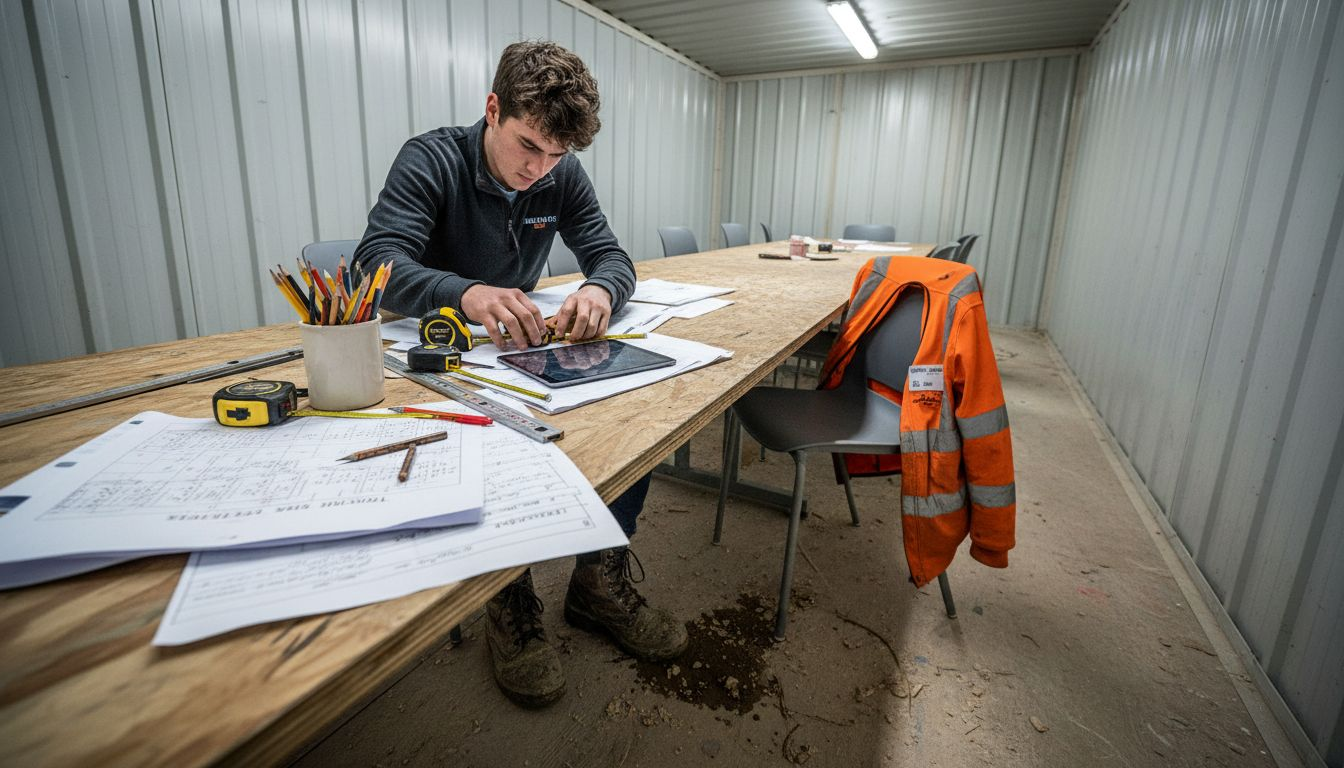
Here is a summary of essential measurement tools and their roles in the quantity takeoff process:
| Tool Type | Function | Business Impact |
|---|---|---|
| Digital measuring device | Captures dimensions from digital drawings | Enhances speed and precision |
| Scale ruler | Measures scaled drawings manually | Provides basic accuracy |
| Digital planimeter | Calculates area directly from plans | Reduces manual error |
| Construction software | Integrates measurements and documentation | Streamlines workflows |
Expert advice: Develop a standardised template for your takeoff sheets that can be easily adapted across different project types, saving time and maintaining consistent documentation standards.
Step 3: Identify and quantify project elements
Identifying and quantifying project elements is a crucial stage in your quantity takeoff process that transforms architectural drawings into precise, measurable components. Your objective is to meticulously break down every aspect of the project into quantifiable units that will form the basis of your cost estimation.
Begin by analysing construction estimate types systematically across different project categories. This involves carefully examining each drawing and categorising project elements into specific groups:
- Structural components (concrete, steel, timber)
- Architectural elements (walls, floors, roofs)
- Mechanical systems (HVAC, pipework)
- Electrical installations
- Finishing materials
Measurement techniques are critical during this phase. Use consistent units of measurement aligned with UK construction standards – typically square metres for area-based elements, linear metres for lengths, and cubic metres for volumetric calculations. Pay close attention to drawing scales, ensuring your measurements are mathematically precise and cross-referenced with project specifications.
Below is a comparison of UK quantity takeoff measurement units by element category:
| Element Type | Common Unit | Example Measurement |
|---|---|---|
| Walls and floors | Square metres | Floor area calculations |
| Pipework and wiring | Linear metres | Electrical cable lengths |
| Concrete and earth | Cubic metres | Foundation volume |
Precision in element identification determines the accuracy of your entire cost estimation process.
Utilise digital measurement tools and software that can help you track and validate quantities with minimal human error. Some advanced tools offer automatic measurement and calculation features that can significantly streamline your workflow.
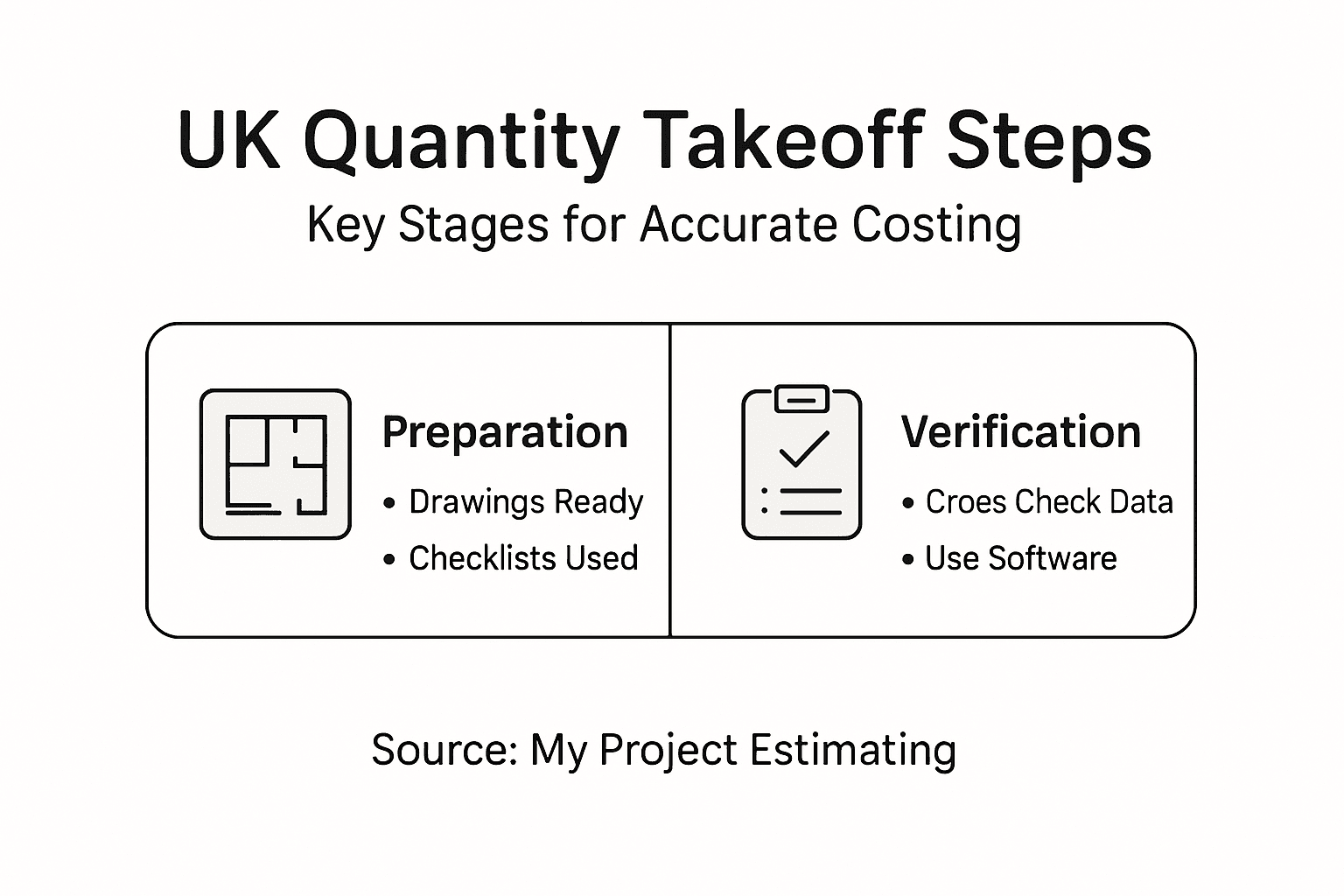
Expert advice: Always maintain a margin of contingency in your quantity calculations, typically 5-10%, to account for potential measurement variations or unforeseen project complexities.
Step 4: Verify measurements and cross-check quantities
Verifying measurements and cross-checking quantities represents the critical quality control stage of your quantity takeoff process. Your goal is to eliminate potential errors, validate your initial measurements, and ensure absolute precision before finalising project estimates.
Establishing a comprehensive checkpoint review process helps catch discrepancies early and enhances confidence in your takeoff data. Implement a systematic verification approach that includes:
- Comparing measurements across different drawing sets
- Checking dimensional accuracy against original specifications
- Validating quantities between related trade sections
- Applying appropriate waste and contingency allowances
- Reconciling any measurement variations
Utilise digital verification techniques that can automatically flag potential inconsistencies. This might involve overlaying digital drawings, using measurement comparison software, or employing advanced computational tools that can quickly identify potential measurement discrepancies.
Meticulous cross-checking transforms good quantity takeoffs into exceptional project estimates.
Consider establishing a two-person review system where independent professionals examine the same measurements, creating an additional layer of verification. This approach can significantly reduce the risk of individual measurement errors passing unnoticed.
Expert advice: Create a standardised verification checklist that you can consistently apply across different project types, ensuring no critical measurement validation steps are overlooked.
Step 5: Compile takeoff data for cost estimation
Compiling takeoff data is the pivotal moment where your meticulous measurements transform into a comprehensive financial blueprint for your construction project. This stage synthesises all your previous work into a structured format that will ultimately guide budgeting and tendering decisions.
Consolidating quantity takeoff data enables precise cost estimation, supporting transparent budget control and competitive tendering. Your compilation should encompass:
- Total material quantities for each project element
- Corresponding unit rates and pricing
- Labour requirements and estimated work hours
- Potential material waste percentages
- Contingency allowances
Utilise standardised reporting templates that allow clear, consistent presentation of your takeoff information. These templates should provide a logical flow that enables quick comprehension of material quantities, associated costs, and potential project variations.
Accurate data compilation is the foundation of successful construction project financial planning.
Ensure your compiled data includes comprehensive annotations that explain measurement methodologies, reference original drawings, and highlight any assumptions made during the takeoff process. This transparency helps stakeholders understand the basis of your cost estimation.
Expert advice: Develop a digital archiving system that allows you to store and easily reference your quantity takeoff documents for future project comparisons and continuous improvement.
Ensure Precision in Your UK Construction Projects with Expert Quantity Takeoff Support
Accurate quantity takeoff is essential for eliminating costly errors and ensuring your project stays on budget. This article highlights the challenges of preparing, organising, and verifying detailed measurements and construction documents so that your cost estimation is precise and reliable. If you want to avoid risks linked to inconsistent data, overlooked elements, or manual measurement mistakes, you need professional assistance tailored to UK construction standards.
At My Project Estimating, we specialise in delivering transparent and meticulous quantity takeoff services that align perfectly with the step-by-step process described here. Whether you require early-stage cost planning or comprehensive reports, our experienced estimators use verified UK data to produce fast and dependable results. Explore insights and solutions in our Uncategorized Archives to understand how precise measurement and organisation can transform your financial project planning. Don’t leave your project’s success to chance act now by visiting My Project Estimating and receive expert support designed to keep your UK construction project on track and within budget.
Frequently Asked Questions
What is a quantity takeoff and why is it important for UK construction projects?
A quantity takeoff is the process of measuring and quantifying materials from project drawings to estimate costs accurately. It is essential as it lays the groundwork for budgeting and aids in preventing costly errors during construction.
How do I prepare drawings and construction documents for quantity takeoff?
To prepare your documents, gather all relevant project documentation such as architectural plans and specifications. Systematically review this information for accuracy and ensure that you have the most recent versions to establish a strong foundation for your cost estimation.
What measurement tools should I use during my quantity takeoff?
You should use tools such as digital measuring devices, scale rulers, digital planimeters, or construction measurement software. Ensure your tools are calibrated correctly to improve precision in your measurements, which can impact the accuracy of your cost estimates.
How do I verify measurements and cross-check quantities?
To verify measurements, implement a systematic review process that compares your measurements against original specifications and across different drawing sets. This step helps identify discrepancies early, ensuring that your final quantities are accurate and reliable.
What information should I compile for cost estimation after completing my quantity takeoff?
You should compile total material quantities, unit rates, labour requirements, potential waste percentages, and contingency allowances. Organise this information in a clear, standardised format to support effective budget control and facilitate transparent tendering decisions.
How can I ensure the accuracy of my quantity takeoff data?
To ensure accuracy, consistently apply a standardised verification checklist during each measurement stage. Incorporating contingency allowances of approximately 5-10% can also help accommodate unforeseen variations, improving the reliability of your estimates.