Every British construction project, from local housing to major infrastructure, relies on financial forecasts that can make or break the budget. Accurate cost estimating is not just a formality for British builders. It is a vital process that shapes project feasibility and future profit. With more than 60 percent of construction delays tied directly to budget inaccuracies, understanding the art and science of cost estimating gives professionals a real edge in today’s competitive market.
Table of Contents
- Defining Cost Estimating In Construction Projects
- Types Of Cost Estimates And Their Uses
- The Process Of Preparing Reliable Cost Plans
- Accuracy, Data Sources, And Common Mistakes
- Impact Of Cost Estimating On Developer Profitability
Key Takeaways
| Point | Details |
|---|---|
| Importance of Cost Estimation | Effective cost estimating is crucial for predicting financial resources needed for construction projects, ensuring budget control and risk management. |
| Types of Cost Estimates | Various estimation types, from conceptual to definitive, help in financial planning throughout a project’s lifecycle, adapting as project details evolve. |
| Data Quality and Accuracy | Reliable cost estimation relies on high-quality, comprehensive data; common mistakes can lead to financial inaccuracies and project delays. |
| Impact on Developer Profitability | Accurate cost estimation enhances competitiveness, improves resource allocation, and reduces financial risks, ultimately supporting better profitability for developers. |
Defining Cost Estimating in Construction Projects
Cost estimating in construction projects represents a critical strategic process for predicting the financial resources required to complete a building or infrastructure development. Cost estimation methods require careful selection and implementation based on project maturity, available data quality, and specific contextual requirements.
At its core, cost estimating involves systematically forecasting the total expenditure necessary to execute a construction project from inception through completion. This process integrates multiple analytical techniques, including deterministic and probabilistic approaches, which help project managers anticipate potential financial challenges and develop robust budgetary frameworks. The UK Government’s guidance emphasises that effective cost estimation isn’t merely about calculating numbers, but understanding the nuanced interplay between project variables and potential financial risks.
Successful construction cost estimating typically encompasses several key components:
- Detailed project scope analysis
- Material and labour cost investigations
- Historical data comparison
- Risk assessment and contingency planning
- Technological and market trend evaluations
Professional estimators utilise sophisticated methodologies to transform complex project specifications into precise financial projections. Robust early-stage planning significantly influences project delivery success, with front-end loading of estimation processes providing critical insights that can prevent potential budget overruns and financial miscalculations. By implementing comprehensive cost estimation strategies, construction professionals can create more predictable, financially sustainable project outcomes.
Types of Cost Estimates and Their Uses
Construction cost estimation encompasses several distinct types, each serving unique purposes throughout a project’s lifecycle. Cost estimation methods vary significantly depending on project complexity and stage, requiring professionals to select appropriate techniques that match specific project requirements.
The primary types of construction cost estimates include:
- Conceptual Estimates: Preliminary assessments created during early project planning stages
- Preliminary Estimates: More refined projections developed after initial project scoping
- Intermediate Estimates: Detailed evaluations created as project design progresses
- Definitive Estimates: Highly precise calculations prepared just before project commencement
- Control Estimates: Ongoing financial tracking throughout project execution
Conceptual estimates represent the earliest financial projections, typically generated with minimal project details. These rough calculations help stakeholders understand potential budget ranges and project feasibility. Intermediate and definitive estimates become progressively more sophisticated, incorporating increasingly granular information about materials, labour, equipment, and potential risks.
Professional estimators utilise comprehensive cost forecasting techniques to transform these estimate types into strategic financial planning tools. Each estimate type provides crucial insights, enabling construction professionals to make informed decisions, manage financial risks, and maintain budgetary control throughout a project’s lifecycle. By understanding and implementing these varied estimation approaches, developers can significantly improve their ability to predict and manage project expenditures with greater accuracy and confidence.
The Process of Preparing Reliable Cost Plans
Comprehensive construction cost planning requires a systematic approach that integrates multiple strategic considerations. The process demands meticulous attention to detail, combining technical expertise with sophisticated analytical techniques to create accurate financial projections for construction projects.
The fundamental steps in preparing reliable cost plans typically involve:
- Detailed project scope definition
- Comprehensive data collection and verification
- Selection of appropriate estimation methodologies
- Risk assessment and contingency planning
- Continuous monitoring and refinement
Data collection represents the cornerstone of effective cost planning. Professional estimators must gather precise information about materials, labour rates, equipment costs, and potential market fluctuations. This process requires cross-referencing multiple sources, including historical project data, current market rates, and specific project parameters.

Developers must understand the intricacies of construction project budgeting to create truly reliable cost plans. This involves employing both deterministic and probabilistic estimation techniques, which allow for more nuanced financial forecasting. By integrating comprehensive risk analysis, detailed documentation, and flexible planning strategies, construction professionals can develop cost plans that provide realistic financial frameworks while maintaining the adaptability necessary to navigate complex project environments.
Accuracy, Data Sources, and Common Mistakes
Cost estimation accuracy hinges critically on the quality and comprehensiveness of data sources used in the analysis. Selecting appropriate cost estimating methodologies requires sophisticated understanding of project-specific variables and potential risk factors that could impact financial projections.
The most common mistakes in cost estimation typically include:
- Relying on outdated or inappropriate historical data
- Insufficient risk assessment and contingency planning
- Overlooking subtle market fluctuations
- Inadequate documentation of estimation assumptions
- Failing to incorporate emerging technological considerations
Data quality represents the foundational element of reliable cost estimation. Professional estimators must meticulously validate information from multiple authoritative sources, including industry benchmarks, current market rates, regional pricing indexes, and specific project-related documentation. This comprehensive approach helps mitigate the inherent uncertainties that can compromise financial forecasting accuracy.
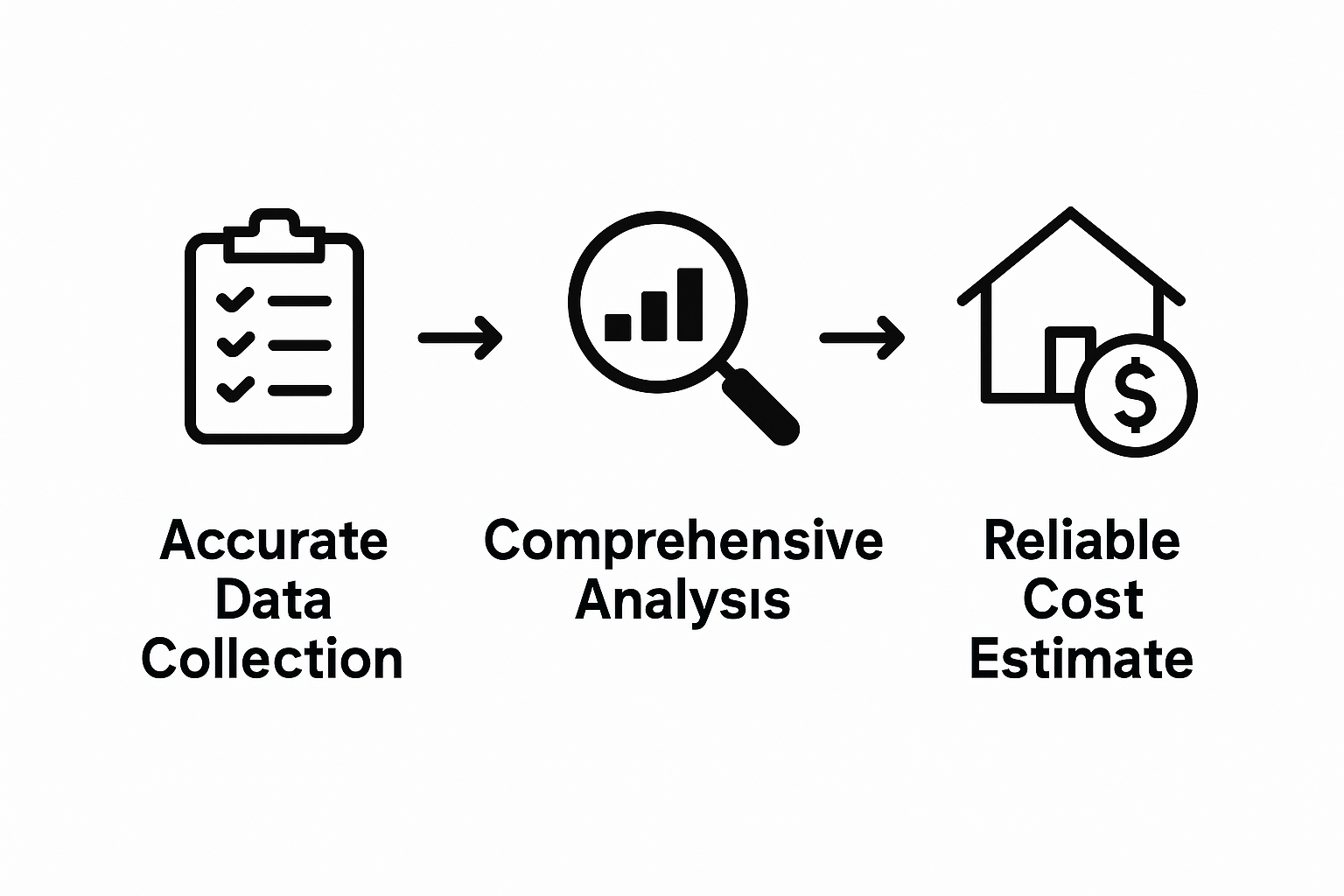
Precision in cost estimation demands a multifaceted approach that combines quantitative analysis with nuanced understanding of complex project dynamics. By developing robust verification processes, maintaining transparent documentation, and continuously updating estimation models, construction professionals can significantly reduce the likelihood of budgetary discrepancies and create more reliable financial frameworks for complex development projects.
Impact of Cost Estimating on Developer Profitability
Professional cost estimating techniques form the critical foundation for financial success in construction development. Accurate cost estimation directly influences a developer’s ability to maintain profitability by providing precise financial forecasting and risk management strategies that can significantly impact project margins and overall business performance.
The primary ways cost estimating influences developer profitability include:
- Preventing unexpected budget overruns
- Enabling more competitive project bidding
- Improving resource allocation efficiency
- Reducing financial risks and contingency expenses
- Supporting more accurate pricing strategies
Financial precision represents the cornerstone of sustainable development projects. Developers who invest in sophisticated cost estimation methodologies can identify potential financial vulnerabilities early, allowing for strategic adjustments that protect profit margins. Professional construction estimating services offer comprehensive insights that transform potential financial risks into manageable, strategic opportunities.
Ultimately, cost estimating transcends mere number crunching, emerging as a strategic tool that empowers developers to make informed decisions. By providing granular insights into project financial dynamics, developers can navigate complex market conditions, optimise resource deployment, and maintain competitive edge in an increasingly challenging construction landscape. The ability to predict and manage financial variables with precision determines not just project success, but long-term organisational sustainability and profitability.
Secure Your Project Budget with Expert Cost Estimating Solutions
Preventing budget overruns is a key challenge for developers navigating the complexities of construction project cost estimating. This article highlights the critical need for accurate cost forecasting and comprehensive risk assessment to maintain profitability and manage financial uncertainties effectively. If you are facing pressure from unpredictable expenses or seeking to transform rough cost estimates into confident financial plans, understanding how to leverage detailed, UK-specific data and professional methodologies is essential.
At My Project Estimating, we specialise in delivering precise, transparent cost estimates tailored to your project’s unique needs. Our services cover early-stage cost planning, detailed quantity takeoffs, and thorough cost reports designed to help you control budgets and reduce risk throughout the project lifecycle. Start by exploring our Uncategorized Archives for insights and then experience a seamless estimating process that supports your decisions from initial drawings to approved estimates. Don’t leave your budget to chance take control now by visiting My Project Estimating and securing your project’s financial success today.
Frequently Asked Questions
What is the importance of cost estimating in construction projects?
Cost estimating is crucial as it predicts the financial resources needed to complete a construction project, helping to establish a budget and prevent unexpected budget overruns.
What are the common types of construction cost estimates?
The common types include conceptual estimates, preliminary estimates, intermediate estimates, definitive estimates, and control estimates, each serving different purposes throughout the project lifecycle.
How does data collection impact cost estimation accuracy?
Accurate data collection is vital as it ensures that estimators use reliable information on materials, labour, and market trends, which enhances the precision of financial projections.
What are the common mistakes to avoid in cost estimating?
Common mistakes include relying on outdated data, insufficient risk assessment, overlooking market fluctuations, and failing to document estimation assumptions clearly.