Most British homeowners underestimate just how quickly renovation or new build costs can spiral out of control. With project overruns affecting almost 60 percent of UK home improvement plans, understanding accurate estimating becomes vital. The right estimator can make the difference between a dream home and financial stress by translating complex blueprints into clear, reliable figures. Get the clarity you need to keep your plans on track and protect your investment from typical budget pitfalls.
Table of Contents
- Role Of Estimators In Home Projects
- Types Of Cost Estimating For Homeowners
- The Estimating Process Step By Step
- UK Standards And Legal Responsibilities
- Common Costing Pitfalls And How To Avoid Them
- Choosing A Qualified UK Estimator
Key Takeaways
| Point | Details |
|---|---|
| Role of Estimators | Estimators provide crucial financial insights, helping homeowners manage budgets through detailed cost assessments. |
| Cost Estimation Methods | Homeowners should understand various estimation methods like top-down, bottom-up, and parametric to optimise their budgeting approach. |
| Legal Responsibilities | Compliance with UK building regulations is essential to avoid legal consequences and ensure project integrity. |
| Common Pitfalls | Homeowners must anticipate potential cost overruns by conducting thorough site assessments and allowing a contingency budget of 15-20%. |
Role of estimators in home projects
Estimators play a pivotal role in transforming home construction projects from conceptual plans to financially viable realities. These specialised professionals provide critical financial insights that help homeowners navigate the complex landscape of building and renovation expenses. By conducting detailed cost assessments for construction projects, they ensure that budgets remain realistic and manageable.
The core responsibility of an estimator involves meticulously analysing project drawings, specifications, and requirements to calculate precise cost projections. They gather detailed quotes from suppliers, assess material costs, evaluate labour expenses, and factor in potential contingencies that might impact the overall budget. This comprehensive approach allows homeowners to understand the full financial implications of their home improvement or construction plans before committing significant resources.
These professionals contribute far beyond simple number crunching. By investigating potential project expenses, estimators help identify potential cost-saving opportunities, recommend alternative materials or methods, and provide strategic financial planning. Their expertise helps prevent budget overruns, reduces financial risks, and ensures that homeowners can make informed decisions about their construction projects.
Expert tip: Always request a detailed, itemised estimate from your professional estimator that breaks down potential costs into clear, transparent categories to avoid unexpected financial surprises.
Types of cost estimating for homeowners
Homeowners embarking on construction or renovation projects can leverage various cost estimating methods to manage their budgets effectively. Cost estimating approaches range from broad strategic techniques to highly detailed computational models, each offering unique advantages for different project scopes and complexity levels.
Four primary types of cost estimation dominate the residential construction landscape. Top-down estimating provides a broad overview by establishing an initial budget based on overall project size and historical data. Bottom-up estimating offers granular precision by breaking down each project component and calculating individual costs meticulously. Analogous estimating draws comparisons with similar past projects to generate approximate budgets, while parametric estimating uses statistical relationships and quantitative project parameters to predict expenses with mathematical precision.
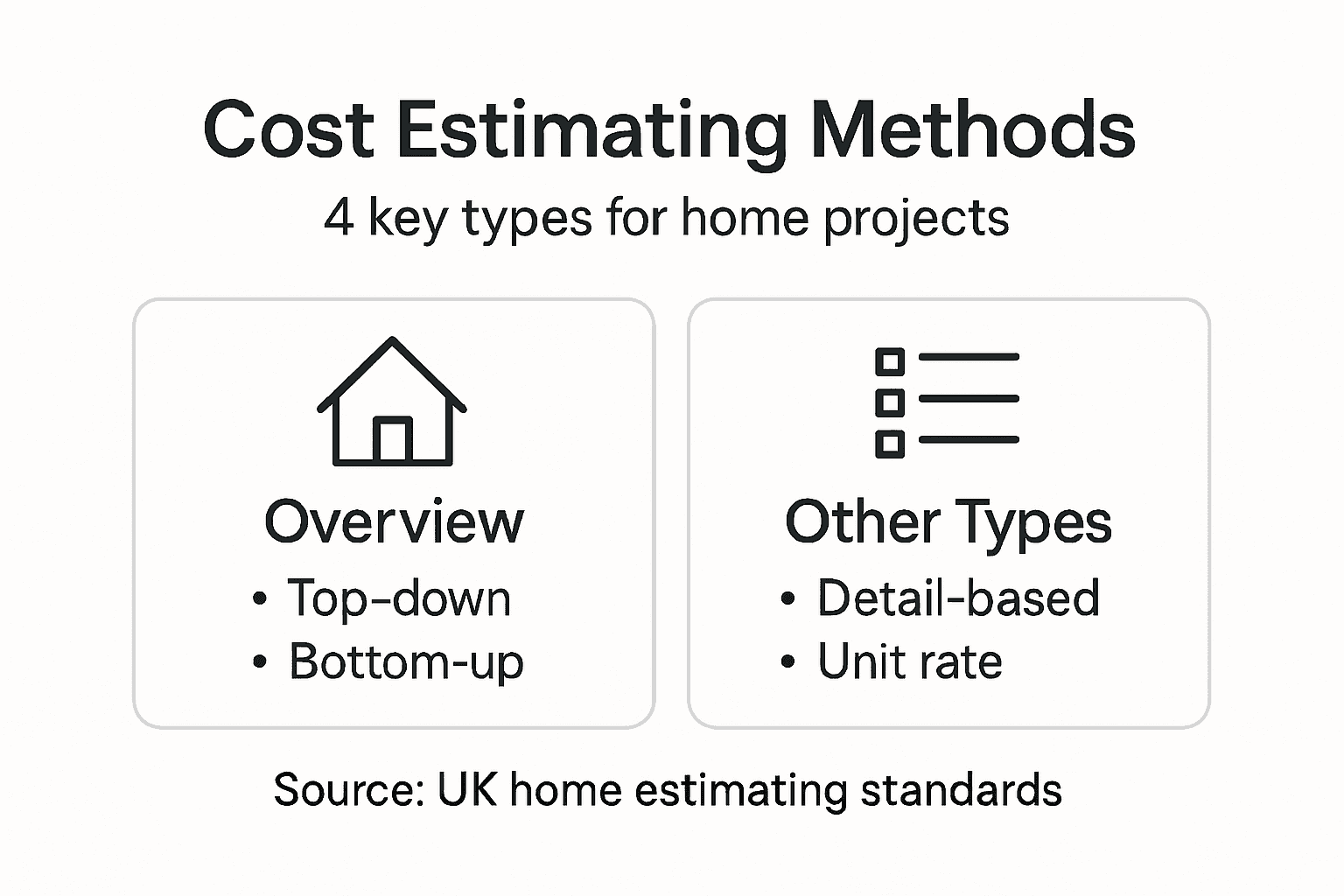
Here is a comparison of primary cost estimating methods for home construction projects:
| Estimating Method | Accuracy Level | Suitable Project Type | Typical Use Case |
|---|---|---|---|
| Top-down | Low to moderate | Early concept or feasibility | Initial budgeting for large builds |
| Bottom-up | High | Complex, detailed specifications | Definitive project costing |
| Analogous | Moderate | Projects similar to past work | Benchmarking against other builds |
| Parametric | Moderate to high | Well-quantified, repetitive tasks | Predictable scopes, extensions |
Online cost estimate providers typically categorise estimates into three primary types: generic approximate rates, detailed spreadsheet breakdowns, and contractor-based quotes. Generic rates offer quick ballpark figures, spreadsheet breakdowns provide intermediate detail, and contractor quotes represent the most accurate assessment, incorporating specific material, labour, and site-specific considerations. Homeowners should select an estimation method that balances their need for accuracy with budget constraints and project complexity.
Expert tip: Always request estimates from multiple sources and compare their methodologies to ensure a comprehensive understanding of potential project costs.
The estimating process step by step
The construction cost estimating process is a meticulous journey that transforms project blueprints into comprehensive financial roadmaps. Technical drawing analysis represents the critical first stage, where estimators carefully examine project specifications, architectural plans, and design requirements to establish a foundational understanding of the project’s scope and complexity.
The estimation workflow typically unfolds through several systematic stages. Initially, estimators conduct thorough site investigations to assess physical conditions and potential challenges. Next, they engage in detailed supplier and subcontractor consultations, gathering precise quotes for materials, labour, and specialist services. This phase involves meticulously calculating direct costs, including raw materials, equipment rental, workforce expenses, and potential contingency allowances. Sophisticated cost models are then developed, integrating these individual components into a comprehensive project budget that accounts for potential variations and unexpected expenditures.

Professional estimators employ multiple verification techniques to ensure accuracy. They cross-reference historical project data, apply industry-standard cost indices, and incorporate regional price variations specific to different construction markets. Detailed spreadsheets and advanced computational models help track every potential expense, from foundational work to finishing touches. The final estimate must not only provide a precise financial projection but also offer strategic insights that help homeowners make informed decisions about their construction or renovation projects.
Expert tip: Request a line-by-line cost breakdown from your estimator to understand exactly how each project component contributes to the total budget.
UK standards and legal responsibilities
Homeowners undertaking construction or renovation projects must navigate a complex landscape of legal requirements and regulatory standards. Building Regulations approval represents a critical legal framework that mandates specific safety, energy efficiency, and accessibility standards for all residential construction work in the United Kingdom.
The legal responsibilities extend across multiple dimensions of project management. Homeowners must ensure compliance with national building codes, which require obtaining formal approvals or working with registered competent professionals. These regulations cover critical aspects such as structural integrity, fire safety, thermal performance, electrical systems, and accessibility provisions. Failure to comply can result in significant legal consequences, including potential prosecution, mandatory remedial work, and complications during property sales due to missing compliance documentation.
Mortgage lenders’ guidelines further reinforce the importance of adhering to established standards. Financial institutions require comprehensive documentation demonstrating that all construction work meets statutory requirements. This includes detailed cost valuations, professional certifications, and evidence of compliance with local and national building regulations. Homeowners must maintain meticulous records of all approvals, inspections, and compliance certificates to protect their legal and financial interests throughout the construction process and beyond.
Expert tip: Consult a professional building surveyor or local authority building control officer before commencing any significant construction work to ensure full regulatory compliance.
Common costing pitfalls and how to avoid them
Homeowners frequently encounter significant financial challenges when estimating construction project costs, often stemming from unrealistic expectations and incomplete planning. Online cost estimation challenges reveal that generic online estimates can provide misleading financial projections that fail to capture the nuanced complexities of individual construction projects.
Several critical pitfalls can derail project budgets and financial planning. These include inadequate site-specific assessments, neglecting potential material price fluctuations, underestimating labour costs, and failing to build substantial contingency funds. Inexperienced homeowners frequently make the mistake of accepting initial quotes without understanding underlying variables such as regional pricing differences, seasonal labour availability, and potential unexpected structural complexities that can dramatically impact overall project expenditure.
Project management risk assessment strategies emphasise the importance of comprehensive planning and continuous budget review. Professional estimators recommend developing dynamic budget models that can adapt to changing circumstances, incorporating flexibility for potential variations in material costs, labour rates, and unexpected site conditions. Successful budget management requires a proactive approach that includes regular financial reassessments, maintaining detailed documentation, and building robust communication channels with contractors and suppliers to anticipate and mitigate potential financial risks.
Below is a summary of common costing pitfalls and effective avoidance strategies:
| Pitfall | Impact on Project Cost | Prevention Strategy |
|---|---|---|
| Inadequate site assessments | Unexpected structural expenses | Conduct detailed site surveys |
| Ignoring material price fluctuations | Sudden budget overruns | Monitor supplier costs regularly |
| Underestimating labour costs | Delays and excessive expenses | Use updated regional wage data |
| Insufficient contingency allowance | Inability to cover unforeseen work | Allocate 15-20% extra budget |
Expert tip: Always allocate a minimum 15-20% contingency budget beyond your initial project estimate to provide financial cushioning for unexpected expenses and potential complications.
Choosing a qualified UK estimator
Selecting an appropriate estimator requires careful consideration of professional qualifications and industry expertise. Construction cost estimation credentials are crucial for ensuring accurate and reliable project budgeting, with top professionals typically holding specialised academic qualifications in construction management, quantity surveying, or related disciplines.
Homeowners should prioritise several key criteria when evaluating potential estimators. These include academic background, professional certifications from recognized bodies like the Royal Institution of Chartered Surveyors (RICS), demonstrable experience in similar project types, and proven proficiency with contemporary cost estimation software. Importantly, a qualified estimator should demonstrate comprehensive understanding of UK building regulations, regional cost variations, and the ability to provide detailed, transparent cost projections that account for potential market fluctuations and project-specific complexities.
Professional education in construction estimating highlights the importance of continuous learning and industry accreditation. Reputable estimators will typically maintain memberships in professional organizations, participate in ongoing professional development, and possess a track record of successful project deliveries. Homeowners should request comprehensive portfolios, verify professional credentials, and seek recommendations or case studies that demonstrate the estimator’s capability to manage projects similar in scope and complexity to their own construction or renovation initiative.
Expert tip: Request proof of professional indemnity insurance and ask to review detailed case studies from previous projects before engaging an estimator to ensure their credibility and expertise.
Secure Your Home Project Budget with Expert Cost Estimates
Homeowners often face challenges such as unrealistic budgets, unexpected expenses, and incomplete cost assessments when planning construction projects. This article highlights key issues like the need for detailed cost breakdowns, contingency planning, and thorough site assessments to avoid financial surprises. Understanding complex estimating methods and navigating UK legal standards adds to the stress of keeping your project financially on track.
My Project Estimating offers tailored solutions to these challenges by providing transparent, accurate, and UK market-specific cost estimates. Our experienced estimators simplify the process, delivering detailed financial insights through a clear four-step approach, from sharing drawings to receiving multiple report formats. Whether you need early-stage cost planning or detailed quantity takeoffs, our services help you make informed decisions and keep your project within budget.
Explore how our professional expertise can save you time and money on your home construction project by visiting Uncategorized Archives – My Project Estimating. Ready to take control of your project costs today? Get started now at My Project Estimating and secure your project’s financial success.
Frequently Asked Questions
What does an estimator do in home construction projects?
Estimators play a crucial role in home construction by analysing project details to provide accurate cost projections. They evaluate project drawings, gather quotes from suppliers, and assess material and labour costs to help homeowners understand the financial implications of their projects.
What are the different types of cost estimating methods for homeowners?
Homeowners can utilise various estimating methods, including top-down estimating for initial budgets, bottom-up estimating for detailed cost breakdowns, analogous estimating for comparisons with similar projects, and parametric estimating which uses statistical relationships to predict costs.
How can I avoid common costing pitfalls in my construction project?
To avoid common pitfalls, conduct thorough site assessments, monitor material price fluctuations, accurately estimate labour costs, and always allocate a contingency fund of 15-20% of the initial budget to cover unexpected expenses.
What qualifications should I look for when choosing an estimator?
When selecting an estimator, prioritise their academic background in construction management or quantity surveying, professional certifications from reputable bodies, relevant experience, and proficiency in modern cost estimation software. Additionally, ensure they have knowledge of applicable regulations and can provide detailed cost projections.