Nearly 85 percent of British commercial projects experience cost overruns due to inaccurate quantity takeoff processes. For UK quantity surveyors and construction project managers, streamlining workflows is vital to stay ahead in a competitive market. This guide reveals actionable strategies to help you compile reliable measurements and present precise figures, supporting better cost planning and stakeholder confidence throughout every project phase.
Table of Contents
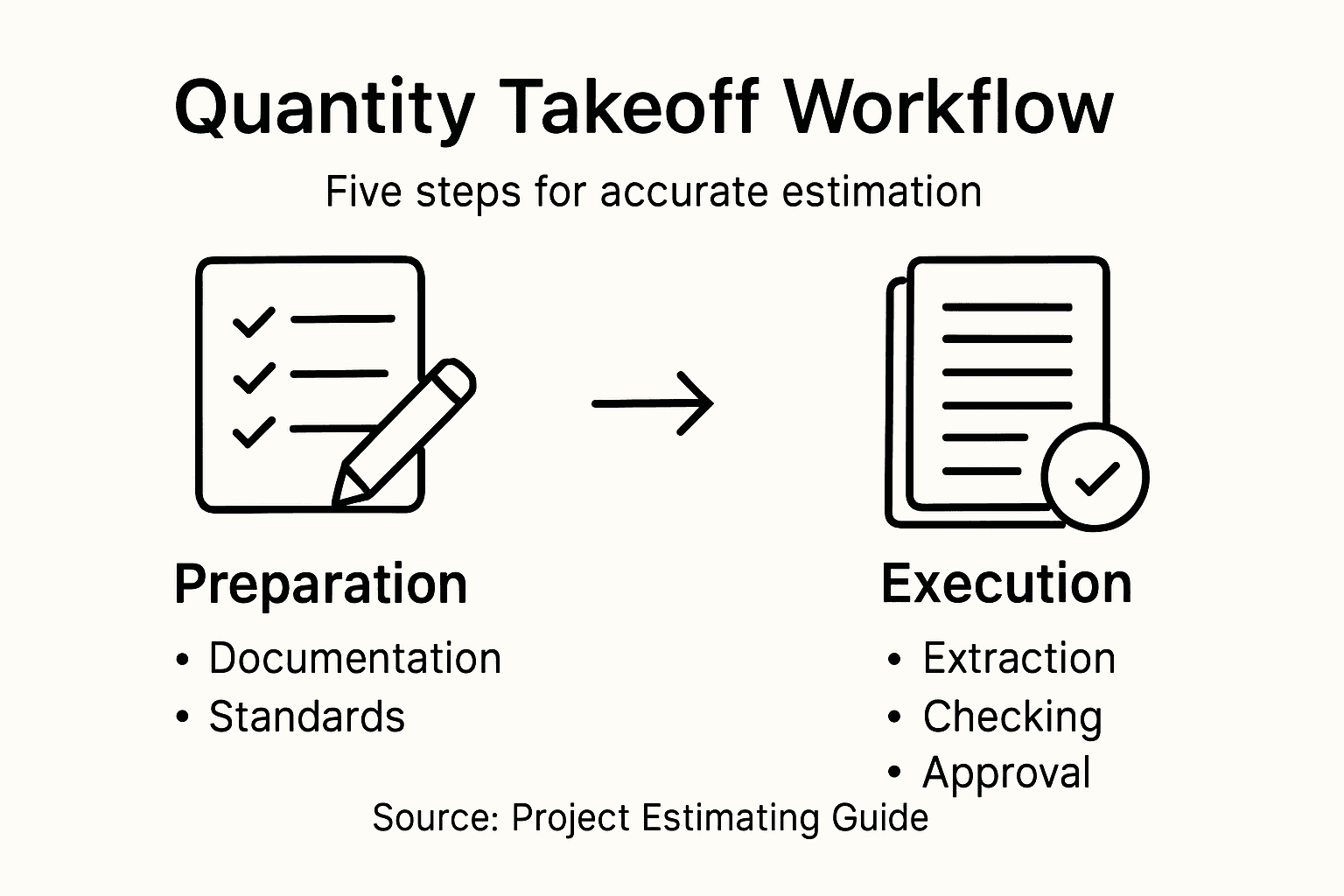
- Step 1: Gather Project Documentation
- Step 2: Set Up Measurement Standards
- Step 3: Extract Quantities From Drawings
- Step 4: Document And Cross-Check Calculations
- Step 5: Present Final Quantities For Approval
Quick Summary
| Key Message | Explanation |
|---|---|
| 1. Gather all project documentation | Compile essential documents like drawings and specifications for accurate measurements and cost estimations. |
| 2. Set up standard measurement protocols | Establish and communicate clear measurement standards to ensure consistency and compliance across the project. |
| 3. Extract quantities accurately | Convert construction drawings into precise numerical data using standardised protocols and digital tools. |
| 4. Implement thorough documentation | Record and cross-check calculations systematically to maintain accuracy and integrity in your quantity takeoff. |
| 5. Present final quantities clearly | Create a comprehensive report with visual aids to facilitate stakeholder understanding and approval of final measurements. |
Step 1: Gather project documentation
Successfully gathering project documentation forms the critical foundation for an accurate quantity takeoff workflow. Your goal is to compile all essential project materials that will inform precise measurements and cost estimations.
Start by systematically collecting the core project documents. This includes architectural drawings, engineering specifications, construction project blueprints, site surveys, and any supplementary technical reports. Examine each document meticulously to ensure you have comprehensive coverage of the project scope. Pay special attention to detailed annotations, scale representations, and any revisions that might impact quantity calculations.
Ensure you obtain both digital and physical copies of documentation from project stakeholders. Request the most recent versions directly from architects, engineers, or project managers. Cross reference multiple document sets to validate information accuracy and identify any potential discrepancies. Quantity surveyor services guidelines recommend maintaining a comprehensive document register to track all received materials.
Pro Tip: Create a digital folder system with clear version tracking to manage multiple document iterations and prevent confusion during your quantity takeoff process.
Step 2: Set up measurement standards
Establishing robust measurement standards is fundamental to achieving precise and consistent quantity takeoffs across your construction project. Your objective is to create a standardised framework that ensures accuracy and compliance with industry best practices.
Begin by referencing the New Rules of Measurement published by the Royal Institution of Chartered Surveyors. These guidelines provide a comprehensive approach to measurement conventions in construction cost management. Select a specific standard method that aligns with your project type whether residential, commercial, or industrial. Review each measurement category meticulously including elemental, component, and work section measurements to guarantee comprehensive coverage.
Carefully document your chosen measurement protocols and communicate them clearly with all project stakeholders. Standard Methods of Measurement recommend creating a detailed reference document that outlines specific measurement approaches for different construction elements. This ensures consistency across drawings, specifications, and quantity calculations. Include precise definitions for measurement units, calculation methodologies, and any project specific nuances that might impact quantification.
Pro Tip: Create a digital measurement standards template that can be quickly adapted for different project types to streamline your quantity takeoff workflow.
Here is a quick reference for common measurement standards in the UK construction industry:
| Measurement Standard | Governing Body | Common Application |
|---|---|---|
| New Rules of Measurement (NRM) | Royal Institution of Chartered Surveyors (RICS) | Building cost management |
| Standard Method of Measurement | Construction Industry (UK-wide best practice) | Quantity surveying |
| Civil Engineering Standard Method of Measurement (CESMM) | Institution of Civil Engineers (ICE) | Civil engineering works |
Step 3: Extract quantities from drawings
Quantity extraction from construction drawings is a precise technical skill that transforms visual information into actionable numerical data. Your goal is to systematically translate graphical representations into accurate quantitative measurements that form the foundation of project cost estimation.

Begin by carefully interpreting construction drawings using standardised measurement protocols. Examine each drawing layer meticulously paying special attention to scale, annotations, and detailed representations of building elements. Utilise digital measurement tools that allow precise point to point measurements and area calculations. Cross reference multiple drawing sets to ensure consistency and identify any potential discrepancies in dimensional representations.
Develop a systematic approach to documenting your quantity extractions. Construction measurement practices recommend creating a structured spreadsheet that captures each measured element with its corresponding quantity, unit of measurement, and drawing reference. Verify your measurements against project specifications and consult with design professionals if any ambiguities arise during the extraction process.
Pro Tip: Invest in calibrated digital measurement software that supports multiple drawing file formats to streamline your quantity extraction workflow.
Step 4: Document and cross-check calculations
Documenting and cross-checking calculations is the critical quality control stage that ensures the integrity and accuracy of your quantity takeoff process. Your primary objective is to create a robust verification system that minimises potential errors and provides transparent evidence of your measurement methodology.
Begin by systematically recording takeoff calculations) in a structured digital format. Create a comprehensive spreadsheet that includes detailed columns for each measurement category such as material type, quantity, unit of measurement, drawing reference, and calculation method. Implement a consistent colour coding or annotation system to distinguish between verified and preliminary measurements, enabling clear visual tracking of your progress and confidence level in each calculated quantity.
Knowledge-based verification frameworks recommend multiple cross-referencing techniques. Compare your hand calculations against digital measurement tools and software outputs. Engage in peer review by having another quantity surveyor independently validate complex or high-value measurement sets. Always maintain a transparent audit trail that demonstrates how each quantity was derived, which provides critical accountability and enables future reference or potential dispute resolution.
Pro Tip: Develop a standardised calculation review checklist that forces systematic verification at each stage of your quantity takeoff process.
The following table summarises key sources of errors in quantity takeoff and how each can be mitigated:
| Error Source | Mitigation Approach | Impact if Unaddressed |
|---|---|---|
| Outdated project documents | Implement strict version control | Inaccurate measurements and costs |
| Inconsistent measurement methods | Adhere to a single measurement standard | Miscommunication among stakeholders |
| Manual data entry mistakes | Use automated digital tools and double-checks | Calculation errors and discrepancies |
| Ambiguous drawing annotations | Clarify with designers or request additional info | Misinterpretation of requirements |
Step 5: Present final quantities for approval
Presenting final quantities requires strategic communication and meticulous documentation that builds stakeholder confidence. Your objective is to transform complex technical measurements into a clear, comprehensible narrative that facilitates informed decision making.
Begin by preparing comprehensive final account procedures that provide transparent and detailed documentation. Create a visually engaging report that breaks down quantities by material type, location, and calculated measurement method. Include clear visual representations such as charts, graphs, and summary tables that highlight key quantity insights. Annotate each quantity with its source drawing reference and calculation methodology to demonstrate rigorous verification.
Integrated quantity reporting frameworks recommend presenting quantities with contextual cost estimates. Schedule a formal review meeting with project stakeholders where you can walk through each measurement systematically. Anticipate and prepare for potential questions by developing a supplementary document that explains your calculation approaches and highlights the precision of your quantity takeoff methodology.
Pro Tip: Develop a standardised presentation template that allows for consistent and professional quantity reporting across different project types.
Master Your Quantity Takeoff Workflow with Expert Estimating Support
Accurate quantity takeoffs rely on meticulous documentation gathering, strict measurement standards and precise calculation verification. These critical steps often present challenges that can delay project timelines and introduce costly errors. If you need transparent, reliable solutions that ensure your takeoff calculations align perfectly with UK construction standards, My Project Estimating is here to help. We specialise in providing detailed quantity takeoffs and cost planning based on verified UK market data, helping you prevent the frustrations of outdated documents and inconsistent measurement methods.
Unlock the full potential of your project planning by visiting Uncategorized Archives – My Project Estimating for insights into our comprehensive estimating services. Take control of your cost forecasting with a trusted partner that offers fast turnaround and clear communication through a simple four-step process. Start making confident, informed decisions to keep your project on budget today by exploring our offerings at My Project Estimating and get your quantity takeoff expertly handled before your next review meeting.
Frequently Asked Questions
What is the first step in the quantity takeoff workflow?
The first step in the quantity takeoff workflow is to gather all essential project documentation. Collect architectural drawings, engineering specifications, and site surveys to ensure comprehensive coverage of the project scope.
How do I set up measurement standards for my project?
To set up measurement standards, reference the New Rules of Measurement published by industry experts. Document your chosen measurement protocols and communicate them to all stakeholders to ensure consistent understanding and implementation throughout the project.
How can I extract accurate quantities from construction drawings?
Accurately extract quantities from construction drawings by carefully interpreting each element with standardised measurement protocols. Use digital measurement tools to make precise point-to-point measurements, and systematically document the extracted quantities in a structured spreadsheet for clarity and organisation.
What practices can I use to document and cross-check my calculations?
Document and cross-check calculations by creating a detailed spreadsheet that records each measurement category, including quantity and unit. Implement a peer review process and compare hand calculations against digital tools to minimise errors and ensure accuracy in your quantity takeoff.
How should I present final quantities for project approval?
Present final quantities by preparing a comprehensive report that breaks down measurements clearly. Include visual elements like charts and summary tables, and schedule a formal review meeting to walk stakeholders through your results, ensuring they understand your methodology and verification processes.