Every UK project manager knows that accurate cost estimates are the backbone of reliable construction budgets. When expert evidence and robust data are missing, financial risks multiply, making it harder to keep major UK projects on track. By focusing on evidence-based information that evolves with your project, construction professionals can gain clearer insight, sharpen budget planning, and reduce unexpected expenses.
Table of Contents
- Defining Data In Construction Cost Estimating
- Types Of Data Used In Project Estimates
- Impact Of Data Quality On Accuracy
- Applying Data-Driven Methods To UK Projects
- Common Pitfalls In Data-Based Cost Planning
Key Takeaways
| Point | Details |
|---|---|
| Importance of Data | Data in construction estimation is essential for financial planning, incorporating various sources to reflect market realities. |
| Role of Technology | Utilising advanced technologies like BIM and predictive analytics enhances the accuracy and adaptability of cost estimations. |
| Data Quality Significance | High-quality data is crucial; inaccuracies can lead to significant financial risks and project mismanagement. |
| Common Pitfalls | Professionals must be aware of pitfalls like outdated sources and confirmation bias to ensure reliable cost projections. |
Defining Data in Construction Cost Estimating
In construction cost estimation, data represents the foundational information that enables precise financial planning and risk management for UK projects. The UK government’s cost estimating guidance emphasises that construction data is not merely numbers, but a dynamic ecosystem of expert knowledge, empirical insights, and contextual understanding that evolves throughout a project’s lifecycle.
Construction cost data encompasses multiple critical dimensions: historical project costs, material pricing, labour rates, equipment expenses, geographical variations, and potential risk factors. These interconnected data points are systematically collected from diverse sources such as previous project records, supplier quotations, industry benchmarks, regional economic indicators, and real-time market intelligence. By integrating these multifaceted information streams, project managers can develop robust, nuanced cost estimates that reflect the intricate realities of contemporary construction environments.
Accurate data collection and analysis require sophisticated methodologies. Construction professionals must leverage advanced technologies like Building Information Modelling (BIM), digital quantity surveying tools, and predictive analytics platforms to transform raw information into actionable financial insights. These technologies enable granular tracking of cost variables, facilitating dynamic estimate adjustments as project parameters shift and external market conditions fluctuate.
Pro tip: Implement a systematic data validation process that cross-references multiple sources and regularly updates your cost estimation database to maintain accuracy and reliability.
Types of Data Used in Project Estimates
In construction project estimating, professionals rely on diverse data categories that collectively form a comprehensive financial blueprint. When developing construction cost estimates, project managers integrate multiple interconnected data types to ensure precision and reliability.
The primary data categories used in project estimates include:
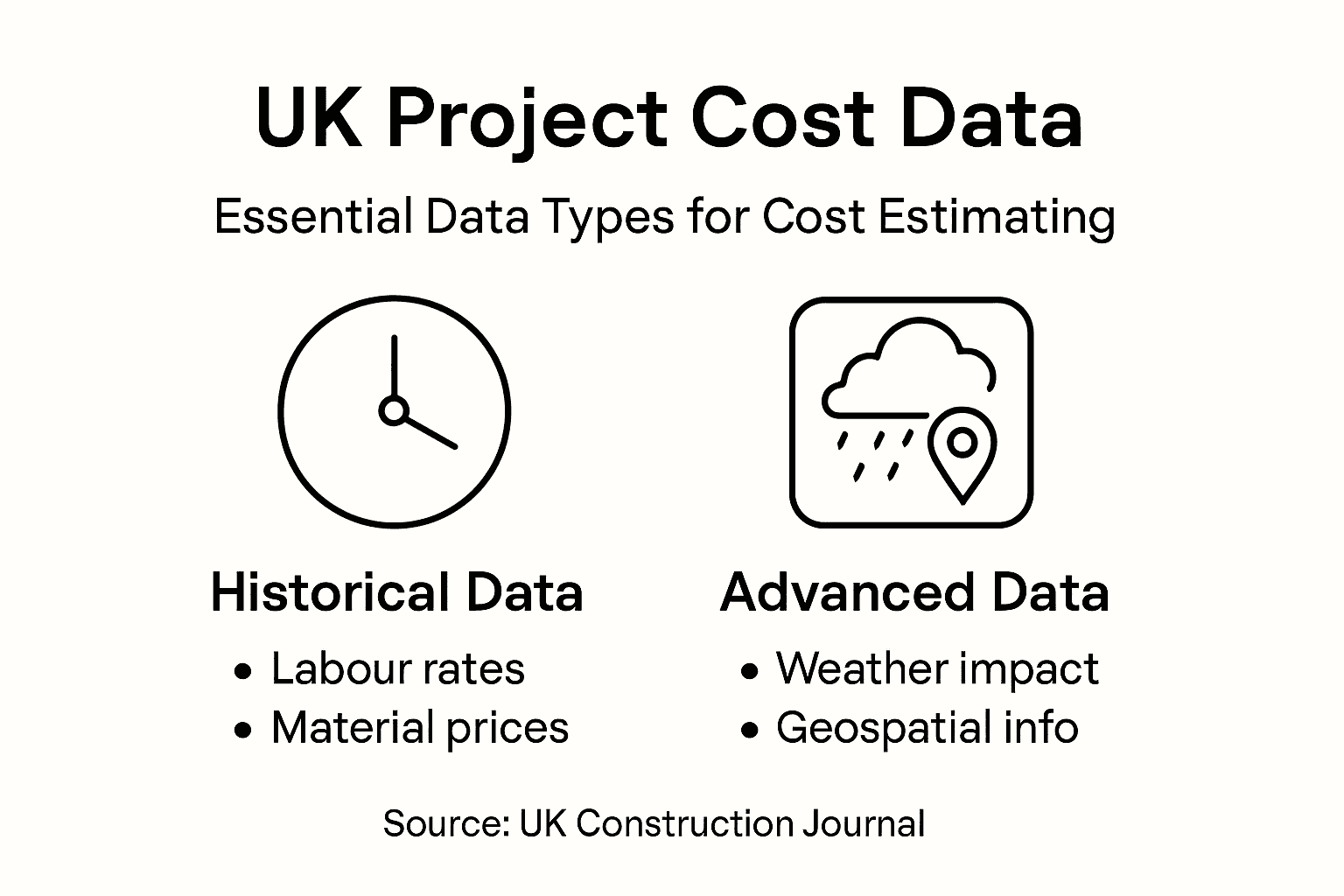
- Historical Cost Data: Detailed records from previous similar projects, capturing actual expenditures, resource utilisation, and performance metrics
- Material Pricing Information: Current market rates for construction materials, including steel, concrete, timber, electrical components, and mechanical systems
- Labour Rate Data: Comprehensive information about workforce costs, including skilled trade rates, regional wage variations, and labour productivity metrics
- Equipment Cost Data: Expenses related to machinery rental, operational costs, maintenance, and depreciation
- Geographical and Regional Cost Indicators: Location-specific pricing adjustments that account for regional economic variations, transportation costs, and local market conditions
Advanced project estimators also incorporate sophisticated data streams such as geospatial information, weather impact assessments, and predictive risk analysis. These additional data layers enable more nuanced financial modeling, allowing construction professionals to anticipate potential cost fluctuations and develop more resilient project budgets. By systematically analysing these diverse data sources, estimators can create increasingly accurate and dynamic financial projections that adapt to complex project environments.
Pro tip: Develop a standardised data collection and validation framework that consistently updates your cost estimation database, ensuring your project estimates remain current and reflective of real-world market conditions.
Impact of Data Quality on Accuracy
In construction project estimating, data quality represents the critical foundation that determines the reliability and precision of financial projections. By examining cost estimating for developers, professionals understand that even minor data inaccuracies can cascade into significant financial risks and project management challenges.
The impact of data quality manifests through several key dimensions:
- Completeness: Ensuring all relevant cost parameters are captured without omissions
- Accuracy: Verifying that individual data points reflect true current market conditions
- Timeliness: Using the most recent and up-to-date information available
- Consistency: Maintaining uniform data collection and validation methodologies
- Reliability: Sourcing information from credible and verified references
Poor data quality introduces substantial financial vulnerabilities. Inaccurate material pricing, outdated labour rates, or incomplete historical cost records can lead to estimation errors ranging from 10% to 30%, potentially translating into substantial budget overruns. Construction professionals must implement rigorous data validation processes, leveraging advanced technologies like machine learning and real-time market analytics to continuously refine and update their estimation databases.
Understanding the impact of data quality on construction cost estimates is essential for effective risk management:
| Data Quality Attribute | Business Impact | Example Consequence |
|---|---|---|
| Completeness | Prevents overlooked expenses | Missed line items cause budget gaps |
| Timeliness | Reflects current market shifts | Outdated prices reduce estimate accuracy |
| Consistency | Ensures comparable data uses | Misalignment between projects leads to confusion |
| Reliability | Reduces estimation uncertainty | Unverified data increases financial risk |
Pro tip: Create a systematic data quality scorecard that regularly assesses and grades each data source, implementing automatic flags for outdated or potentially unreliable information.
Applying Data-Driven Methods to UK Projects
Data-driven methods have transformed construction project estimating, offering unprecedented precision and strategic insight for UK professionals. The cost estimation methods represent a sophisticated approach that goes beyond traditional guesswork, integrating advanced analytical techniques to create more reliable financial projections.
Key components of data-driven cost estimation in the UK construction sector include:
- Predictive Modelling: Utilising statistical techniques to forecast potential cost scenarios
- Machine Learning Algorithms: Analysing complex historical data to identify patterns and predict future trends
- Risk Quantification: Developing probabilistic models that account for uncertainty and variability
- Real-Time Market Intelligence: Incorporating dynamic economic indicators and regional cost fluctuations
- Parametric Estimation Techniques: Creating mathematical models that correlate project parameters with expected costs
Successful implementation requires a holistic approach that combines technological sophistication with deep domain expertise. Construction professionals must develop robust data infrastructure, invest in advanced analytics capabilities, and cultivate a culture of continuous learning and adaptation. This means not just collecting data, but actively interpreting and applying insights across project lifecycles, ensuring that each estimation becomes more refined and accurate than the last.
Here is a quick comparison of traditional versus data-driven approaches in UK construction estimating:
| Approach | Tools Used | Typical Accuracy | Key Limitation |
|---|---|---|---|
| Traditional | Manual calculations, spreadsheets | Moderate, often 70-85% | Prone to human error |
| Data-Driven | BIM, analytics platforms, AI | High, regularly trends 90-95% | Requires investment and training |
Pro tip: Develop a centralised data repository that integrates multiple information sources, enabling cross-referencing and validation of cost estimation inputs.
Common Pitfalls in Data-Based Cost Planning
Data-based cost planning offers powerful insights, but UK construction professionals must navigate several critical challenges to ensure accurate financial projections. Construction cost planning requires meticulous attention to potential pitfalls that can undermine the entire estimation process.
The most significant data-based cost planning pitfalls include:
- Outdated Data Sources: Relying on historical information that no longer reflects current market conditions
- Confirmation Bias: Selectively interpreting data to support preconceived expectations
- Insufficient Data Validation: Failing to cross-reference and verify information from multiple sources
- Overreliance on Algorithms: Treating mathematical models as infallible without human critical analysis
- Neglecting Contextual Variations: Applying generic data without considering project-specific nuances
Successful cost planning demands a sophisticated approach that balances technological capabilities with human expertise. Construction professionals must develop a critical mindset that views data as a tool for informed decision-making, not an absolute truth. This involves creating robust validation protocols, maintaining scepticism towards automated recommendations, and continuously updating data collection methodologies to capture the complex, dynamic nature of construction project economics.
Pro tip: Implement a structured data review process that includes regular external audits and cross-functional validation to identify and mitigate potential estimation biases.
Unlock Accurate UK Construction Cost Estimates with Reliable Data
The challenge of ensuring complete, timely, and accurate data in UK construction cost estimating can feel overwhelming. This article reveals how poor data quality can lead to costly budget overruns and risks that every builder, architect, or developer wants to avoid. Our solutions at My Project Estimating directly address these pain points by offering transparent, data-driven, and UK market-verified cost estimates. We understand the critical need for validated information that evolves with real-time market fluctuations to keep your projects financially on track.
Don’t let unreliable data hold your project back. Whether you need early-stage cost planning, detailed quantity takeoffs, or comprehensive cost reports, our professional estimators deliver accurate insights quickly with a proven four-step process. Start making informed decisions today by exploring our tailored services on the Uncategorized Archives – My Project Estimating page. Visit My Project Estimating now to secure precision in your cost planning and safeguard your project budget.
Frequently Asked Questions
What types of data are essential for construction cost estimating?
Construction cost estimating relies on various data types including historical cost data, material pricing information, labour rate data, equipment cost data, and geographical cost indicators to ensure precision and reliability in estimates.
How does data quality impact the accuracy of cost estimates?
Data quality is crucial for accurate cost estimates; poor data quality can lead to errors ranging from 10% to 30%, resulting in significant budget overruns. Attributes like completeness, accuracy, timeliness, consistency, and reliability are essential for ensuring high data quality.
What technologies can enhance data-driven cost estimating?
Technologies such as Building Information Modelling (BIM), digital quantity surveying tools, and predictive analytics platforms are vital for transforming raw data into actionable insights, thereby improving the accuracy and reliability of cost estimates.
What are common pitfalls in data-based cost planning?
Common pitfalls include relying on outdated data sources, confirmation bias, insufficient data validation, overreliance on algorithms, and neglecting project-specific nuances, all of which can compromise the accuracy of cost estimates.