Every UK project manager knows that what you budget at tender rarely matches the final account. Cost fluctuation is not a surprise in construction, but a common challenge, shaped by shifting supply chains, regulatory updates, and volatile material prices. Understanding the driving forces behind these changes helps you improve budget accuracy and protect your margin. This guide explains how cost fluctuation contract mechanisms work in the UK market and how to use them for better cost control.
Table of Contents
- Defining Construction Cost Fluctuations In The UK
- Major Factors Driving Cost Changes
- Role Of Supply Chains And Global Events
- Impact Of UK Regulation And Policy Shifts
- Managing And Forecasting Budget Risks
Key Takeaways
| Point | Details |
|---|---|
| Understanding Cost Fluctuations | Construction costs in the UK fluctuate due to material prices, labour rates, and plant hire charges, necessitating accurate budgeting and continuous monitoring. |
| Impact of Supply Chains | Global events and supply chain disruptions can significantly affect material availability and pricing, stressing the importance of robust procurement strategies. |
| Regulatory Changes and Compliance | Ongoing changes to regulations and compliance requirements impose additional costs; planning for these is crucial from the project’s outset. |
| Effective Risk Management | Proactively managing budget risks by differentiating controllable and uncontrollable factors allows for better financial forecasting and project stability. |
Defining Construction Cost Fluctuations in the UK
Construction cost fluctuations are changes in the price of labour, materials, and equipment throughout the duration of a project. In the UK market, these fluctuations reflect the dynamic nature of the construction industry, where costs rarely remain static from the time you prepare your initial estimate to project completion. Unlike a simple price increase, cost fluctuation encompasses the complex interplay of supply chain disruptions, market demand shifts, regulatory changes, and external economic pressures that affect your bottom line during construction.
For quantity surveyors and project managers, understanding what drives these movements is fundamental to accurate budgeting. The Royal Institution of Chartered Surveyors has documented fluctuating price mechanisms used in UK construction contracts, which outline how contractual adjustments account for cost changes in response to factors like currency exchange rates, material price shifts, and project delays. These mechanisms exist precisely because cost fluctuations are an expected feature of UK construction work, not an anomaly. When you sign a contract that runs for 18 months or longer, you’re essentially entering into an agreement where some costs will move beyond the original figures.
The UK construction materials sector demonstrates this reality clearly. Recent government statistics on building material prices show fluctuations in materials such as bricks and blocks, reflecting wider supply and demand pressures affecting the entire sector. These aren’t isolated incidents but rather systematic variations that impact your project’s material costs month on month. When you’re sourcing steel reinforcement, concrete, or structural timber, you’re contending with prices that shift based on global commodity markets, transportation costs, and supplier availability. A project starting in January will face different material pricing by June, even if specifications remain identical.
Cost fluctuations manifest across three primary categories: material costs, labour rates, and plant and equipment hire charges. Material price movements stem from both international commodity markets and domestic supply constraints. Labour fluctuations arise from wage inflation, worker availability, and seasonal demand for skilled trades. Equipment costs reflect hire market dynamics and the broader economic environment. Understanding these distinct categories helps you anticipate where pressure points will emerge in your specific project type. A residential development faces different cost drivers than an industrial warehouse or commercial office space.
To help clarify the distinct sources of construction cost movement, here is a summary comparing cost fluctuation categories:
| Category | Main Causes | Typical Impact on Projects |
|---|---|---|
| Material Costs | Commodity prices, supply constraints | Alters procurement timing and prices |
| Labour Rates | Wage inflation, labour shortages | Leads to higher wage bills, delays |
| Plant & Equipment Hire | Hire market dynamics, fuel prices | Increases operational expenditure |
The distinction between cost fluctuations and contingency is crucial for your financial planning. Contingency represents money set aside for unknown risks and unforeseen site conditions. Cost fluctuation addresses known market dynamics that will inevitably affect pricing as the project progresses. Your initial estimate might include a contingency allowance of 5-10 percent, but cost fluctuations operate separately, often governed by contract clauses that automatically adjust payments based on published indices. This separation ensures clarity when projects exceed budget, helping you determine whether overruns stem from poor estimating, scope changes, or legitimate market movements beyond anyone’s control.
Pro tip: Build your cost estimates on the UK construction indices most relevant to your project type, then separately track actual market movements monthly against those published baselines to identify emerging cost trends before they significantly impact your budget.
Major Factors Driving Cost Changes
Construction cost changes in the UK stem from a complex web of interconnected market forces that operate simultaneously. Unlike a single dominant factor, your project costs fluctuate because of multiple pressures working in tandem: material availability and pricing, labour market dynamics, supply chain disruptions, regulatory shifts, and broader economic conditions. Understanding these distinct drivers helps you anticipate where budget pressure will emerge and when you need to lock in prices through fixed contracts or forward purchasing agreements.
Material costs represent the most visible and volatile driver of construction price movements. Steel, concrete, timber, bricks, and specialist components all respond to global commodity markets, transportation costs, and domestic supply constraints. When crude oil prices spike, the cost of transporting materials across the country increases immediately. When demand for construction steel outpaces production capacity, manufacturers raise prices. Recent material price inflation trends show how building components experience significant price swings driven by both international commodity cycles and domestic construction activity levels. A shortage of skilled bricklayers doesn’t just affect labour rates; it also creates bottlenecks that delay projects, extending your timeline and increasing overhead costs. Seasonal variations matter too. Winter weather drives up costs for concrete curing, whilst spring demand from multiple projects competing for materials pushes prices upward.
Labour market pressures create another layer of cost fluctuation that directly impacts your project timeline and budget. UK construction faces persistent skills shortages in trades such as carpentry, plumbing, and electrical work. When demand for these specialists exceeds supply, wage rates climb. Beyond base wages, employers must account for increased National Insurance contributions, pension scheme costs, and competition for talent. Skilled workers can choose between multiple projects, so contractors must offer premium rates to secure labour. Apprenticeship numbers and immigration policy both influence labour availability. Post Brexit changes to worker mobility have tightened labour supply in certain regions, particularly affecting London and the South East where competition for workers intensifies costs. Weather delays compound labour costs by keeping workers on site longer without productive output.

Supply chain disruptions have become a structural feature of UK construction rather than temporary anomalies. Construction professionals report supply chain pressures as a persistent cost driver affecting project delivery. When a major supplier experiences production issues or logistics delays, alternative suppliers may not have capacity, forcing projects to accept delayed material deliveries or premium pricing for expedited shipments. Freight costs fluctuate with fuel prices and shipping capacity. Some specialist components, such as certain mechanical systems or facade materials, have limited suppliers globally, meaning disruptions anywhere in the world cascade to your UK project.
Regulatory and policy changes introduce cost shifts that you cannot negotiate around. Building Regulations updates, environmental compliance requirements, and health and safety standards all add costs. When regulations tighten, suppliers must invest in compliance, passing those costs forward. Energy efficiency standards increasingly require premium materials and specialist installation. Planning conditions may impose requirements for sustainable materials or local sourcing, affecting both availability and price. Tax changes, such as VAT adjustments or business rates modifications, ripple through the supply chain.
Broader economic conditions set the backdrop for all these individual factors. When the economy grows strongly, demand for construction increases, pushing material and labour costs upward as supply tightens. Conversely, economic uncertainty can suppress demand but paradoxically increase costs as suppliers reduce production, offering less competitive pricing. Interest rate movements affect borrowing costs for developers and contractors, influencing their willingness to commit to projects. Currency exchange rates matter significantly since the UK imports substantial quantities of construction materials and components.
Pro tip: Monitor your key material suppliers’ quarterly forecasts and track published construction cost indices monthly; this gives you early warning of 4 to 8 week price movements before they hit your project, allowing time to adjust procurement strategy or renegotiate contract terms.
Role of Supply Chains and Global Events
Your project costs rise and fall based on what happens thousands of miles away, not just in your local market. Supply chains connect UK construction to global manufacturing, and when disruptions occur anywhere in that chain, your budget feels the impact within weeks. A factory closure in Southeast Asia, geopolitical tensions affecting shipping routes, or extreme weather disrupting logistics all translate into delayed materials, inflated freight costs, and impossible deadlines. The interconnected nature of modern supply chains means that construction is no longer a purely local business; it operates within a global system where distant events become local problems.
The fragility of these supply networks became glaringly apparent during recent years of disruption. Global supply chain events like the COVID-19 pandemic and Brexit exposed how quickly construction projects can face material shortages and cost inflation when logistics networks collapse or trade barriers shift. The pandemic locked down manufacturing facilities worldwide, reducing production capacity precisely when demand remained high. Container ships sat in wrong ports. Semiconductor shortages rippled through to specialist building equipment. Skilled workers contracted illness, reducing site productivity. Brexit introduced customs clearance delays and paperwork complexity that added weeks to material delivery times. Even as these specific crises have eased, their legacy persists: supply chains operate with less buffer capacity, prices remain elevated, and uncertainty has become the default planning assumption.
Material availability now fluctuates significantly based on global commodity cycles and geopolitical events. Construction material price volatility reflects how global supply constraints, shipping disruptions, and logistics challenges affect UK project costs directly. When Russian and Ukrainian conflict disrupted fertiliser and metal supplies, construction material prices spiked. When tensions in the Middle East threatened shipping through the Suez Canal, freight costs doubled overnight. Timber prices surged when wildfires reduced production in key supplier regions. Steel availability tightened when Indian and Australian mines faced operational disruptions. These aren’t theoretical concerns; they’re live risks affecting your material procurement every month. A project scheduled to use imported facade materials faces different cost exposure than one using domestic products, yet both depend on global logistics working smoothly.
Transportation and logistics form the hidden backbone of construction cost stability. Fuel prices drive haulage costs, making your materials more expensive when crude oil spikes. Shipping container availability affects whether materials arrive on time or cost premium rates for expedited freight. Port capacity determines how quickly imported components clear customs and reach your site. Lorry driver availability influences haulage costs and delivery schedules. During the energy crisis of 2022, fuel surcharges added 15 to 25 percent to haulage costs temporarily. When the Suez Canal blockage occurred, freight costs from Asia doubled. These aren’t margin adjustments; they’re real cost pressures that compress your project budget.
Supplier concentration increases vulnerability to disruption. Many specialist components, from mechanical ventilation systems to structural curtain walling, come from limited manufacturers globally. A production issue at a sole supplier means no alternatives exist. A fire at a major component factory can delay your project by months. Brexit reduced the number of EU suppliers British contractors could easily access, concentrating purchases with remaining providers who now face less competition and less pressure on pricing. When supply is concentrated, suppliers have pricing power. Competition vanishes, and you negotiate from weakness.
Build supply chain resilience into your cost planning and procurement strategy. Rather than chasing the lowest material price from a single supplier, consider whether paying a modest premium for dual sourcing protects you against disruption. Stock critical long-lead items earlier in the project timeline, accepting slightly higher carrying costs to avoid panic purchasing when shortages emerge. Work with suppliers to establish realistic delivery schedules that assume disruptions rather than hoping for perfect logistics. Include material cost escalation clauses in contracts that account for commodity price movements, protecting both you and your suppliers from unexpected swings.
Pro tip: Identify your project’s top five long-lead items and second-source each one with a backup supplier; this costs slightly more upfront but protects against the catastrophic project delays and premium pricing that emerge when primary suppliers face disruption.
Impact of UK Regulation and Policy Shifts
Regulation doesn’t just set rules; it sets costs. Every time Building Regulations tighten, fire safety standards evolve, or energy efficiency requirements shift, your project budget absorbs new expenses. These aren’t optional extras or nice-to-have improvements. They’re mandatory compliance obligations that contractors must price in from day one. The UK construction industry operates within a heavily regulated environment, and regulatory changes cascade through supply chains, labour requirements, and material specifications with surprising speed. Understanding how policy shifts affect your costs helps you anticipate budget impacts before they blindside you during procurement or construction.
The Building Safety Act 2022 represents the most significant regulatory shift affecting UK construction costs in recent years. The Building Safety Regulator charging scheme introduced new compliance costs through increased oversight, inspection requirements, and safety standards particularly for higher-risk buildings. Projects over seven storeys or containing flats now face enhanced regulatory scrutiny, more frequent inspections, and detailed documentation requirements. These aren’t trivial additions. Increased inspections mean delays whilst awaiting regulator sign-off at critical stages. Enhanced safety standards require certified materials and specialist installation methods that cost more than standard approaches. Fire safety requirements impose material upgrades, sometimes necessitating replacement of previously acceptable components with fire-rated alternatives. A residential project that would have cost £2 million under previous regulations might cost £2.25 million under current ones purely from compliance obligations. Smaller projects below the regulatory threshold face different cost structures than those triggering Building Safety oversight, creating cost discontinuities that surprise unprepared estimators.
Energy efficiency regulations drive continuous material and specification upgrades. Part L of the Building Regulations updates periodically, raising insulation standards and requiring more sophisticated mechanical ventilation systems. Each update obsoletes previously acceptable materials and methods, forcing suppliers to stock new products and contractors to retrain on new installation techniques. When regulations mandate lower U-values for windows or walls, standard construction methods become non-compliant. Contractors must specify premium insulation, install more complex junctions, or specify triple-glazed windows instead of double-glazed alternatives. These aren’t cosmetic upgrades; they’re structural specification changes that affect material costs, labour hours, and subcontractor expertise. Environmental regulations increasingly require sustainable material sourcing, recycled content specifications, or carbon accounting, all of which shift material sourcing and add cost verification burdens.
Planning conditions increasingly impose cost obligations tied to sustainability and community benefit. Developments must now frequently provide renewable energy systems, green infrastructure, or biodiversity enhancements. What used to be optional green features have become mandatory planning conditions. Solar panel systems, green roofs, wildlife habitats, and water recycling systems all add cost. A planning permission might require carbon neutrality or near-zero carbon performance, forcing more expensive mechanical systems and construction methods. These aren’t negotiable extras; they’re planning obligations. Refuse planning consent and the project doesn’t proceed. Accept the conditions and your cost base rises automatically.
Health and safety legislation drives labour costs and site management complexity. Updated COSHH regulations, asbestos management requirements, and worker protection standards all increase overhead costs. Asbestos surveys on older buildings, remedial works for contaminated sites, and specialist training for workers all add cost. Contractors must employ safety officers, conduct more inspections, and maintain more detailed records. These costs don’t appear in material pricing but they appear in labour rates and site management fees.
Ongoing policy reforms in construction regulation continue reshaping cost structures across planning, building safety, and environmental compliance. Future changes to planning frameworks may accelerate timescales or impose new requirements. Building Regulations amendments can become mandatory on short notice. Contractors absorb these changes by raising prices because they cannot absorb unlimited compliance cost.
When estimating, build in regulatory compliance as a distinct cost category rather than hoping it disappears. Identify which regulations apply to your specific project type and location, then price compliance explicitly. Include time for regulator engagement, inspection scheduling, and documentation. Don’t assume outdated cost benchmarks apply to current regulations; that’s how projects blow budgets.
Pro tip: Request confirmation from your local Building Control team early in planning about which Building Regulations apply and any known upcoming regulatory changes, then budget compliance costs separately from material and labour, protecting yourself against underestimated regulatory burdens.
Managing and Forecasting Budget Risks
Budget risk management isn’t about predicting the future with perfect accuracy. It’s about recognising which cost drivers you can influence, which ones you cannot, and building financial buffers in the right places. Construction projects operate in uncertainty. Material prices move. Labour availability shifts. Weather delays projects. Regulations change mid-construction. Your job as a quantity surveyor or project manager is not to eliminate these risks but to anticipate them, price them appropriately, and monitor them continuously throughout delivery. Effective budget risk management transforms cost fluctuations from project-destroying surprises into manageable variables that you’ve already accounted for.
Start by identifying which risks actually matter to your specific project. Not all cost drivers carry equal weight. A commercial office project depends heavily on steel pricing and specialist mechanical systems; a residential development depends more on labour availability and regulatory compliance. Foundational risk management principles emphasise identifying, assessing, and actively mitigating risks rather than hoping they disappear. Create a risk register specific to your project that lists the top ten cost drivers, estimates their probability of occurrence, quantifies their potential financial impact, and identifies mitigation strategies. A risk register isn’t a theoretical exercise; it’s your decision-making tool. When material prices spike mid-project, you refer to your risk register to understand whether this was anticipated and provisioned for, or whether it represents a genuine budget threat requiring corrective action.
Price risk explicitly rather than hiding it in contingency. Many estimators create a single contingency figure covering everything from unknown ground conditions to supplier failures to regulatory changes. This approach obscures risk, making it impossible to track which risks actually occur versus which ones never materialise. Better practice separates known risks from unknown ones. Quantifiable risks such as material price escalation, labour wage inflation, and regulatory compliance costs belong in your base estimate with explicit escalation provisions. Unknown risks such as unforeseen ground conditions or major supply chain shocks belong in contingency. This separation means your estimate is transparent about what’s included and what assumptions underpin it. When you present a budget to a client, you can explain which elements are certain, which are indexed to published benchmarks, and which are contingency for unknowns. Risk allocation and pricing approaches in construction contracts define how risks transfer between parties, affecting how you price for risk exposure. If your contract places material price risk on you, you must price for that exposure. If the contract passes risk to the client through escalation clauses, your pricing adjusts accordingly.
Monitor actual costs against forecast continuously. Monthly cost tracking isn’t just for accountants; it’s your early warning system for emerging budget threats. Track material prices against the indices you used in your estimate. Track labour costs against agreed rates. Track programme delays and their cost implications. When actual costs diverge from forecast by more than 2 to 3 percent, investigate why. Small variances compound. A 3 percent overspend on labour in month three becomes a 12 percent overspend by month twelve if unaddressed. Monthly monitoring gives you time to implement corrective actions such as value engineering, procurement strategy adjustments, or programme changes before minor variances become major problems.
Build escalation provisions into long-term contracts rather than accepting fixed prices for work extending beyond six months. When a supplier quotes a fixed price for materials deliverable over 18 months, they’re either building enormous contingency into their price or they’re accepting risk they may not survive. Fixed prices for extended periods incentivise suppliers to reduce risk by front-loading cost increases. Escalation clauses tied to published indices such as the RICS Building Cost Information Service indices protect both you and suppliers. You know costs will adjust based on external benchmarks, not supplier guesswork. Suppliers know they won’t absorb unexpected inflation. This approach reduces overall project cost more effectively than trying to negotiate fixed prices that suppliers price defensively.
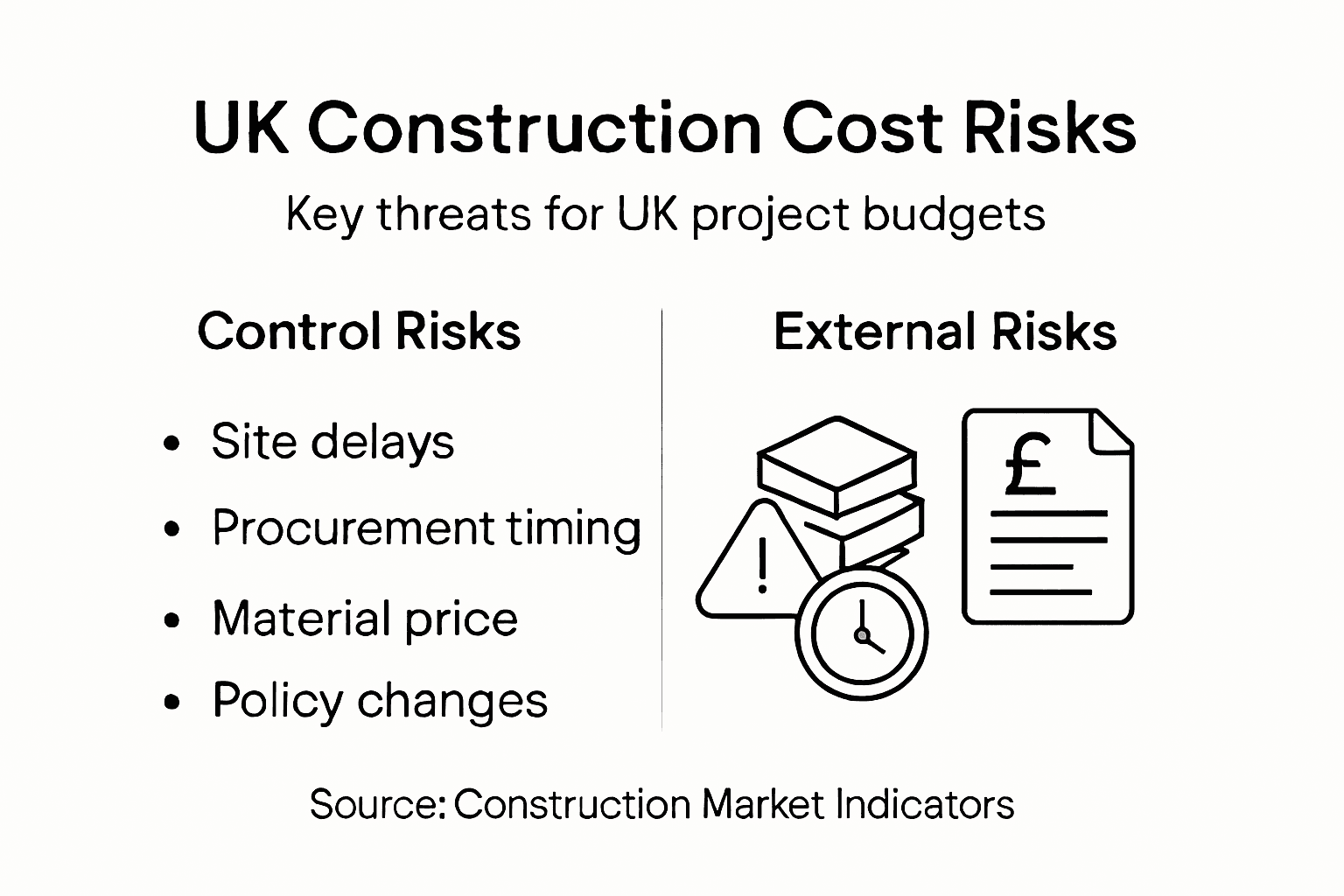
Differentiate between risks you control and risks you cannot control. Site management decisions, procurement timing, and programme planning are within your control. Global commodity prices, labour market conditions, and weather are largely outside your control. Spend management effort on controllable risks. Negotiate harder on procurement. Sequence work to optimise labour utilisation. Plan around seasonal factors. For uncontrollable risks, focus on forecasting and contingency planning rather than prevention.
Understanding which risks in construction are within your control versus those that are not is essential for effective budget management:
| Risk Type | Examples | Level of Control | Key Management Approach |
|---|---|---|---|
| Controllable | Procurement timing, programme planning | High | Negotiate, re-sequence, value engineer |
| Uncontrollable | Commodity prices, regulatory changes | Low | Build in contingencies, track indices |
Pro tip: Build a rolling 12 month cost forecast updated monthly with actual costs and revised forecasts, tracking each major cost category against published indices; this transforms reactive budget management into proactive risk visibility and gives you 6 to 8 weeks’ warning of emerging cost pressures before they impact your final account.
Take Control of Construction Cost Fluctuations with Precise UK Estimating
Understanding and managing the complex causes of cost fluctuations in the UK construction market is essential for keeping your projects on budget. As highlighted, factors like material price swings, labour rate changes, global supply chain disruptions and evolving regulations can unexpectedly inflate your costs. These challenges demand accurate cost planning based on real-time UK market data and proactive risk management strategies to minimise budget surprises. Terms such as cost fluctuation, contingency, and published construction cost indices are not just jargon; they are the foundation of professional estimating that protects your project’s financial health.
To address these issues head-on, My Project Estimating delivers fast and transparent cost estimates tailored specifically for UK construction projects. Whether you need early-stage cost planning or detailed quantity takeoffs, our services integrate the latest market intelligence and regulatory insights so you can confidently map out budget risks. Explore how our precise and timely estimating solutions help architects, developers and builders master cost fluctuations by visiting our Uncategorized Archives for practical insights and sample reports. Don’t wait for costs to spiral out of control. Visit My Project Estimating now to start controlling your construction budgets with expert UK-specific guidance and transparent, reliable cost forecasts.
Frequently Asked Questions
Why do construction costs fluctuate during a project?
Construction costs fluctuate due to changes in materials, labour rates, and equipment hire prices influenced by supply chain disruptions, market demand, and economic conditions.
What are the major factors driving construction cost changes?
The major factors include material availability and pricing, labour market dynamics, supply chain disruptions, regulatory shifts, and broader economic conditions that affect demand and pricing.
How do supply chain disruptions impact construction costs?
Supply chain disruptions can lead to delayed materials and increased shipping costs, resulting in inflated project budgets and extended timelines.
What role do regulations play in construction cost fluctuations?
Regulatory changes, such as updates to building regulations, compliance costs, and energy efficiency standards, impose mandatory expenses that directly increase project costs.