Unexpected cost overruns can easily derail even well-planned construction projects, leaving UK construction project managers under pressure to deliver results on time and within budget. Setting up efficient workflows for accurate cost forecasting is not just about paperwork but a critical safeguard against financial risks and budget drift. This practical guide outlines step-by-step processes for organising project documentation, collating reliable cost data, and delivering actionable reports that help you maintain financial control from the very first drawing to the final account.
Table of Contents
- Step 1: Set Up Project Documentation And Receive Drawings
- Step 2: Collate And Verify Accurate Cost Data Sources
- Step 3: Develop Comprehensive Itemised Cost Estimates
- Step 4: Validate Estimates With Market Benchmarking
- Step 5: Finalise, Review And Deliver Cost Reports
Quick Summary
| Key Point | Explanation |
|---|---|
| 1. Gather all project documentation | Collect essential drawings from architects and engineers to ensure a clear understanding of project requirements. |
| 2. Implement structured cost data collection | Create a systematic approach to gather and verify pricing information from multiple reliable sources before budgeting. |
| 3. Develop detailed cost estimates | Break down project expenses into granular components for effective oversight and budget control throughout the project. |
| 4. Conduct market benchmarking | Compare your estimates to industry standards to validate accuracy and identify opportunities for financial improvement. |
| 5. Finalise and deliver clear cost reports | Create comprehensive reports that communicate detailed financial insights to stakeholders for informed decision-making. |
Step 1: Set up project documentation and receive drawings
In construction project management, setting up project documentation is the critical foundation for successful budget forecasting and execution. This initial stage involves collecting, reviewing, and organising all essential project drawings to ensure accuracy and clarity from the outset.
The first step involves systematically gathering all project-related documentation. You’ll want to request comprehensive drawings from architects, engineers, and design professionals that detail every aspect of the planned construction. These critical construction drawings provide the blueprint for accurate cost estimation and project planning.
Key documents you’ll need to collect include:
- Architectural floor plans
- Structural engineering drawings
- Mechanical and electrical system schematics
- Site survey and topographical maps
- Detailed specification documents
When receiving drawings, follow a systematic review process:
- Check document completeness and revision status
- Verify scale and dimensional accuracy
- Confirm all necessary views and sections are included
- Assess drawing compatibility with project requirements
Professional quantity surveyors recommend maintaining a comprehensive digital archive of all project drawings to facilitate easy reference and version control.
Ensure all drawings comply with Construction Design and Management Regulations, which mandate proper documentation standards for construction projects. Cross-reference drawings with your initial project brief to identify any potential discrepancies early.
Expert tip: Create a centralised digital folder with clear naming conventions for all project drawings to streamline document management and reduce potential miscommunication.
Step 2: Collate and verify accurate cost data sources
Accurate cost data collection is the cornerstone of reliable project budgeting. In this critical phase, you’ll systematically gather and validate financial information from multiple sources to create a robust cost forecasting framework.
Begin by identifying comprehensive cost data sources that will form the foundation of your project budget. These typically include:
- Historical project cost records
- Supplier quotations and current market rates
- Material price indices
- Labour rate databases
- Subcontractor pricing schedules
- Government construction cost publications
To ensure precision, implement a systematic cost planning approach that involves meticulous verification of each data point. Cross-reference multiple sources to validate pricing information and eliminate potential discrepancies.
Effective cost data collection requires a disciplined approach, treating each financial input as a critical piece of the project’s financial puzzle.
Establish a structured process for documenting and comparing cost data:
- Create a centralised digital spreadsheet for all cost sources
- Record the date and origin of each cost reference
- Note any regional or seasonal variations in pricing
- Validate information against at least two independent sources
Pay special attention to recent market fluctuations and regional pricing differences that could impact your project’s financial projections. Maintain a dynamic cost database that allows for real-time updates and adjustments.

Expert tip: Develop a standardised template for cost data entry to ensure consistency and make cross-referencing significantly easier throughout the project lifecycle.
Step 3: Develop comprehensive itemised cost estimates
Developing a detailed and precise cost estimate is crucial for maintaining financial control throughout your construction project. This step transforms your collected cost data into a comprehensive, granular breakdown that will guide your entire budgeting process.
To create robust estimates, you’ll need to apply systematic cost estimating techniques that break down project expenses into manageable components. Your itemised estimate should cover every potential expenditure with meticulous attention to detail.
Key elements to include in your comprehensive cost estimate:
- Labour costs for each project phase
- Material expenses with specific quantities
- Equipment rental and purchase costs
- Subcontractor and specialist trade pricing
- Overhead and indirect expenses
- Contingency allowances for potential variations
Implement a structured approach to developing your estimate:
- Start with a detailed quantity takeoff
- Calculate individual resource costs
- Apply appropriate pricing factors
- Include regional cost adjustments
- Add contingency percentages
Precision in cost estimation is not about perfection, but about creating a realistic financial roadmap that anticipates potential variations.
Ensure your estimates account for external factors and market dynamics. This means regularly updating your pricing, considering seasonal variations, and incorporating recent market intelligence into your calculations.
Expert tip: Create a standardised estimation template that allows for quick updates and provides a consistent framework for comparing project costs across different initiatives.
Step 4: Validate estimates with market benchmarking
Market benchmarking is a critical process that transforms your preliminary cost estimates from educated guesses into robust, defensible financial projections. By comparing your project’s estimated costs against industry standards, you’ll gain confidence in your budgeting accuracy and identify potential areas of improvement.
To implement effective market benchmarking techniques, you’ll need a systematic approach that goes beyond simple price comparisons. This process involves collecting and analysing comprehensive performance data from multiple sources.
Key benchmarking strategies include:
- Comparing costs with similar regional construction projects
- Analysing industry-standard pricing indices
- Reviewing historical project data from comparable developments
- Consulting professional quantity surveying networks
- Examining regional cost variation databases
- Tracking material and labour cost trends
Effective benchmarking is not about finding the lowest price, but understanding the true value and performance metrics of your cost estimates.
Implement a structured benchmarking process:
- Collect comprehensive market data
- Identify relevant comparison projects
- Analyse cost variations and performance indicators
- Adjust your estimates based on insights
- Document your benchmarking methodology
Maintain a dynamic benchmarking approach that adapts to changing market conditions. This means regularly updating your comparison data and remaining flexible in your cost estimation techniques.
Expert tip: Develop a standardised benchmarking template that allows for quick, consistent comparisons across different project types and scales.
The following table distinguishes between cost estimation and benchmarking, clarifying their unique roles in construction budgeting:
| Task | Main Purpose | Key Benefit |
|---|---|---|
| Cost Estimation | Predict project expenses | Enables proactive budget planning |
| Market Benchmarking | Validate estimate accuracy | Highlights competitive positioning |
Step 5: Finalise, review and deliver cost reports
The final stage of your project cost forecasting workflow involves transforming your detailed financial analysis into a clear, professional report that communicates project budgeting insights effectively. This crucial step bridges your meticulous calculations with stakeholder understanding and decision-making.
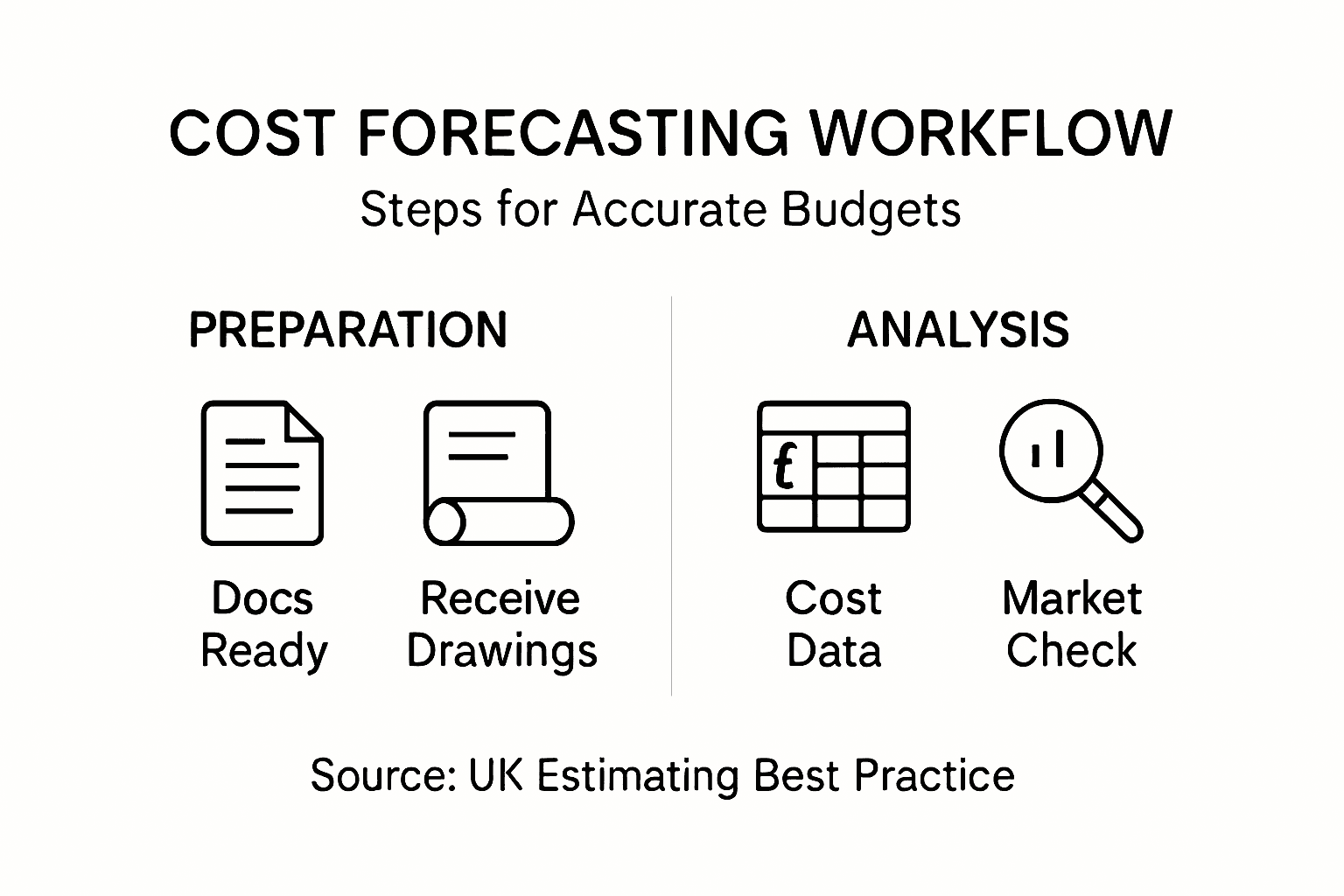
To create comprehensive cost control documentation, you’ll need a systematic approach that ensures accuracy, transparency, and actionable insights. Your cost report should provide a complete narrative of the project’s financial landscape.
Key components of an exceptional cost report include:
- Executive summary of total project costs
- Detailed cost breakdown by project phase
- Variance analysis between estimated and actual expenses
- Graphical representations of financial data
- Risk assessment and contingency explanations
- Recommendations for financial optimisation
Follow this structured review process:
- Cross-reference all financial data
- Validate calculations and assumptions
- Verify compliance with project specifications
- Check formatting and visual clarity
- Obtain internal peer review
A well-crafted cost report is not just a document, but a strategic communication tool that guides project financial decision-making.
Prepare multiple report formats to suit different stakeholder needs, such as detailed technical versions for quantity surveyors and simplified summaries for project managers and clients.
Expert tip: Create a standardised report template with automated calculation checks to streamline your reporting process and minimise human error.
Here is a summary table outlining the main objectives at each stage of the construction cost forecasting workflow:
| Project Stage | Primary Objective | Outcome for Project |
|---|---|---|
| Set up documentation | Ensure accurate project foundation | Clear, reliable design references |
| Collate cost data | Gather robust pricing sources | Reliable base for budgeting |
| Itemise estimates | Detail all expenditure breakdowns | Well-structured budget control |
| Benchmark market | Compare costs with industry norms | Identifies savings and risks |
| Deliver reports | Communicate clear financial insights | Informed stakeholder decisions |
Enhance Your Project Cost Forecasting with Expert UK Estimating Services
Accurate project cost forecasting requires more than just gathering drawings and data. It demands precise itemised estimates, market-validated benchmarks and clear reporting to empower confident budget decisions. If you find yourself facing challenges such as incomplete cost data, fluctuating market prices or the complexity of consolidating detailed estimates, My Project Estimating offers tailored solutions built for the UK construction sector. Our services utilise verified market figures and a streamlined process that transforms your project documentation into transparent, reliable cost plans.
Explore how you can overcome budgeting uncertainties and accelerate your project timelines by visiting our Uncategorized Archives – My Project Estimating for insightful estimating support. Ready to take control of your construction budget today? Connect with us at My Project Estimating and start benefiting from expert guidance through every stage of your project cost forecasting workflow.
Frequently Asked Questions
What is the first step in the Project Cost Forecasting Workflow?
The first step involves setting up project documentation and receiving drawings. Systematically gather all project-related documents, including architectural floor plans and engineering drawings, to establish a reliable foundation for your budgeting process.
How can I ensure my cost data is accurate when developing a budget?
To ensure accuracy in your cost data, collate and verify multiple financial information sources, such as historical project cost records and current market rates. Implement a structured process to compare and validate this data, which will lead to a more reliable budget.
What are the key components to include in an itemised cost estimate?
Key components of an itemised cost estimate include labour costs, material expenses, equipment costs, subcontractor pricing, overhead expenses, and contingency allowances. Break down each expense meticulously to create a comprehensive financial roadmap for your project.
How do I perform market benchmarking for my cost estimates?
To perform market benchmarking, compare your estimated costs against industry standards and similar construction projects. Collect comprehensive market data and adjust your estimates based on insights gained from this comparison to enhance their accuracy.
What should I include in my final cost report?
Your final cost report should include an executive summary, detailed cost breakdowns, variance analysis, graphical representations, risk assessments, and recommendations for optimisation. Ensure that your report is clear and professional to effectively communicate financial insights to stakeholders.
How can I maintain control over project costs throughout the lifecycle?
You can maintain control by regularly updating your cost estimates and leveraging a dynamic cost database that reflects real-time pricing changes. Establish a systematic review process and frequently compare actual expenses against your forecasts to manage deviations effectively.