A five hundred thousand pound project can look profitable on paper, yet leave you scrambling to cover wages when a milestone payment is delayed. For British construction project managers, this scenario is all too familiar. With cash flow forecasting providing a true picture of when money actually moves in and out, you gain the foresight to avoid critical shortfalls. This overview unpacks practical forecasting methods that meet the specific demands and risks of United Kingdom construction—helping you keep projects stable and finances secure.
Table of Contents
- What Cash Flow Forecasting Means in Construction
- How Cash Flow Forecasting Works in Practice
- Popular Methods and Tools Used Today
- Common Pitfalls and Industry-Specific Risks
- Meeting UK Legal and Contractual Obligations
- Improving Accuracy and Project Outcomes
Key Takeaways
| Point | Details |
|---|---|
| Importance of Cash Flow Forecasting | In construction, cash flow forecasting is essential to ensure that ongoing work can be funded despite potential delays in client payments. |
| Dynamic Nature of Forecasting | Unlike static budgets, cash flow forecasts must be updated regularly to account for actual spend and changes in project timelines. |
| Stress Testing Assumptions | Project managers should stress test their forecasts against worst-case scenarios to prepare for unexpected cash flow issues. |
| Legal Compliance | Forecasts must reflect contractual obligations, including payment terms and retention clauses, to avoid legal disputes and financial risks. |
What Cash Flow Forecasting Means in Construction
Cash flow forecasting in construction is not a luxury or something you tackle when things get tight. It is the practice of predicting when money flows into and out of your project, month by month, week by week, sometimes even day by day. Think of it as creating a financial timeline that shows exactly when you will receive payment from your client, when you need to pay suppliers, when wages come out of the account, and when material deliveries will strain your budget.
Unlike a static budget that sits there on a spreadsheet, cash flow forecasting is dynamic. A £500,000 project might have a healthy overall budget, but if your client delays a milestone payment by six weeks while your plant hire and labour costs keep flowing outward, you face a genuine cash shortage. This is where construction differs from many other industries. Monitoring the timing and amounts of cash coming in and going out becomes critical because projects have long timelines and delayed payments are standard practice. Your business could theoretically be profitable on paper yet unable to pay your workers on Friday because client payments haven’t landed. That contradiction happens to construction companies constantly.
In UK construction, cash flow forecasting specifically addresses several layers of complexity that sit on top of standard business accounting. You are juggling project payment milestones (which rarely align with your actual spend), material purchase orders (placed weeks before delivery), labour costs (paid weekly or fortnightly regardless of invoice timing), subcontractor invoices, and contract retention clauses that hold back 5 to 10 percent of payments until project completion. Your forecast must account for all of these moving parts simultaneously. Predicting inflows and outflows tied to construction contracts helps both you and your client plan financial liquidity throughout the project lifecycle by aligning payment schedules, valuations, and expenditure.
Why does this matter to you as a project manager? Because forecasting prevents the situation where you cannot fund ongoing work or face insolvency despite having a signed contract worth serious money. It tells you exactly which weeks will be tight, allows you to arrange bridging finance before problems emerge, and gives you visibility into whether your project margins are sustainable given payment timing. When you can see three months ahead and know that you will be owed £180,000 in month two whilst spending £140,000, you can plan accordingly. Without forecasting, you are managing crisis to crisis.
Professional tip Create a rolling 13-week cash flow forecast updated every week with actual spend and received payments, ensuring you always have visibility into the critical cash timeline ahead rather than relying on one forecast prepared at project start.
How Cash Flow Forecasting Works in Practice
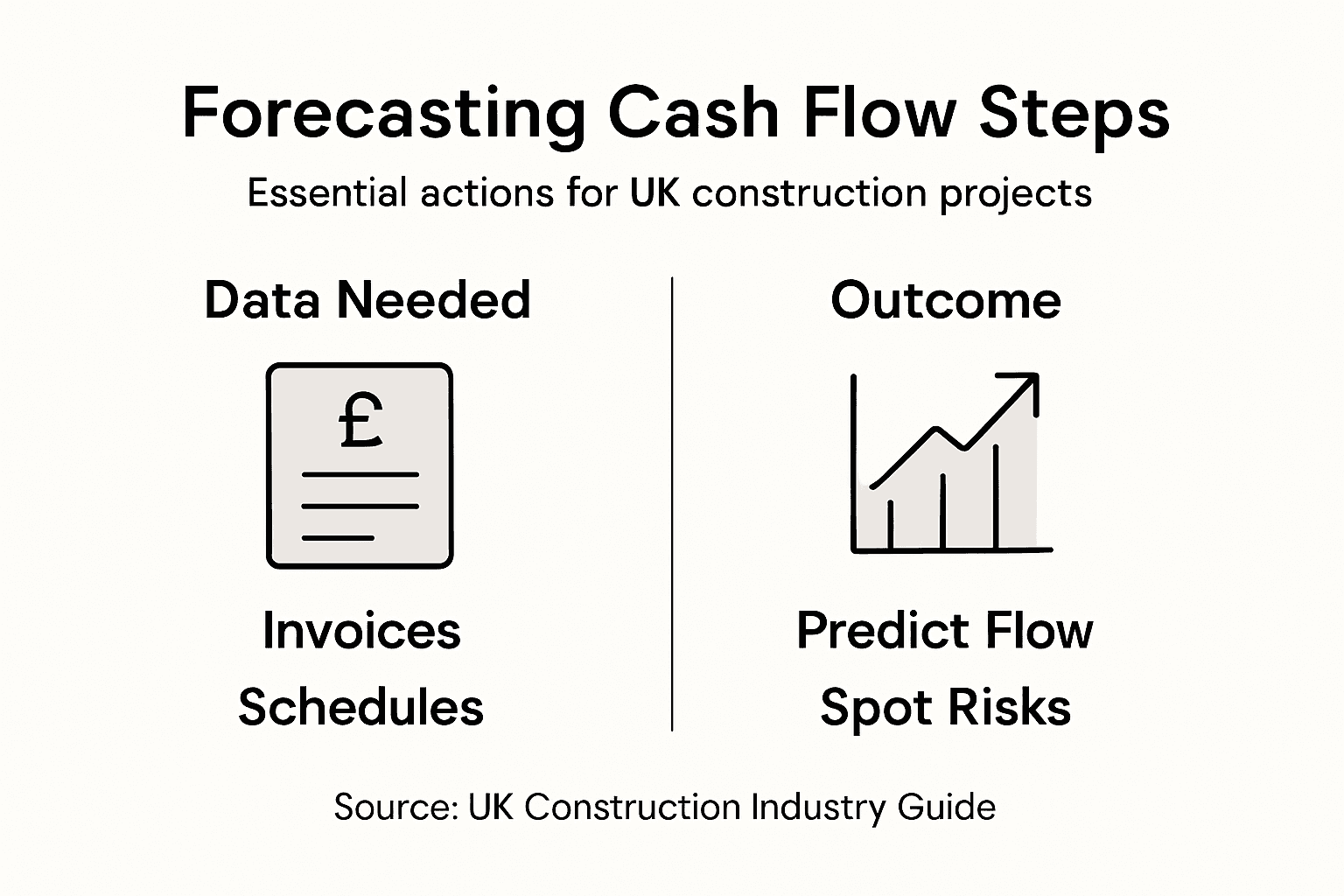
The mechanics of cash flow forecasting start with gathering data. You need to pull together every financial thread connected to your project: project invoices issued to clients, scheduled payment dates from contracts, supplier payment terms, labour costs, plant and equipment hire, subcontractor invoices, and overhead allocations. This is not glamorous work. You are essentially building a detailed picture of money moving in and out across defined periods, usually month by month. Collecting detailed data on expected payments and expenses including project invoices, scheduled client payments, supplier contracts, and overheads forms the foundation. Once you have gathered this information, you categorise it into two columns: inflows (what you will receive) and outflows (what you will pay). This categorisation is straightforward in theory but requires discipline because you cannot guess or estimate dates. You need actual contract terms, actual payment schedules, and actual supplier invoices.

Once data is collected and organised, you create a forecast table that typically covers at least 12 months ahead. Each month shows your projected cash position: opening balance, all expected inflows that month, all expected outflows, and closing balance. The closing balance of one month becomes the opening balance of the next, creating a rolling projection. This is where patterns emerge. You might discover that months three and four are cash negative because your client’s final payment does not arrive until month five, but you have significant plant hire and labour costs due in months three and four. That visibility is gold. You can then decide whether to negotiate earlier milestone payments, arrange bridging finance, or adjust project scheduling. Without this table in front of you, these cash gaps remain invisible until you get a phone call from your accountant saying your overdraft is maxed.
The critical part that separates successful forecasting from abandoned spreadsheets is the refresh cycle. Your forecast is not a set-and-forget document. Real projects shift. Clients delay payments by two weeks. Suppliers push delivery dates back. Material costs spike unexpectedly. Weather stops work for a fortnight. Your forecast must update regularly, ideally every four weeks, to reflect actual project progress and payment realities. Forecasts need regular updating to reflect changes in project progress, payment delays, or cost variations ensuring financial decisions are timely and based on current realities. Many project managers create a forecast at project start and never touch it again, then wonder why cash runs dry. The firms that manage this well treat forecasting as an ongoing conversation with their numbers, not a one-time exercise.
Here is what the practical workflow looks like:
- Gather all financial data from contracts, invoices, and commitments
- Enter inflows by their contractual payment milestone dates
- Enter outflows by their actual due dates (not invoice dates)
- Build the month-by-month table showing running cash position
- Identify months where closing balance falls below your safe minimum
- Set a calendar reminder to refresh the forecast every four weeks
- Compare actual spend and receipts against forecast and adjust forward projections
The forecast itself becomes your early warning system. When you see that month six will be problematic three months in advance, you have time to act. You might request stage payment adjustments, reduce spending in that month by phasing work differently, arrange a short-term facility, or negotiate extended payment terms with suppliers. Construction projects are long and complex enough without being blindsided by cash shortages you could have predicted.
Professional tip Separate your forecast into fixed costs (wages, rent, insurance) and project-variable costs (materials, subcontractors, plant), so you can clearly see which months are tight due to project timing versus which are tight due to overhead burden.
Popular Methods and Tools Used Today
If you are still using a basic spreadsheet for cash flow forecasting, you are far from alone. Excel remains the workhorse of construction project management, and for good reason. A well-structured spreadsheet with clear formulas, colour coding, and rolling calculations costs nothing and requires no training beyond basic spreadsheet skills. Many firms build templates that work perfectly well for their specific needs. However, spreadsheets have real limitations. They exist in isolation. A change to your project programme does not automatically update your cash flow forecast. A supplier invoice adjustment means manually hunting through cells and recalculating. Scaling across multiple projects becomes cumbersome. The bigger your operation, the more spreadsheets become a bottleneck rather than a solution.
This is why construction-specific financial management software has grown considerably. Popular methods include payment schedules aligned with contract milestones, historic cost curves, and formula based projections using tools tailored for construction project financial management. Beyond traditional spreadsheet models, Cost Value Reconciliation (CVR) has become a standard approach in UK construction. CVR compares your project’s actual value (measured by what you have completed) against your actual cost (what you have spent) to identify if you are on track financially. This method integrates directly with your project programme and contract milestones, making forecasts more accurate because they are rooted in real project progress rather than assumptions.
The shift toward software solutions is being driven by integration capabilities. Modern construction financial tools connect to your project management system, pulling in programme data automatically. They link to your accounting system so invoices feed directly into forecasts. They track actual site expenditure in near real-time rather than waiting for monthly reports. Construction firms increasingly use statistical data analysis derived from past projects, project program data, and Cost Value Reconciliation processes for improved forecasting accuracy and risk management. This integration means your cash forecast updates as circumstances change rather than becoming obsolete the moment reality diverges from plan.
Choosing between spreadsheets and software depends on your project scale and complexity. For a single small project, spreadsheet forecasting works fine. For a firm managing multiple concurrent projects with varying contract terms, payment schedules, and subcontractor arrangements, software becomes invaluable. The common theme across all effective approaches is that they combine historical data (what similar past projects actually cost and how long they actually took) with real-time current data (what is actually happening on this project right now). Whether you build this in Excel or purchase dedicated software, the principle remains the same.
Three popular software categories serve construction firms today:
- Project-specific software tracks time, costs, and resources, then integrates financial data into cash flow models
- Accounting-linked solutions pull invoice and payment data automatically, removing manual data entry errors
- Advanced forecasting platforms combine programme scheduling, cost data, and risk analysis to produce probabilistic cash forecasts showing best case, likely case, and worst case scenarios
Many firms operate in hybrid mode, using spreadsheets for individual projects but then consolidating results into software for company-wide cash visibility. This approach balances flexibility with oversight. Your project managers maintain control over their individual forecasts whilst finance leadership gets a consolidated view across all projects.
Here is a summary of common cash flow forecasting methods in UK construction and their business impact:
| Methodology | Key Features | Typical Business Impact |
|---|---|---|
| Excel Spreadsheet | Manual data entry, customisable formulas | Low cost, suited to small projects |
| Cost Value Reconciliation | Links costs to value of work done | Tracks profitability accurately |
| Accounting Software | Automated invoice and payment integration | Reduces human error, real-time updates |
| Forecasting Platforms | Scenario analysis, risk modelling | Improved accuracy, supports complex projects |
Professional tip Start by mapping your current forecasting process in a simple spreadsheet, then only invest in software once you can clearly articulate what manual steps waste the most time or create the most errors.
Common Pitfalls and Industry-Specific Risks
The gap between a forecast that looks good in theory and one that actually keeps your project solvent comes down to recognising where forecasts fail. The most damaging pitfall is relying on overly optimistic assumptions. Project managers naturally want to believe their timeline will hold, their suppliers will deliver on schedule, and clients will pay precisely when the contract says they will. But construction does not work that way. Weather stops work. Supply chains break. Clients have cash flow problems of their own and delay payments by weeks. When you build a forecast on best-case assumptions and reality delivers worst case, you get blindsided. The antidote is stress testing your forecast. For every key inflow, ask yourself what happens if that payment arrives six weeks late. For every major outflow, consider what happens if material costs spike 15 percent or a subcontractor goes under. Common pitfalls include relying on outdated or inaccurate data, failing to consider cyclical events like industry shutdowns and underestimating variability in payment timings that can create unexpected cash shortages.
Construction-specific risks sit on top of normal business forecasting challenges. The sector faces pressures that other industries simply do not encounter. Delayed client payments are the norm, not the exception. Many clients themselves manage cash flow tightly and will hold onto your payment for as long as contract terms allow, typically 30 days from invoice. If your contract includes milestone payments, those often come 14 to 30 days after you certify the work as complete. Stack these together and you can be weeks or months out of pocket for work you have already completed and paid for. Material cost volatility creates another layer of risk. Steel prices move. Specialist components have lead times measured in months. A shortage in one material category can ripple across your entire supply chain. You forecast material costs based on quotes received, but if those quotes expire or market conditions shift, your actual spend diverges sharply from forecast. Subcontractor failure is a genuine risk that many forecasts ignore. A subcontractor disappears mid-project or declares insolvency, forcing you to hire replacement contractors at premium rates. Your forecast assumed one contractor at agreed rates. Now you are paying 20 or 30 percent more and absorbing that cost.
Beyond these sector-specific challenges, construction forecasts suffer from excessive optimism baked into the underlying data. Cost forecasting can be overly optimistic due to lack of robust data and excessive reliance on subjective reporting without leveraging statistical analysis and historical project data. Project teams estimate costs, durations, and schedules. These estimates carry inherent bias. A team member who estimates their own work often underestimates because they believe they will work more efficiently, face fewer obstacles, and encounter fewer surprises than actually occur. When dozens of these slightly optimistic estimates roll up into a master forecast, the cumulative error becomes substantial. A project forecast 5 percent optimistic on cost and 10 percent optimistic on schedule can completely hide a brewing cash crisis.
Weather and external disruptions present yet another layer. The Construction Act, statutory compliance, and regulatory changes can affect payment schedules and project timelines. Bad weather adds weeks to outdoor work. Supply chain disruptions (like those seen in recent years) extend material delivery times from weeks to months. Labour availability fluctuates. Your forecast made three months ago assumed stable conditions. None exist in reality.
Here is what makes your forecast vulnerable:
- Data more than four weeks old
- Assumptions not stress tested against worst case scenarios
- No contingency buffer for weather or supply delays
- Overly tight milestone dates that ignore historical project slippage
- Client payment terms not properly modelled for actual payment behaviour
- Subcontractor risks not explicitly identified and quantified
- No mechanism to flag when actual spend or receipts diverge from forecast
The firms that survive construction’s cash flow challenges treat forecasts as living documents that constantly challenge their assumptions. They do not assume their estimates were accurate. They compare forecast to reality every week and ask why divergence occurred, then adjust forward projections accordingly.
Professional tip Build a sensitivity analysis into your forecast showing how cash position changes if material costs rise 10 percent, client payments delay by four weeks, or labour availability drops 20 percent, so you know your safety margin before crisis arrives.
Meeting UK Legal and Contractual Obligations
Cash flow forecasting in UK construction is not simply about predicting when money arrives. It is fundamentally about compliance with the legal framework that governs construction contracts and payment practices. The Construction Act 1996, as amended, sets out strict requirements for payment timescales, notice periods, and dispute resolution. If your forecast does not account for these legal realities, you are not forecasting accurately. You are creating fiction. The Construction Act stipulates that payment must be made within a specified timeframe (typically 30 days from invoice or certification). Contractors have the right to suspend work if payment is not made within seven days of the due date. This is not a suggestion. If your cash flow forecast assumes you can delay a supplier payment by six weeks without consequence, you have not read your contract carefully enough. Similarly, many contracts include retention clauses that hold back 5 to 10 percent of certified value until project completion or defect rectification periods close. Your forecast must explicitly account for when that retention will be released back to you, because until it is, that money is not yours.
Forecasts must account for payment terms, valuation methods, retention release schedules, and client contractual requirements to ensure compliance and protect against disputes. Beyond the Construction Act itself, your forecast must address practical contractual realities unique to your specific project. Some clients require stage payments tied to measurable milestones. Others use a percentage completion method. Some require architect certification before payment is released. Your forecast needs to reflect your actual contract, not a generic template. The difference between when you complete work and when you can invoice, and the further gap between invoicing and actual payment, can stretch across two or three months. Build that into your numbers. If your contract says the client gets 30 days to pay from invoice, do not forecast that money arriving on day 31. Real clients will take the full 30 days and often longer.
Beyond payment timescales, UK tax and regulatory obligations sit squarely on top of your cash flow. HMRC compliance requires you to manage VAT, PAYE, and Construction Industry Scheme (CIS) deductions. If you are registered for VAT, you collect it from clients but must pay it to HMRC quarterly. If you are a CIS subcontractor, clients withhold tax from your invoices, reducing what you actually receive. Your cash flow forecast must account for these outflows because they are not optional. Missing a VAT or PAYE deadline creates penalties and can trigger investigation. CIS withholding means your net cash inflow is lower than your gross invoice value. Cash flow forecasting must factor in legal obligations including HMRC tax payments (VAT, PAYE, CIS) and Construction Act stipulations on payment timescales to support compliance and timely fund allocation. Many project managers overlook CIS impact because it happens invisibly in the background. Your client withholds it automatically. But when you forecast cash available to pay your workers and suppliers, you need to remember that your net cash from that invoice is significantly less than what you invoiced.
Contractual variation and change orders introduce another compliance layer. When scope changes, payment entitlements shift. Your original forecast assumed the original contract value. A variation order might increase that value or extend the timeline, which shifts when retention is released and when final payment occurs. Your forecast must be flexible enough to accommodate these changes without becoming unreliable. The firms that manage cash well treat their forecast as a living document that updates whenever contract terms change, not a static plan created at project start and ignored.
Key legal and contractual elements your forecast must address:
- Payment timescales specified in your contract (typically 30 days)
- Valuation and certification requirements before payment is due
- Retention percentages and scheduled release dates
- VAT handling and quarterly payment obligations to HMRC
- CIS withholding amounts if you are a subcontractor
- Notice periods required under the Construction Act for payment suspension
- Variation order procedures and how they affect cash timing
- Defect liability periods and final retention release
Non-compliance with these obligations does not just create legal risk. It creates immediate cash flow problems. A payment dispute under the Construction Act can trigger work suspension. Missing a tax deadline creates penalties on top of the original payment. A poorly managed variation order leaves you uncertain about when you will be paid. Your forecast protects you by making these legal requirements explicit and quantified in financial terms.
Professional tip Create a separate schedule in your forecast document listing all payment milestones, retention release dates, and tax payment deadlines, so you have a single reference point for all legal and contractual cash timing requirements.
The table below highlights typical UK legal and contractual elements affecting construction cash flow:
| Legal Element | Description | Cash Flow Impact |
|---|---|---|
| Construction Act | Regulates payment timescales and rights | Determines when funds must be paid |
| Retention Clauses | Holds back 5-10% until completion | Delays receipt of full payment |
| VAT Payments | Quarterly HMRC payments on collected VAT | Requires set-aside cash, penalty risk |
| CIS Deductions | Tax withheld from subcontractor payments | Reduces usable cash from invoices |
Improving Accuracy and Project Outcomes
Accuracy in cash flow forecasting separates firms that thrive from those that struggle through constant crises. The difference is not luck. It is methodology. When you move away from intuition and guesswork toward data-driven financial models, your forecasts become reliable. This means building your forecast on three layers: historical data from your own past projects, current market conditions for materials and labour, and real-time tracking of what is actually happening on your project right now. Historical data tells you what similar projects actually cost and how long they genuinely took. Your first office refurbishment might have assumed 12 weeks. It took 16 weeks. Your second office refurbishment should factor in that your estimates are typically 25 percent optimistic on duration. When you apply this learning to future forecasts, you reduce error. Current market data means you are not quoting material prices from six months ago. You have current supplier quotes reflecting today’s market, not last quarter’s rates. Real-time tracking means you compare your forecast weekly against actual spend and receipts, identifying divergence immediately rather than discovering problems at month-end.
Improving accuracy involves using data-driven financial models incorporating historical project data, regional market conditions, and full project lifecycle tracking to provide better visibility of financial health. This integration of forecast outputs with contract valuation reports and cost control processes allows more timely risk identification and management. When your forecast shows a cash shortfall arriving in eight weeks, you have time to act. You can request staged payments, phase work differently, or arrange bridging finance. When you discover the shortfall exists only by running out of money, you have no options. The firms managing cash successfully treat forecasting as a continuous cycle. They forecast. They execute. They compare forecast to reality. They adjust. They repeat. This is not a once-quarterly activity. This is a weekly or fortnightly rhythm.
The mechanics of improving accuracy involve moving beyond spreadsheet estimates toward statistical analysis grounded in historical evidence. Stop asking your team to guess. Instead, pull data from your last five similar projects. What was the average labour cost per square metre? How much did materials actually cost versus what was quoted? How long did foundation work genuinely take versus schedule? Build your new forecast using these statistical patterns rather than individual opinions. This removes the unconscious optimism bias that lives in every estimate. Your site manager estimates four weeks to complete brickwork because that is what they hope will happen. Statistics from your last five projects show brickwork consistently takes five and a half weeks. Use the statistics. Construction-specific technologies that automate data collection enable dynamic forecasting, reducing error margins and supporting proactive financial management through more informed decision-making. This does not require expensive software. It requires discipline. Create a simple tracker that records each week: planned spend versus actual spend, planned receipts versus actual receipts, updated forecast for the next 12 weeks. The act of doing this forces you to notice patterns and divergence.
Better accuracy directly improves project outcomes in three measurable ways. First, fewer surprises. When your forecast is accurate, cash crises do not appear overnight. You see them coming three months away and plan accordingly. Your workers get paid on time. Your suppliers continue delivering. Your project moves forward smoothly. Second, better decision making. You know three months ahead that your cash will be tight in month five. You can then decide whether to negotiate earlier client payments, reduce spending by phasing work differently, or arrange credit facilities. These are conscious decisions made with time to plan. Without accurate forecasting, these decisions happen in panic mode under pressure. Third, improved margins. When you are managing crisis to crisis, costs spiral. You pay premium rates for expedited deliveries. You hire emergency labour at overtime rates. You waste time on rework caused by poor coordination. An accurately forecast project with visible cash flow lets you optimise execution. You can negotiate better supplier terms because you have advance notice of your needs. You can schedule labour efficiently because you see cash availability ahead. You can coordinate trades properly because you are not constantly juggling who gets paid this week.
The steps to improve your forecasting accuracy are straightforward but require commitment:
- Gather historical data from your past five projects of similar type and scale
- Calculate average costs per unit (per square metre, per linear metre, per item) across those projects
- Compare your estimates against historical averages and adjust if significantly different
- Build your forecast using these adjusted figures rather than raw estimates
- Track actual spend and receipts weekly against your forecast
- At month-end, analyse where divergence occurred and why
- Adjust your forecast for the remaining project duration based on actual performance
- Apply these learnings to your next project forecast
Accuracy compounds over time. Your second project forecast is more accurate than your first because you learned from actual outcomes. Your fifth forecast is considerably more accurate than your second. The firms building reliable cash flow forecasting capabilities do not do so overnight. They do so by treating forecasting as a learnable skill that improves with discipline and attention.
Professional tip Maintain a simple spreadsheet for each project type (residential, commercial, industrial) recording actual costs per unit and actual duration versus planned, so you build a growing library of historical data that makes each subsequent forecast more accurate than the last.
Take Control of Cash Flow with Expert Cost Estimating Solutions
Cash flow forecasting in UK construction projects demands precision, timely data, and clear insight into payment schedules alongside real costs. The challenges of delayed client payments, retention clauses, and fluctuating material costs can strain your project’s finances and threaten on-time completion. If you struggle to align your financial timeline with actual project milestones or fear missing critical payment deadlines under the Construction Act, you are not alone. You need tools that provide accurate, transparent cost estimates based on real UK market data to support your cash flow forecasts and avoid costly surprises.
At My Project Estimating, we specialise in providing tailored cost planning and detailed estimates designed to integrate seamlessly with your cash flow management practices. Our quick turnaround on comprehensive reports, including quantity takeoffs and Bill of Quantities preparation, empowers builders, architects, and developers to forecast cash inflows and outflows confidently. Discover how professional estimating can enhance your forecasting accuracy, align your contractual payment milestones, and mitigate risks highlighted in your project. Visit our Uncategorized Archives to explore case studies and insights or start transforming your cash flow planning today by partnering with us at My Project Estimating. Don’t let uncertain costs undermine your project’s success. Act now for dependable forecasting support.
Frequently Asked Questions
What is cash flow forecasting in construction?
Cash flow forecasting in construction is the practice of predicting when money will flow into and out of a project, creating a timeline that helps manage finances effectively throughout the project lifecycle.
Why is cash flow forecasting important for construction projects?
Cash flow forecasting is crucial because it prevents cash shortages despite having profitable projects on paper. It helps project managers plan for financial liquidity, ensuring that they can meet wage, supplier, and operational costs while waiting for client payments.
How often should cash flow forecasts be updated?
Cash flow forecasts should be updated regularly, ideally every four weeks, to reflect actual project progress, changes in payment timing, and other financial realities, ensuring that the forecast remains accurate and actionable.
What common pitfalls should be avoided in cash flow forecasting?
Common pitfalls include relying on overly optimistic assumptions, not stress testing forecasts against worst-case scenarios, failing to account for delayed client payments, and using outdated or inaccurate data.