Uncertainty often shadows the early stages of a construction project, leading many UK architects and project managers to feel that accurate budgeting is out of reach. This sense of doubt frequently stems from common misconceptions about early-stage cost planning and the belief that initial estimates are set in stone. Understanding that cost planning is an iterative process helps you shift focus towards developing flexible financial strategies that adapt as your project evolves, empowering you to manage risk and set a solid foundation for success.
Table of Contents
- Defining Early-Stage Cost Planning And Common Myths
- Main Types And Stages Of Cost Planning Processes
- How Elemental And Order-Of-Cost Estimates Work
- Stakeholder Roles And Responsibilities In Early Planning
- Risks, Common Pitfalls, And How To Mitigate Them
- Best Practice For Accuracy And Reliable Budgeting
Key Takeaways
| Point | Details |
|---|---|
| Early-Stage Cost Planning | It is a dynamic roadmap that requires continuous refinement and should not be seen as a one-off activity. |
| Common Myths | Acknowledge that initial estimates are not definitive and that expert knowledge is essential for precise planning. |
| Risk Mitigation | Proactive identification and management of risks are crucial for ensuring financial stability throughout the project lifecycle. |
| Best Practices | Implementing iterative estimation, transparent reporting, and expert validation enhances budgeting accuracy and reliability. |
Defining early-stage cost planning and common myths
Early-stage cost planning represents a sophisticated strategic approach for construction professionals to establish realistic financial frameworks before comprehensive project details emerge. This critical process goes far beyond simple budgeting, serving as a dynamic roadmap for financial management and risk mitigation in UK construction projects.
The UK government provides clear guidance on understanding cost planning as an evolving methodology. Cost estimating principles emphasise that early estimates should never be treated as fixed figures, but rather as flexible ranges reflecting project uncertainty.
Key characteristics of effective early-stage cost planning include:
- Developing probabilistic cost ranges instead of precise point estimates
- Incorporating contingency allowances for potential variations
- Utilising historical project data and industry benchmarks
- Regularly updating estimates as project information becomes more detailed
- Considering both direct and indirect cost factors
Common myths surrounding early-stage cost planning can significantly hinder project success. Many architects and project managers mistakenly believe that initial estimates are definitive or that cost planning is a one-time activity. In reality, cost planning is an iterative process that requires continuous refinement and professional expertise.
Most professional construction teams misunderstand three fundamental myths about early-stage cost planning:
- Initial estimates are completely accurate
- Cost planning can be done without specialised knowledge
- Contingency budgets are unnecessary overhead
Project financial management demands a nuanced approach that recognises the inherent complexity and dynamic nature of construction budgeting. Successful professionals understand that early-stage cost planning is less about predicting exact numbers and more about establishing flexible, informed financial strategies.
Pro tip: Always allocate at least 10-15% contingency in your early-stage cost estimates to account for potential unforeseen expenses and market fluctuations.
Main types and stages of cost planning processes
Cost planning in UK construction projects encompasses several sophisticated methodologies designed to provide financial clarity and risk management throughout project development. Order of cost estimates represent a critical early-stage approach that enables professionals to establish preliminary financial frameworks before detailed designs emerge.
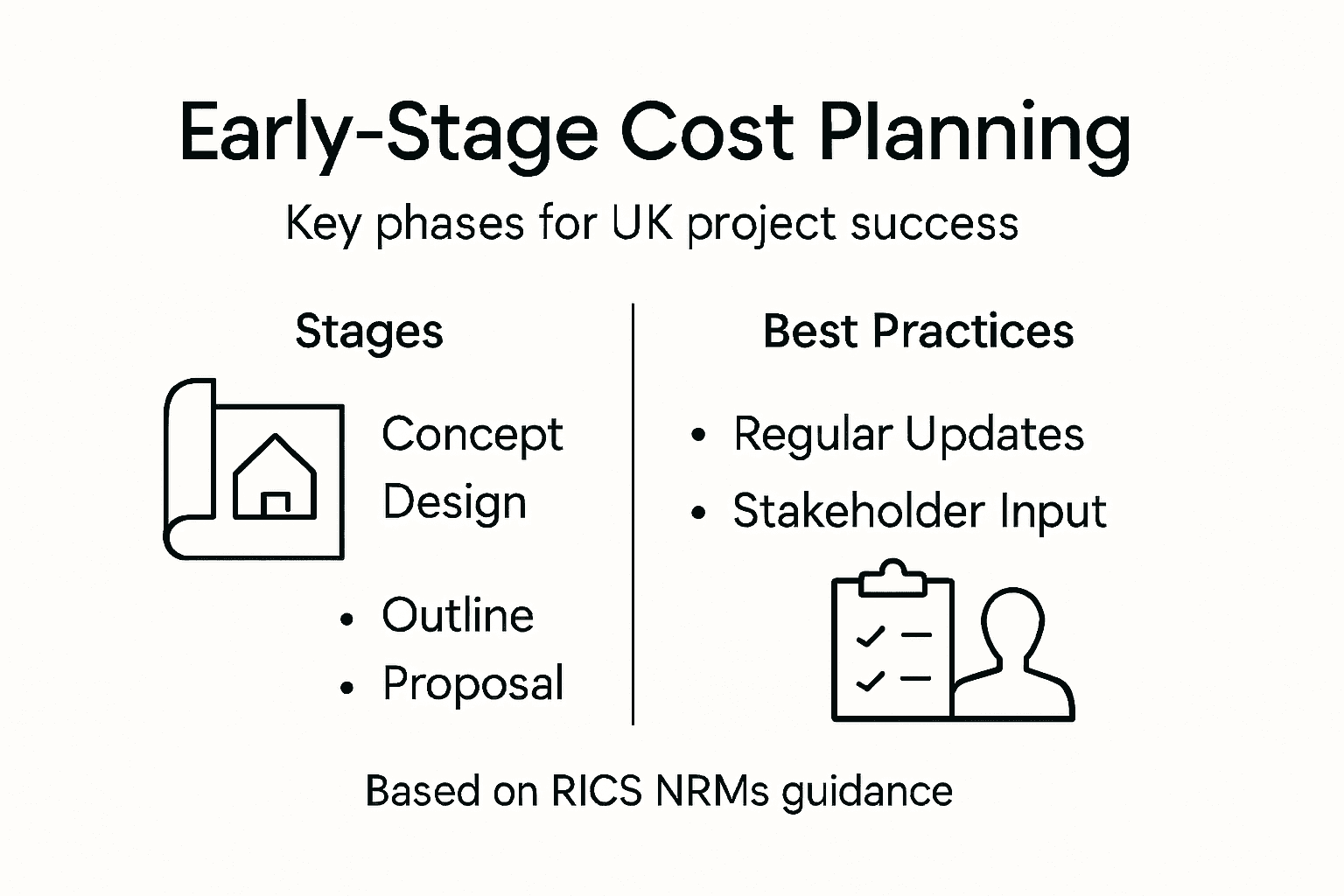
The main types of cost planning processes typically involve multiple strategic stages that progressively refine financial projections:
- Initial brief preparation: Gathering foundational project requirements
- Preliminary cost estimation: Developing broad cost ranges
- Elemental cost planning: Categorising expenses by specific building elements
- Detailed cost analysis: Refining estimates with increasing project information
- Cost control and monitoring: Tracking financial performance throughout project lifecycle
Professional cost planning follows structured approaches that align with industry standards such as the RICS New Rules of Measurement. These processes typically progress through distinct stages that become increasingly precise as project details crystallise.

Most construction professionals recognise three primary cost planning methodologies:
Here is a comparison of key cost planning methodologies used in UK construction projects:
| Methodology | Typical Use Case | Primary Advantage |
|---|---|---|
| Elemental Cost Planning | Early-stage detailed breakdown | Granular expense visibility |
| Parametric Estimation | Projects with limited details | Fast, scalable estimates |
| Comparative Analysis | Benchmarking against past data | Reliable reference pricing |
- Elemental cost planning
- Parametric cost estimation
- Comparative cost analysis
Each methodology offers unique advantages depending on project complexity, available information, and specific sector requirements. Successful implementation demands a nuanced understanding of how different estimation techniques can be strategically combined to produce robust financial forecasts.
Effective cost planning is not about achieving perfect predictions, but creating flexible financial frameworks that adapt as project details emerge.
Pro tip: Always maintain a dynamic cost planning approach that allows for regular updates and refinements as new project information becomes available.
How elemental and order-of-cost estimates work
Early-stage construction cost estimation requires sophisticated techniques that transform preliminary project insights into actionable financial frameworks. Order-of-cost estimates represent a critical methodology for establishing initial project affordability by leveraging benchmark data from comparable developments.
Elemental cost planning breaks down project expenses into systematic categories, providing granular financial visibility:
- Foundations: Structural base costs
- Walls and floors: Enclosure and spatial division expenses
- Roof structures: Covering and weatherproofing expenditures
- Mechanical services: Internal system installation costs
- Electrical infrastructure: Power and communication network expenses
These methodologies follow a progressive approach that becomes increasingly precise as project details emerge. Professional estimators utilise multiple strategies to manage financial uncertainty and provide robust budgetary guidance.
The key differences between order-of-cost and elemental estimates include:
- Level of project detail required
- Complexity of data collection
- Precision of financial projections
- Applicability across different project stages
Effective cost estimation is not about perfect predictions, but creating flexible financial frameworks that adapt to evolving project requirements.
Successful implementation demands a nuanced understanding of how these estimation techniques can be strategically combined to produce comprehensive and reliable financial forecasts.
Pro tip: Develop a comprehensive benchmarking database of previous project costs to enhance the accuracy of your early-stage cost estimates.
Stakeholder roles and responsibilities in early planning
Successful early-stage project planning demands strategic collaboration and clearly defined responsibilities across multiple professional roles. Project delivery guidance emphasises the critical importance of coordinated stakeholder engagement to ensure comprehensive financial and operational planning.
Key stakeholder roles in early project planning typically include:
- Project Director: Overall strategic leadership and final decision-making
- Cost Estimator: Developing detailed financial projections
- Senior Responsible Owner: Ensuring alignment with organisational objectives
- Technical Specialists: Providing expert insights on specific project elements
- Finance Manager: Verifying budgetary feasibility and financial compliance
Each stakeholder brings unique expertise and responsibilities that collectively create a robust planning ecosystem. Professional collaboration requires clear communication channels, defined expectations, and a shared commitment to project success.
The primary responsibilities for each key stakeholder group include:
- Providing accurate and timely information
- Conducting thorough risk assessments
- Maintaining transparent communication
- Supporting integrated planning processes
- Making data-driven decisions
Effective stakeholder management transforms individual contributions into a cohesive, strategic project planning approach.
Successful early planning demands a holistic approach that balances technical expertise, financial acumen, and collaborative problem-solving.
Pro tip: Establish a comprehensive stakeholder communication matrix that defines reporting lines, information sharing protocols, and decision-making responsibilities from the project’s inception.
Risks, common pitfalls, and how to mitigate them
Early-stage construction cost planning presents numerous potential risks that can derail project financial management if not carefully addressed. Cost estimating guidance highlights the critical importance of proactively identifying and mitigating potential financial uncertainties.
The most significant risks in early project planning include:
- Scope uncertainty: Incomplete project definition leading to unexpected costs
- Data limitations: Insufficient historical or comparable project information
- Inadequate risk contingencies: Failing to account for potential variations
- Unrealistic assumptions: Overly optimistic financial projections
- Insufficient stakeholder communication: Misaligned project expectations
Mitigating these risks requires a structured and comprehensive approach to cost planning. Professional project teams must develop robust strategies that address potential financial vulnerabilities before they become critical issues.
Key risk mitigation strategies include:
The following table summarises typical risks in early-stage cost planning and suggested mitigation strategies:
| Common Risk | Example Scenario | Suggested Mitigation |
|---|---|---|
| Scope Uncertainty | Incomplete project brief | Seek thorough stakeholder input |
| Data Limitations | Outdated market rates | Source recent industry data |
| Unrealistic Assumptions | Ignoring inflation trends | Conduct scenario analysis |
| Poor Stakeholder Alignment | Conflicting budget expectations | Establish clear communication |
| Inadequate Contingency | Underestimating unforeseen events | Include minimum 10% buffer |
- Implementing rigorous estimate review processes
- Developing comprehensive contingency budgets
- Conducting thorough market research
- Maintaining flexible financial models
- Establishing clear communication protocols
Effective risk management transforms potential financial threats into manageable project parameters.
Successful risk mitigation demands a proactive, systematic approach that combines technical expertise, financial acumen, and strategic foresight. Professional teams must remain vigilant and adaptable throughout the project lifecycle.
Pro tip: Create a dedicated risk register that tracks potential financial uncertainties, assigns ownership, and establishes clear mitigation strategies from the project’s inception.
Best practice for accuracy and reliable budgeting
Achieving accurate and reliable project budgeting requires a sophisticated, multifaceted approach that goes beyond simple numerical calculations. Cost management principles emphasise the importance of dynamic, responsive financial planning throughout the project lifecycle.
Key best practices for ensuring budgetary accuracy include:
- Comprehensive data collection: Gathering detailed historical and current market information
- Iterative estimation: Continuously refining cost projections
- Risk-adjusted contingencies: Building flexible financial buffers
- Transparent reporting: Maintaining clear communication channels
- Expert validation: Engaging specialist cost estimators for review
Successful budgeting demands a structured methodology that addresses the inherent complexities of construction financial management. Professional teams must develop robust strategies that anticipate potential variations and maintain financial flexibility.
Critical steps in reliable budget development include:
- Establishing clear baseline cost estimates
- Implementing rigorous benchmarking processes
- Developing comprehensive risk assessment frameworks
- Creating adaptive financial models
- Conducting regular performance reviews
Reliable budgeting is an ongoing process of refinement, not a one-time calculation.
Professional cost management requires a proactive approach that combines technical expertise, strategic foresight, and continuous improvement.
Pro tip: Develop a dynamic cost tracking system that allows real-time budget monitoring and enables immediate adjustments as project conditions evolve.
Master Your Early-Stage Cost Planning with Expert Support
Understanding the complexities of early-stage cost planning is crucial to ensure your UK construction project stays on track financially. With challenges like scope uncertainty and the need for iterative cost refinement, you require precise, adaptable, and transparent estimating solutions. At My Project Estimating, we specialise in providing detailed, UK-specific early-stage cost planning services that integrate contingency allowances and benchmark data, helping you avoid common pitfalls and make informed financial decisions from the start.
Discover how you can benefit from our professional estimating expertise by exploring insights in our Uncategorized Archives – My Project Estimating. Take control of your project’s budget through a clear four-step process that ensures fast turnaround, high accuracy, and transparent pricing. Don’t let uncertainty jeopardise your project’s success. Visit My Project Estimating today and start turning flexible financial frameworks into reliable budgets. Ready to move forward confidently? Reach out now and secure your project’s financial future.
Frequently Asked Questions
What is early-stage cost planning in construction?
Early-stage cost planning is a strategic approach used by construction professionals to establish flexible financial frameworks before detailed project specifics are available. It aims to manage risks and budget uncertainties by developing probabilistic cost ranges and incorporating contingency allowances.
What are the common myths about early-stage cost planning?
Common myths include the belief that initial estimates are completely accurate, that cost planning can be performed without specialised knowledge, and that contingency budgets are unnecessary. In reality, early-stage cost planning is an iterative process that requires continuous refinement and expertise.
What are the main types of cost planning methodologies?
The primary cost planning methodologies include Elemental Cost Planning, which provides a detailed breakdown of expenses; Parametric Estimation, used for projects with limited information; and Comparative Analysis, which benchmarks costs against similar past projects to inform pricing decisions.
How can risks in early-stage cost planning be mitigated?
Risks can be mitigated by implementing rigorous estimate review processes, developing comprehensive contingency budgets, conducting thorough market research, maintaining flexible financial models, and establishing clear communication protocols among stakeholders.