Late or inaccurate cost estimates can quickly unravel even the most promising UK construction projects, leaving architects and project managers scrambling to regain financial control. Early estimating is more than just a rough guess; it is a dynamic interpretation that sets the stage for every major planning and budgeting decision. By understanding why initial estimates must be flexible and risk-aware, professionals can improve project outcomes and build confidence in their financial projections from day one.
Table of Contents
- Defining Early Estimating In Construction Projects
- Key Methods For Early Project Estimation
- Role In Financial Control And Cost Planning
- Impacts On Risk Reduction And Decision-Making
- Common Pitfalls Of Late Or Inaccurate Estimating
Key Takeaways
| Point | Details |
|---|---|
| Importance of Early Estimating | Early estimating is crucial for determining preliminary project costs and feasibility, enabling better financial planning and resource allocation. |
| Flexibility and Updates | Estimates should remain flexible and updated as project details become clearer, accommodating uncertainties and potential adjustments. |
| Risk Management | Early estimates help identify potential financial risks, allowing for proactive contingency planning and improved decision-making. |
| Common Pitfalls | Avoid delays and inaccuracies in estimating to prevent budget overruns and ensure stakeholder confidence in project execution. |
Defining Early Estimating in Construction Projects
Early estimating represents a critical strategic process in construction project management that involves generating preliminary cost projections during the initial planning stages. Unlike detailed final estimates, these early approximations provide crucial insights into potential financial requirements and project feasibility.
The UK government’s infrastructure guidance defines early estimating as a complex practice of establishing initial cost ranges that evolve as project details become clearer. Cost estimation principles emphasise presenting estimates as flexible ranges that reflect inherent project uncertainties.
Key characteristics of early construction project estimates include:
- Provisional financial projections
- Reflects incomplete project information
- Incorporates risk and uncertainty factors
- Serves as foundational planning tool
- Updated progressively as project scope clarifies
Research from academic sources highlights that early estimates are not static calculations but dynamic interpretations influenced by multiple factors. Infrastructure project challenges demonstrate that these initial estimates require sophisticated human judgment, considering social, political, and technical variables.
The estimation process typically involves assessing project parameters such as:
- Preliminary design specifications
- Expected material costs
- Anticipated labour requirements
- Potential technical complexities
- Estimated project duration
Pro tip: Always maintain flexibility in early estimates and build comprehensive contingency margins to account for unforeseen project complexities.
Key Methods for Early Project Estimation
Early project estimation requires sophisticated approaches that blend analytical techniques with practical insights. Construction professionals employ multiple strategic methodologies to generate accurate preliminary cost projections, each designed to address the inherent uncertainties of initial project planning stages.
One prominent technique involves predictive analytics for construction costs, which utilises data-driven approaches to enhance estimation accuracy. These advanced methods leverage historical project data, statistical models, and sophisticated algorithms to generate more precise early-stage financial forecasts.
Key early project estimation methods include:
- Analogous estimating
- Parametric estimating
- Bottom-up estimating
- Three-point estimating
- Regression analysis
- Machine learning predictive models
These estimation techniques share common characteristics that improve their reliability:
To clarify estimation techniques, here is a side-by-side comparison:
| Method | Ideal Use Scenario | Strengths | Limitations |
|---|---|---|---|
| Analogous Estimating | Early in project with minimal data | Fast, builds on past experience | Prone to oversimplification |
| Parametric Estimating | Projects with quantifiable metrics | Generates data-driven forecasts | Requires robust historical data |
| Bottom-Up Estimating | Detailed design information | High accuracy potential | Time-intensive, needs specifics |
| Machine Learning | Complex, data-rich projects | Detects patterns, adaptive | Depends on quality datasets |
- Utilise historical project performance data
- Incorporate risk and uncertainty factors
- Provide flexible range-based projections
- Allow progressive refinement as project details emerge
- Support informed decision-making
Parametric estimation stands out as particularly effective, using statistical relationships between historical project data and current project parameters. By analysing cost drivers and performance metrics, this method enables more nuanced and contextually relevant financial projections.
Pro tip: Combine multiple estimation techniques to cross-validate your projections and reduce potential bias in early project cost assessments.
Role in Financial Control and Cost Planning
Early project estimation plays a pivotal role in establishing robust financial control mechanisms for construction projects. By generating precise preliminary cost projections, professionals can create strategic financial frameworks that guide budget allocation, risk management, and overall project financial planning.

Cost estimating requirements outlined by the UK Infrastructure and Projects Authority highlight the critical nature of these initial financial assessments. These early estimates serve as foundational tools for making informed budgetary decisions and establishing comprehensive risk management strategies.
Key financial control functions of early project estimation include:
- Establishing initial budget baselines
- Identifying potential cost risks
- Creating flexible financial contingency plans
- Supporting strategic resource allocation
- Enabling proactive financial management
- Facilitating stakeholder financial communication
The estimation process provides multiple strategic advantages for financial control:
For convenient reference, here is a summary of key financial control functions enabled by early project estimation:
| Financial Control Aspect | Impact on Project | Example Benefit |
|---|---|---|
| Initial Budget Baseline | Guides resource allocation | Prevents underfunding |
| Risk Identification | Enables proactive mitigation | Minimises unexpected overruns |
| Financial Contingency Planning | Strengthens response to changes | Funds set aside for challenges |
| Stakeholder Communication | Builds project trust | Clear budget updates |
- Provides transparent cost visibility
- Enables early identification of potential budget overruns
- Supports comprehensive financial planning
- Helps secure appropriate project funding
- Allows continuous financial performance tracking
Comprehensive financial planning requires a dynamic approach that recognises the evolving nature of project costs. By developing sophisticated estimation techniques, construction professionals can create adaptable financial frameworks that respond to changing project requirements and market conditions.
Pro tip: Develop a systematic approach to tracking and updating cost estimates throughout the project lifecycle to maintain accurate financial control.
Impacts on Risk Reduction and Decision-Making
Early project estimation serves as a critical strategic risk management tool, providing construction professionals with a comprehensive framework for identifying and mitigating potential financial vulnerabilities before they escalate into significant challenges.
Infrastructure project risk assessments highlight the importance of proactive estimation in exposing potential project uncertainties. By systematically analysing potential risk factors during the initial planning stages, project managers can develop more robust decision-making strategies.
Key risk reduction strategies enabled by early estimation include:
- Identifying potential cost escalation points
- Mapping uncertain project variables
- Developing comprehensive contingency plans
- Creating flexible financial buffers
- Establishing clear risk communication protocols
- Enabling preemptive mitigation strategies
Decision-making improvements through early estimation manifest in several critical areas:
- Enhanced financial predictability
- More accurate resource allocation
- Improved stakeholder confidence
- Reduced likelihood of project disruptions
- Greater strategic planning capabilities
Risk management in construction projects requires a nuanced approach that recognises the dynamic nature of project uncertainties. Early estimates provide a structured mechanism for transforming potential risks from unknown variables into manageable strategic considerations.
Pro tip: Create a comprehensive risk register during initial project estimation, regularly updating it to track and mitigate potential uncertainties throughout the project lifecycle.
Common Pitfalls of Late or Inaccurate Estimating
Inaccurate project estimating represents a significant risk for construction professionals, potentially derailing financial planning and project execution. Cost estimation errors can transform seemingly manageable projects into financial nightmares, compromising organisational credibility and long-term sustainability.
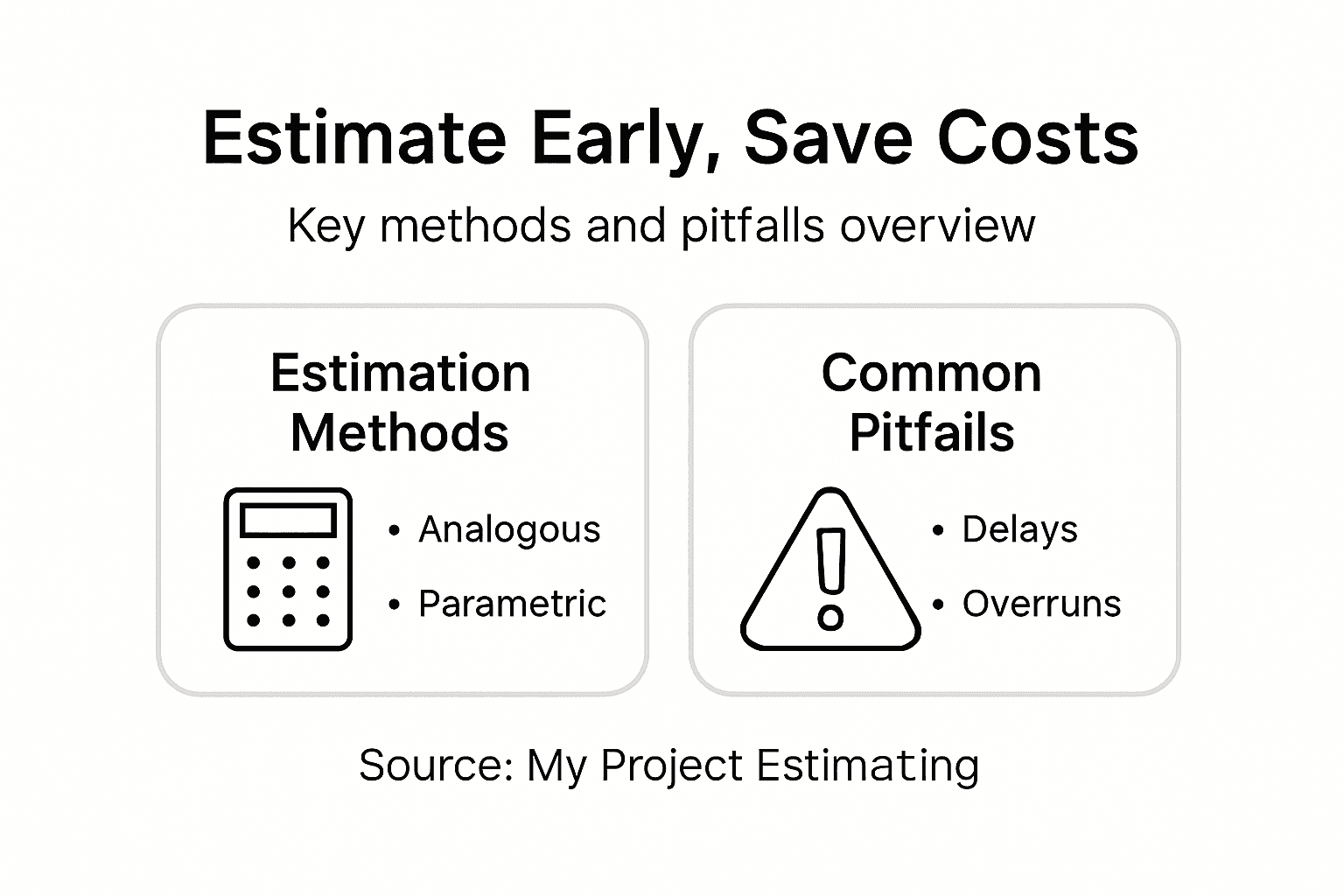
Early-stage cost estimating challenges reveal that late or imprecise estimates contribute substantially to project budget escalations. These estimation failures often stem from inadequate initial scoping, incomplete risk assessments, and fundamental misunderstandings of project complexity.
Common pitfalls in project estimation include:
- Insufficient historical data analysis
- Overlooking potential complexity factors
- Underestimating resource requirements
- Failing to account for market volatility
- Inadequate contingency planning
- Neglecting interdependency risks
Significant consequences of poor estimation manifest through:
- Unexpected budget overruns
- Reduced stakeholder confidence
- Potential project cancellation
- Reputational damage
- Financial instability
Strategic estimation demands comprehensive approaches that anticipate and mitigate potential variabilities. Successful construction professionals recognise that estimation is not a singular event but a continuous, dynamic process requiring constant refinement and critical analysis.
Pro tip: Implement a rigorous peer-review process for initial estimates to identify potential blind spots and improve overall estimation accuracy.
Take Control Early to Prevent Budget Overruns
Budget overruns can turn a promising construction project into a costly challenge. The article highlights how early estimating—providing provisional financial projections during initial planning—helps identify risks, set realistic budgets, and maintain financial control throughout your project journey. Many professionals struggle with incomplete data, overlooked risks, or sudden changes, but incorporating flexible, data-driven estimates like parametric or analogous techniques empowers you to make informed decisions that protect your bottom line.
At My Project Estimating, we specialise in early-stage cost planning tailored to UK construction projects. Our expert estimators deliver transparent, accurate results quickly by combining historical UK market data with flexible, evolving cost models. Whether you are an architect, developer, or builder seeking to avoid unforeseen expenses and improve stakeholder confidence, our services provide the clear financial visibility and risk mitigation strategies you need. Start strengthening your budget management today by exploring our Uncategorized Archives – My Project Estimating for tips and insights. Don’t leave your project’s financial health to chance—visit My Project Estimating now and ensure your estimates are robust from the very start.
Frequently Asked Questions
Why is early estimating important in construction projects?
Early estimating is crucial as it helps establish initial cost projections, allowing for better budget allocation and risk management during the planning stages of a project.
What are the main methods used for early project estimation?
Key methods for early project estimation include analogous estimating, parametric estimating, bottom-up estimating, three-point estimating, regression analysis, and machine learning predictive models.
How does early estimating help in reducing project risks?
Early estimating identifies potential cost escalation points and develops comprehensive contingency plans, thus enabling proactive risk management and reducing the likelihood of unexpected financial challenges.
What are the common pitfalls of inaccurate early project estimates?
Common pitfalls include insufficient historical data analysis, overlooking complexity factors, underestimating resource requirements, and inadequate contingency planning, all of which can lead to unexpected budget overruns.