Over 60 percent of british construction projects face budget overruns from the start. This common issue often links back to unclear cost breakdowns or missing market data. Whether you are planning your first build or looking to refine an established process, understanding each step in comprehensive cost planning can save both time and money. The following guide reveals practical methods used by experts to help you create clearer, more reliable cost estimates for any british construction project.
Table of Contents
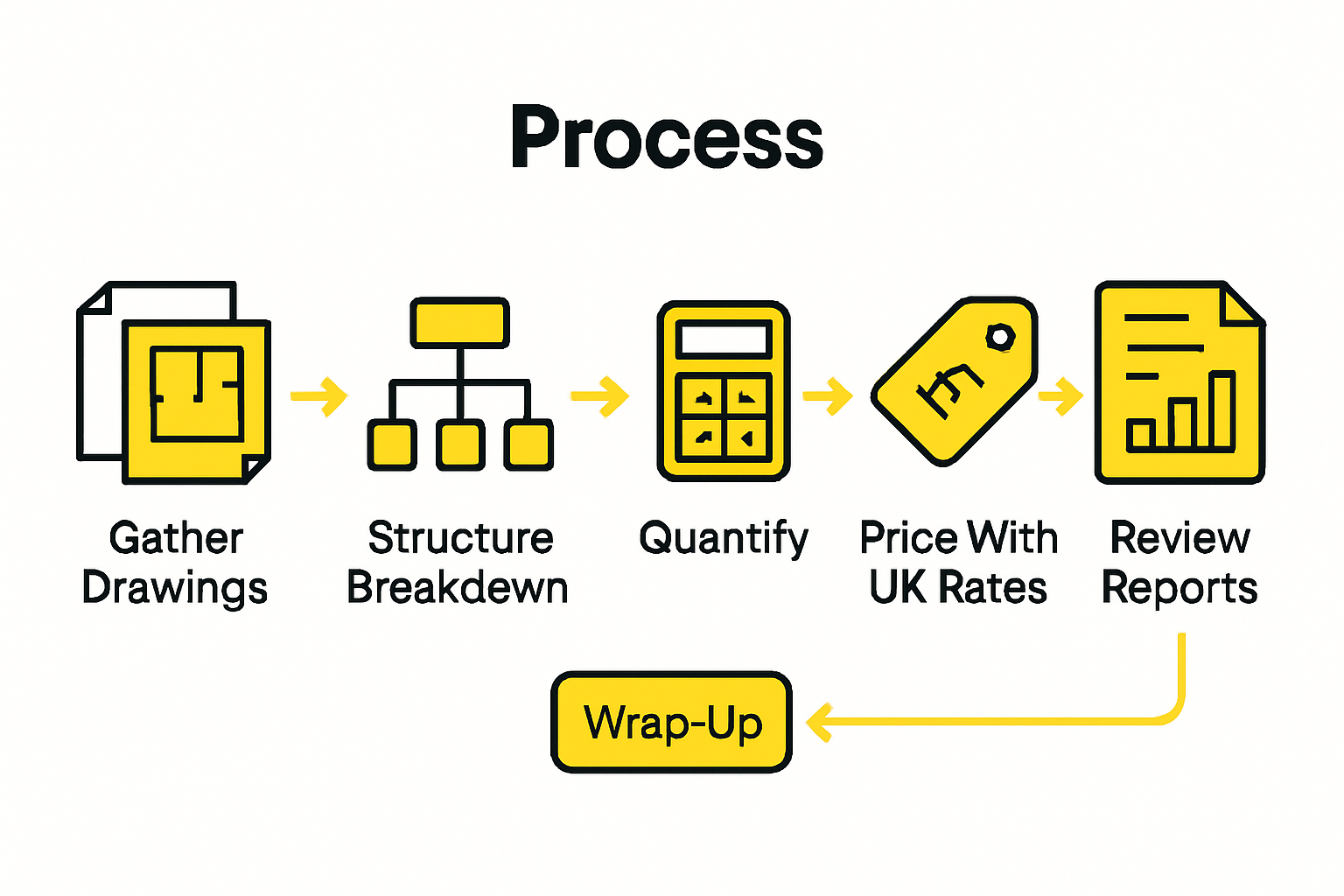
- Step 1: Gather Project Information and Drawings
- Step 2: Develop a Detailed Cost Breakdown Structure
- Step 3: Prepare and Quantify All Construction Elements
- Step 4: Apply Verified UK Market Rates and Adjustments
- Step 5: Review, Approve and Finalise Cost Reports
Quick Summary
| Key Point | Explanation |
|---|---|
| 1. Gather critical project documentation | Collect complete architectural and engineering drawings to establish a solid planning foundation. |
| 2. Create a detailed cost breakdown | Categorise all costs systematically to track expenditures accurately throughout the project. |
| 3. Quantify construction elements meticulously | Measure and document each component to ensure a precise financial inventory for planning. |
| 4. Apply current UK market rates | Use verified market rates to translate quantities into precise financial values reflecting real costs. |
| 5. Conduct thorough cost report reviews | Implement a peer review process to ensure accuracy and credibility in your final cost estimates. |
Step 1: Gather Project Information and Drawings
Successful construction cost planning begins with comprehensive project information collection. Your goal in this initial stage is to gather all essential documentation and visual materials that will form the foundation of your detailed cost breakdown.
Start by requesting complete architectural and engineering drawings from your project team. According to the Construction Project Information Committee, these drawings must provide clear, precise specifications to ensure efficient project planning. Focus on obtaining site plans, floor layouts, elevation diagrams, and detailed technical schematics that reveal the precise scope of your construction project.
Carefully examine each drawing for critical details such as building dimensions, material specifications, structural elements, and any unique architectural features. The Avanti project emphasised the importance of overcoming information ambiguities early in the process. Pay special attention to potential variations or non standard elements that might impact your cost calculations.
Pro tip: Create a comprehensive checklist of required documents before your initial consultation. This might include site surveys, geological reports, environmental impact assessments, and preliminary design sketches. By being systematic, you will minimise potential information gaps that could lead to unexpected costs later.
Once you have gathered all project information and drawings, you are ready to move to the next critical stage of construction cost planning: preliminary quantity takeoffs and initial cost estimation.
Step 2: Develop a Detailed Cost Breakdown Structure
Building a comprehensive cost breakdown structure forms the critical backbone of your construction project financial planning. This systematic approach will transform raw project information into a clear financial roadmap that tracks every pound spent.
According to the UK Government Cost Estimating Guidance, developing a consistent cost breakdown structure supports accurate comparisons and benchmarking across different project stages. Begin by categorising your costs into primary sections such as labour, materials, equipment, subcontractor expenses, permits, and overhead costs. Within these main categories, create detailed subcategories that provide granular tracking of expenditures.
The University of Essex recommends distinguishing between one-off and recurring expenses to provide greater financial clarity. For instance, break down labour costs into direct workforce expenses, training, insurance, and potential overtime. Similarly, materials might include base materials, transportation, storage, waste management, and potential price escalation contingencies.
Pro tip: Develop your cost breakdown structure with future scalability in mind. Create a flexible template that allows for easy updates and modifications as your project evolves. This approach ensures your financial tracking remains precise and adaptable throughout the construction process.

With a robust cost breakdown structure in place, you are now prepared to move forward into the next critical phase: quantifying and estimating specific project expenses.
Step 3: Prepare and Quantify All Construction Elements
Quantifying construction elements is a meticulous process that transforms your project blueprint into a precise financial and material inventory. Your objective is to systematically measure and document every component required for successful project completion.
Following the Common Arrangement of Work Sections framework, begin by categorising your construction elements into standardised work sections. This UK construction industry convention provides a comprehensive approach to coordinating bills of quantities with project specifications. Break down your project into fundamental categories like groundworks, structural elements, external works, mechanical systems, electrical installations, and finishing works.
The National Building Specification recommends creating detailed documentation that precisely describes materials, standards, and workmanship requirements. For each construction element, calculate exact quantities including linear metres for pipework, square metres for flooring and walls, cubic metres for concrete volumes, and individual units for specialised components like windows, doors, and technical equipment.
Pro tip: Invest time in creating highly detailed measurement records. Use digital measurement tools, laser measuring devices, and systematic cross referencing between architectural drawings and your quantification spreadsheets to ensure absolute accuracy.
With your construction elements comprehensively quantified, you are now prepared to transition into the next critical phase of cost estimation and pricing analysis.
Step 4: Apply Verified UK Market Rates and Adjustments
Applying accurate market rates is the critical bridge between your quantified construction elements and their true financial implications. Your goal is to transform raw measurements into precise monetary values that reflect current UK construction market realities.
The Building Cost Information Service provides comprehensive cost data through their Price Adjustment Formulae Indices (PAFI), which offer detailed pricing information across building, civil engineering, and maintenance sectors. Begin by consulting these authoritative indices to establish base rates for each construction element. Pay close attention to regional variations, material specific pricing, and current market trends that might impact your cost calculations.
According to the UK Government Cost Estimating Guidance, developing robust cost estimates requires gathering precise market evidence and adopting a consistent pricing approach. Incorporate factors such as labour rates, material costs, equipment expenses, and potential price fluctuations. Consider additional adjustments for seasonal variations, supply chain complexities, and regional economic conditions specific to your project location.
Pro tip: Create a dynamic pricing matrix that allows for quick updates and adjustments. Regularly cross reference your rates with multiple sources including industry publications, supplier quotations, and recent project benchmarks to maintain pricing accuracy.
With verified market rates applied, you are now prepared to compile a comprehensive and realistic cost estimate for your construction project.
Step 5: Review, Approve and Finalise Cost Reports
The final stage of your construction cost breakdown workflow demands meticulous attention to detail and a strategic approach to financial validation. Your objective is to transform your detailed cost calculations into a comprehensive, credible, and actionable financial document.
According to the UK Government Cost Estimating Guidance, cost reports should be presented as a range that accounts for potential risks and uncertainties. This approach provides stakeholders with a realistic perspective on potential financial variations. Begin by conducting a thorough line by line review, comparing your calculated rates against current market benchmarks, and identifying any potential discrepancies or areas requiring further investigation.
The University of Essex recommends carefully distinguishing between one off expenses and recurring costs during your final review. This differentiation is crucial for creating a transparent and comprehensive financial projection. Scrutinise each cost category, verifying that all direct and indirect expenses have been accurately captured, and ensure that your contingency margins reflect the project’s complexity and potential risk factors.
Pro tip: Implement a rigorous peer review process. Have another experienced estimator or project manager independently verify your cost report, looking for potential oversights, mathematical errors, or unrealistic assumptions that might have slipped through initial calculations.
With your cost report thoroughly reviewed, approved, and finalised, you have successfully completed the construction cost breakdown workflow, providing a robust financial blueprint for your project.
Take Control of Your Construction Costs with Expert UK Estimating
Breaking down complex construction costs into clear, manageable parts is crucial to avoid budget overruns and unexpected financial risks. If you have struggled with gathering precise project information, developing detailed cost breakdown structures, or applying verified UK market rates, you are not alone. This article highlights common challenges such as accurate quantity takeoffs and creating transparent cost reports, which underpin effective financial planning for any construction project.
My Project Estimating specialises in offering professional, tailored cost planning solutions across the UK construction industry. With rapid turnaround times and transparent pricing, we support architects, developers, builders, and homeowners in navigating the entire workflow from initial drawings to final cost reports. Explore practical estimating insights in our Uncategorized Archives and start your project on firm financial footing. Do not let uncertainties in cost breakdowns stall your project progress.
 Visit My Project Estimating today to receive expert support designed to keep your construction projects on budget and on schedule.
Frequently Asked Questions
What initial project information do I need to gather for construction cost planning?
Start by collecting all essential documentation such as architectural and engineering drawings, site plans, and floor layouts. Ensure that you create a checklist to avoid missing crucial details, which could lead to unexpected costs later.
How can I develop a comprehensive cost breakdown structure for my construction project?
Begin by categorising costs into main sections like labour, materials, and overheads. Then, create detailed subcategories to track expenditures granularly, ensuring that your financial roadmap accurately reflects all costs involved in the project.
What are the key steps for quantifying construction elements?
Quantify each construction element by using standardised work sections and exact measurements for components like concrete and windows. Employ digital tools for accuracy, documenting these quantities to create a precise financial and material inventory for your project.
How do I apply verified market rates to my construction cost estimates?
Use current market data to assign accurate prices to your quantified construction elements, factoring in regional variations and material-specific pricing. Regularly update this data to maintain pricing accuracy and reflect real market conditions throughout your project.
What should I include in my final cost report to stakeholders?
Include a comprehensive range that accommodates potential risks and uncertainties, clearly distinguishing between one-off and recurring costs. Conduct a line-by-line review and ensure all direct and indirect expenses are captured, presenting a detailed financial projection for transparency and credibility.
Recommended
- How to Estimate Construction Costs for UK Projects – My Project Estimating
- Construction Estimating Guide 2025: Accurate UK Cost Plans – My Project Estimating
- Complete Guide to Cost Management in Construction – My Project Estimating
- Cost Forecasting in Construction UK | Accurate UK Construction Cost Forecasts
- UK Website Design Cost: A Complete Guide | Website Design & Google Ads That Generate Leads
- Custom Home Project Workflow: Step-by-Step Guide for Success