More than 60 percent of British residential developments exceed their original budgets due to inaccurate early-stage estimates. For property developers, a single miscalculation can turn promising projects into costly setbacks. Understanding the purpose and structure of tender estimates is crucial for those who want to minimise financial surprises and gain tighter control over project costs.
Table of Contents
- Defining Tender Estimate In UK Construction
- Types Of Tender Estimates And Their Differences
- How Tender Estimates Are Prepared And Reviewed
- Tender Estimates Versus Other Cost Plans
- Common Pitfalls And How To Avoid Them
Key Takeaways
| Point | Details |
|---|---|
| Understanding Tender Estimates | Tender estimates provide a detailed financial projection for construction projects, encompassing direct and indirect costs, risk assessments, and resource needs. |
| Types of Estimation Methods | Various methodologies such as top-down, bottom-up, and analogy/parametric approaches offer different levels of precision and are suited to specific project stages. |
| Preparation and Review Process | Creating tender estimates involves meticulous documentation and a thorough review process to ensure transparency and competitive fairness among bidders. |
| Avoiding Common Pitfalls | Employing collaborative frameworks, clear communication, and comprehensive risk assessments can help mitigate challenges in tender estimating and improve project outcomes. |
Defining Tender Estimate in UK Construction
A tender estimate represents a precise financial projection prepared during the early stages of construction project planning, specifically designed to provide potential contractors and developers with a comprehensive understanding of anticipated project costs. In the United Kingdom’s construction sector, these estimates serve as critical financial blueprints that outline expected expenditures, resource requirements, and potential budgetary challenges.
Within the UK construction landscape, tender estimates for construction projects are meticulously crafted documents that go beyond simple cost calculations. They incorporate detailed assessments of project specifications, material costs, labour expenses, equipment requirements, and potential risk factors. These comprehensive documents enable developers, contractors, and stakeholders to make informed decisions about project feasibility, budgeting, and resource allocation.
Tender estimates typically include several key components that provide a holistic view of potential project expenses. These components generally encompass direct costs like materials and labour, indirect costs such as site management and administrative overheads, contingency allowances for unexpected expenses, and precise breakdowns of potential financial risks. Professional estimators utilise advanced computational methods, historical project data, and current market insights to generate these detailed financial projections.
Professional Tip: Always request multiple tender estimates from different quantity surveyors to cross-validate projected costs and identify potential discrepancies in financial calculations.
Types of Tender Estimates and Their Differences
In the United Kingdom’s construction industry, tender estimates are categorised into distinct approaches that help professionals assess project costs with varying levels of precision and complexity. Cost estimation approaches primarily include three fundamental methodologies: top-down, bottom-up, and analogy/parametric estimates, each serving unique purposes in project financial planning.
The top-down estimate provides a broad overview of project expenditure, focusing on major cost elements and overall project scope. Typically used in early project stages, this approach offers a quick financial snapshot that allows developers to understand potential budget requirements without delving into granular details. Conversely, the bottom-up estimate represents a meticulous methodology that breaks down individual project tasks, enabling precise cost calculations by examining specific components, labour requirements, and material expenses at a granular level.
The analogy/parametric estimate represents a sophisticated approach that leverages historical project data and sophisticated computational models to generate financial projections. Framework agreements in construction demonstrate how these estimates can vary based on contract types, risk assessments, and procurement methods. Professional estimators utilise parametric models to extract insights from previous similar projects, applying statistical techniques to extrapolate potential costs with remarkable accuracy.
Professional Tip: Combine multiple estimation approaches to develop a comprehensive and robust financial projection that mitigates potential budgetary risks.
Here’s a side-by-side comparison of common tender estimate methodologies in UK construction:
| Methodology | Precision Level | Typical Use Case | Key Advantage |
|---|---|---|---|
| Top-down | Low to medium | Early-stage budget assessment | Rapid overview of total costs |
| Bottom-up | High | Detailed project breakdown | Granular cost certainty |
| Analogy/Parametric | Medium to high | Leveraging similar historical data | Strong predictive accuracy |
How Tender Estimates Are Prepared and Reviewed
The preparation of tender estimates in the United Kingdom follows a structured and meticulous process that begins with developing comprehensive project objectives and detailed specifications. Tender preparation involves creating precise Invitations to Tender (ITT) that clearly outline project requirements, budget parameters, technical specifications, and performance expectations for potential bidders.
During the preparation phase, construction professionals carefully compile detailed documentation that includes project scope, technical drawings, specific performance criteria, and anticipated deliverables. This documentation serves as the foundation for bidders to develop accurate cost estimates, ensuring transparency and enabling fair competition. The process requires meticulous attention to detail, with estimators considering multiple factors such as material costs, labour expenses, equipment requirements, potential risks, and projected timelines.

The review process for tender estimates is equally rigorous, involving comprehensive evaluation against predefined criteria. Public procurement guidelines mandate transparent assessment that goes beyond simple price comparisons. Evaluators examine bidders’ economic and financial standings, technical capabilities, quality of proposed solutions, and potential risk mitigation strategies. Scoring mechanisms typically involve weighted assessments that balance cost considerations with qualitative factors, ensuring that the selected tender represents the most advantageous overall proposal.
Professional Tip: Develop a comprehensive checklist of evaluation criteria before issuing tender documents to streamline the review process and ensure consistent, objective assessment of submitted proposals.
Tender Estimates Versus Other Cost Plans
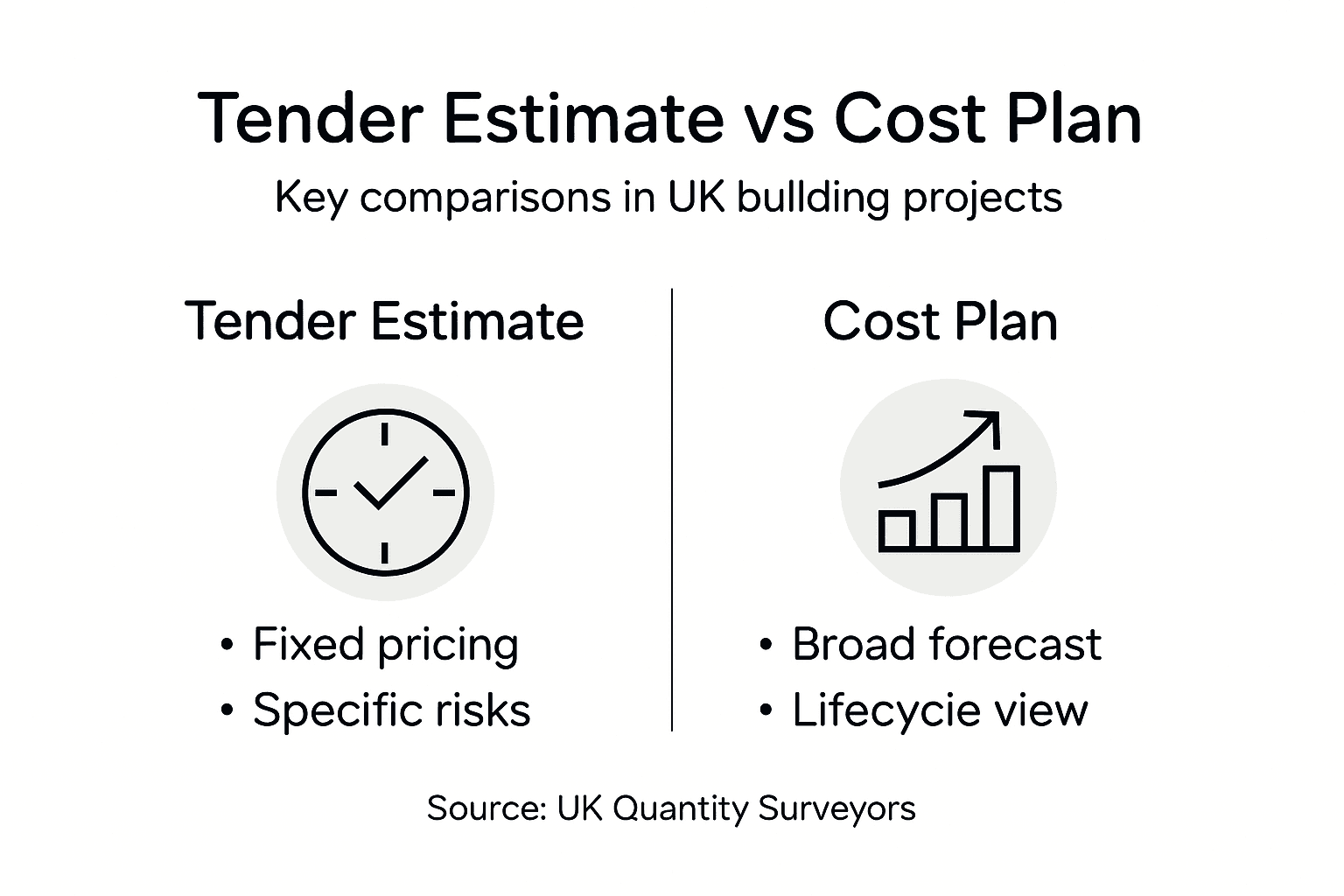
In the UK construction industry, tender estimates occupy a unique position distinct from other cost planning methodologies. Tender estimates focus specifically on procurement stage pricing, serving a critical function in selecting suppliers through competitive bidding, whereas alternative cost plans serve broader project management objectives.
Traditional cost plans typically provide comprehensive financial overviews throughout a project’s lifecycle, incorporating broader considerations like long-term maintenance, operational expenses, and contingency provisions. By contrast, tender estimates are laser-focused on competitive pricing, risk allocation, and immediate contract award criteria. These estimates demand granular detail about immediate project requirements, with pricing strategies that explicitly account for specific risk distributions between contractors and project owners.
Risk allocation strategies in tender estimates fundamentally differentiate them from standard cost planning approaches. While general cost plans might present static financial projections, tender estimates dynamically incorporate risk premiums, pricing strategies, and explicit risk management considerations. This approach ensures that potential contractors understand exactly how financial and operational risks will be distributed, preventing potential underpricing or overly restrictive contract terms.
Professional Tip: Develop a comprehensive risk matrix alongside your tender estimate to clearly communicate potential project uncertainties and their financial implications to potential bidders.
Common Pitfalls and How to Avoid Them
In the realm of tender estimates, construction professionals frequently encounter significant challenges that can derail project success. Inappropriate risk allocation strategies represent one of the most critical pitfalls, where poorly defined risk distributions can lead to inflated pricing, project delays, and potential contract disputes.
A primary challenge emerges when project teams focus exclusively on initial capital costs rather than comprehensive whole-life project benefits. This narrow perspective often results in underestimating long-term expenses, overlooking potential operational complexities, and selecting contractors based solely on the lowest upfront price. Professional estimators must therefore develop holistic evaluation frameworks that consider multiple dimensions beyond immediate financial constraints, including contractor capabilities, historical performance, and potential future maintenance requirements.
Collaborative project frameworks can mitigate many common tender estimate pitfalls by promoting transparent communication and shared risk understanding. Successful strategies include implementing robust data-driven governance models, maintaining continuous stakeholder engagement, and developing clear, unambiguous project scope definitions that minimise potential misunderstandings or interpretative variations between contractors and project owners.
Below is a summary of challenges in tender estimating and how collaborative frameworks address them:
| Challenge | Typical Impact | Collaborative Approach Benefit |
|---|---|---|
| Poor risk allocation | Inflated prices, disputes | Transparent risk sharing |
| Focus on initial costs only | Underestimated long-term costs | Merged financial and lifecycle view |
| Ambiguous project scope | Misunderstandings, delays | Clear, shared scope definition |
| Limited contractor engagement | Unreliable estimates | Early stakeholder involvement |
Professional Tip: Conduct comprehensive pre-tender market research and engage potential contractors early to validate your estimate assumptions and reduce unexpected pricing variations.
Take Control of Your Project Costs with Expert Tender Estimates
Managing tender estimates can feel overwhelming with risks of inaccurate pricing and unclear risk allocation threatening your UK development’s success. The article highlights how crucial it is to have detailed, transparent, and precise tender estimates that consider all material, labour, and risk factors along with effective evaluation strategies. If you want to avoid common pitfalls and ensure your project finances are solid from the start, it is vital to partner with reliable estimating professionals who specialise in the UK construction market.
At My Project Estimating, we offer tailored solutions that align perfectly with the demands outlined in this article. Our expert team provides early-stage cost planning, thorough quantity takeoffs, and comprehensive cost reports all crafted using verified UK data to help you confidently prepare tender estimates. Discover how our streamlined four-step process can help you reduce budgeting risks, clarify risk allocation, and improve decision making. Explore our offerings in the Uncategorized Archives – My Project Estimating to empower your project today. Take the next step toward transparent, accurate cost management by visiting My Project Estimating now and secure your project’s financial success.
Frequently Asked Questions
What is a tender estimate in construction?
A tender estimate is a detailed financial projection created during the early stages of project planning, outlining anticipated costs, resource needs, and potential budgetary challenges for construction projects.
How are tender estimates prepared?
Tender estimates are prepared by developing project specifications and compiling documentation such as technical drawings and performance criteria, allowing bidders to provide accurate cost estimates based on these detailed prerequisites.
What are the different types of tender estimates?
The main types of tender estimates include top-down estimates, which provide a broad overview of costs; bottom-up estimates, which offer detailed assessments of tasks and components; and analogy/parametric estimates, which leverage historical data for predictive accuracy.
What common pitfalls should be avoided when preparing tender estimates?
Common pitfalls include inappropriate risk allocation, focusing solely on initial costs, ambiguous project scope, and limited contractor engagement. Addressing these issues requires clear definitions, robust governance frameworks, and early engagement with stakeholders.
Recommended
- What Is a Construction Tender? Key Insights for UK Projects
- Construction Tender Process Explained: UK Guide – My Project Estimating
- Cost Estimating for Developers – Preventing Budget Overruns
- Construction Cost Drivers Explained: Key UK Factors – My Project Estimating
- The Real Cost of Working with AEC Daily, RedVector & CEU Events – CEU Builder