Cost overruns are an all-too-familiar concern for construction project managers across the United Kingdom. Achieving true reliability in cost estimation means more than tallying figures—it requires a robust process built on expert judgement, evidence-based methods, and ongoing quality assurance. By mastering this approach, you gain the confidence to deliver timely, accurate budgets and inspire trust among stakeholders throughout every stage of residential project delivery.
Table of Contents
- Defining Reliability In Construction Estimates
- Types Of Estimates And Their Distinctions
- Essential Data Sources And Methodologies
- Role Of Estimator Experience And Accuracy
- Risks, Pitfalls And How To Avoid Them
Key Takeaways
| Point | Details |
|---|---|
| Reliability of Estimates | Reliable cost estimation is a dynamic process that evolves throughout the project lifecycle, requiring continuous validation and updates. |
| Types of Estimates | Understanding different estimation types, like Preliminary and Control Estimates, is crucial for effective project financial management. |
| Data Sources and Methodologies | Utilising diverse data sources, including historical records and market price indices, enhances the accuracy of financial projections. |
| Estimator Expertise | The experience and skills of the estimator significantly influence the reliability of cost forecasts, necessitating ongoing professional development. |
Defining Reliability in Construction Estimates
In the complex world of UK construction, reliability in cost estimation is far more than a simple number on a spreadsheet. It represents a sophisticated process of progressively refining project financial predictions through systematic analysis and expert judgment. Cost estimating principles emphasise that reliability evolves from initial broad ranges to increasingly precise forecasts as project details become clearer.
Reliability in construction estimates fundamentally depends on several critical factors:
- Comprehensive Risk Assessment: Identifying and quantifying potential financial uncertainties
- Expert Knowledge: Leveraging experienced professionals’ insights and historical data
- Systematic Documentation: Maintaining transparent and traceable estimation methodologies
- Continuous Validation: Regularly comparing estimated costs against actual project expenditures
The UK government’s guidance highlights that a reliable estimate is not a static document, but a dynamic tool that adapts throughout the project lifecycle. Systemic evidentiary governance plays a crucial role in ensuring that construction estimates maintain high standards of accuracy and impartiality.
Moreover, reliability transcends mere numerical precision. It encompasses the credibility of the estimation process, the reputation of the professionals involved, and the institutional frameworks that support robust financial forecasting. Construction professionals must view estimates as living documents that require continuous refinement and scrutiny.
Pro tip: Develop a standardised estimation template that incorporates historical project data, risk contingencies, and clear documentation trails to enhance your cost estimation reliability.
Types of Estimates and Their Distinctions
In the UK construction industry, understanding the nuanced landscape of cost estimation types is critical for project success. Construction estimates play a pivotal role in transforming initial project concepts into financially viable realities, with each estimation type serving a unique and strategic purpose throughout the project lifecycle.
The primary types of construction estimates include:
- Preliminary Estimates: Initial rough calculations based on historical project data and broad project parameters
- Detailed Estimates: Comprehensive breakdowns of anticipated costs with granular line-item analysis
- Quantity Estimates: Precise measurements and quantifications of materials, labour, and resources required
- Bid Estimates: Competitive pricing documents prepared for tender submissions
- Control Estimates: Dynamic budgeting tools tracking real-time expenditure against initial projections
Each estimate type represents a progressive refinement of financial understanding, moving from conceptual approximations to increasingly precise fiscal blueprints. Preliminary estimates offer initial feasibility insights, while bid estimates become critical during competitive tendering processes. Control estimates emerge as living documents that continuously validate and adjust financial expectations throughout project execution.
Professional construction managers must recognise that these estimation types are not isolated tools, but interconnected strategies that collectively provide a holistic view of project financial health. The ability to seamlessly transition between and integrate these different estimation approaches distinguishes exceptional project financial management.
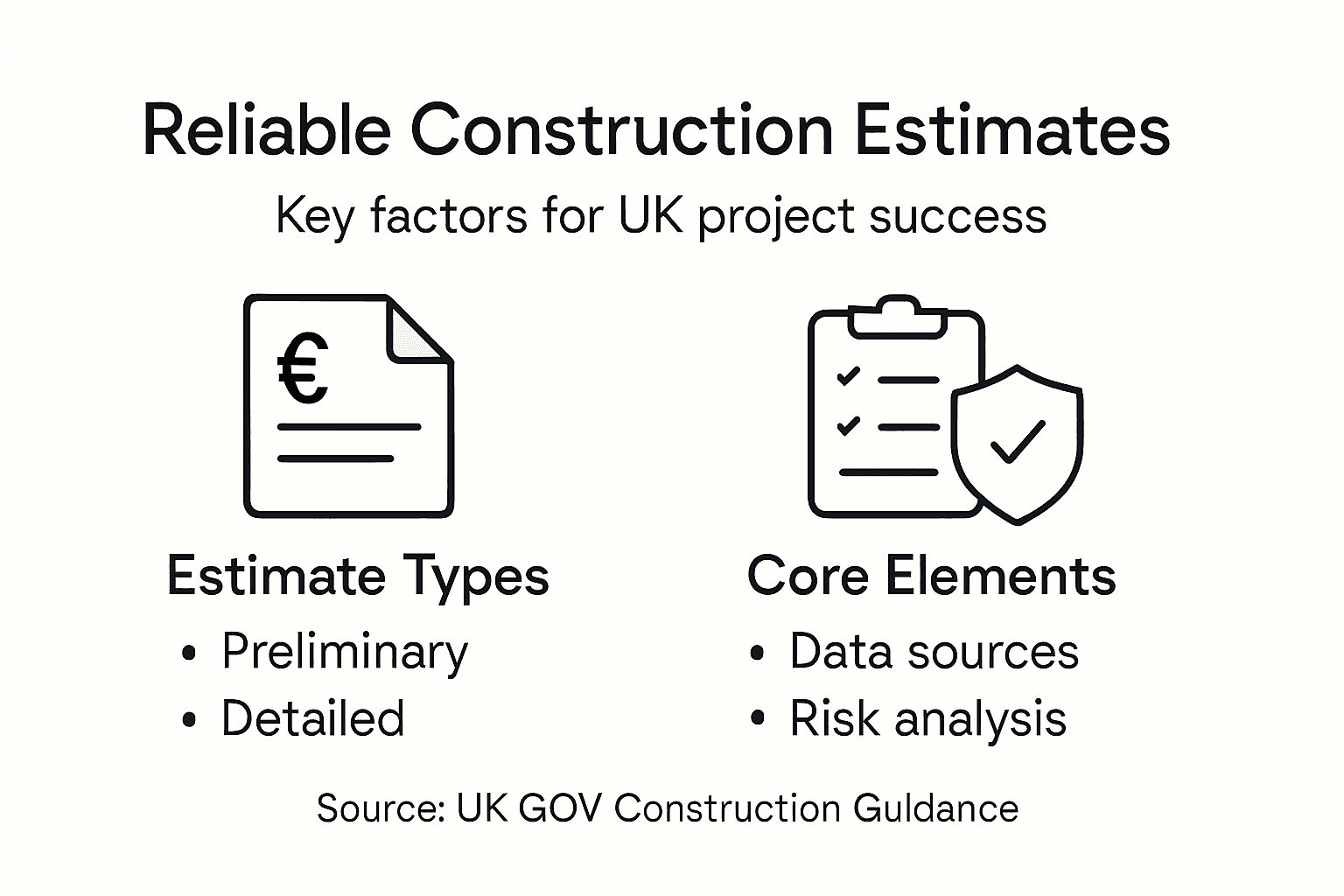
To better understand which type of estimate to use during each project stage, here is a summary table:
| Project Phase | Suitable Estimate Type | Main Objective |
|---|---|---|
| Concept and Feasibility | Preliminary Estimate | Assess project viability |
| Design and Planning | Detailed Estimate | Define accurate project budget |
| Procurement and Tender | Bid Estimate | Submit competitive proposals |
| Construction Execution | Control Estimate | Track and adjust costs ongoing |
Pro tip: Develop a standardised estimation workflow that systematically progresses from preliminary to control estimates, ensuring comprehensive financial tracking and minimising budgetary risks.
Essential Data Sources and Methodologies
Constructing reliable cost estimates requires a sophisticated approach to data gathering and analytical methodology. UK Infrastructure and Projects Authority guidance emphasises the critical importance of systematic, evidence-based approaches that transform raw information into precise financial projections.
Key data sources for construction cost estimation include:
- Historical Project Records: Detailed documentation from previous similar projects
- Market Price Indices: Current construction material and labour cost trends
- Supplier Quotations: Recent pricing information from verified construction suppliers
- Regional Cost Databases: Localised pricing information specific to different UK regions
- Professional Cost Journals: Specialised publications tracking construction economic indicators
The methodology for developing robust estimates involves a structured, multi-stage approach. Construction professionals must first aggregate comprehensive project documentation, carefully selecting appropriate estimation techniques that align with project complexity. This process demands meticulous risk calculation, where potential financial variables are systematically identified and quantified.

Successful estimation methodologies go beyond mere number-crunching. They require a nuanced understanding of project-specific variables, market dynamics, and potential contingencies. Professional estimators must blend analytical rigour with contextual knowledge, transforming raw data into actionable financial insights that support strategic decision-making.
For quick reference, here is a comparison of key data sources and their primary advantages:
| Data Source | Typical Use | Main Advantage |
|---|---|---|
| Historical Project Records | Benchmarking and pattern recognition | Provides baseline cost insights |
| Market Price Indices | Adjusting to current market realities | Keeps estimates up to date |
| Supplier Quotations | Pricing high-value items | Adds specificity to forecasts |
| Regional Cost Databases | Local project budgeting | Ensures geographic accuracy |
| Professional Cost Journals | Analysing industry-level changes | Tracks sector-wide trends |
Pro tip: Create a standardised documentation template that captures all critical project variables, ensuring consistent and comprehensive data collection across different estimation stages.
Role of Estimator Experience and Accuracy
Estimator expertise forms the critical backbone of reliable construction cost forecasting in the UK. Professional estimators represent a unique blend of technical knowledge, analytical skills, and industry intuition that transforms complex project data into precise financial projections.
Key competencies that define exceptional estimator performance include:
- Technical Education: Advanced degrees in quantity surveying or construction management
- Industry Experience: Minimum 5-7 years of hands-on project cost planning
- Analytical Skills: Ability to interpret complex financial and technical documentation
- Risk Assessment Capabilities: Sophisticated understanding of potential project variables
- Technological Proficiency: Advanced skills with estimation software and digital tools
The accuracy of construction estimates directly correlates with an estimator’s depth of professional experience. Seasoned professionals develop an intuitive understanding of market nuances, regional cost variations, and potential project contingencies that cannot be replicated by junior practitioners. They can anticipate hidden costs, understand complex project dynamics, and provide nuanced financial insights that go beyond simple numerical calculations.
Moreover, exceptional estimators function as strategic advisors, not just number-crunchers. They bridge the gap between technical specifications and financial feasibility, providing stakeholders with comprehensive insights that support informed decision-making. Their expertise transforms raw project data into actionable financial strategies that can make the difference between project success and potential financial challenges.
Pro tip: Invest in continuous professional development and maintain a comprehensive portfolio of project case studies to enhance your estimation accuracy and credibility.
Risks, Pitfalls and How to Avoid Them
In the intricate landscape of UK construction estimating, understanding potential financial vulnerabilities is paramount. Common estimating mistakes can transform promising projects into financial challenges, making proactive risk management essential for project success.
Key estimation risks that demand strategic mitigation include:
- Labor Cost Underestimation: Failing to account for comprehensive workforce expenses
- Indirect Cost Overlooking: Neglecting hidden project-related financial requirements
- Market Price Volatility: Insufficient adaptation to rapidly changing material costs
- Scope Creep: Inadequate initial project definition leading to uncontrolled expenses
- Communication Breakdown: Poor alignment between stakeholder expectations and actual project parameters
Effective risk management requires a multifaceted approach that combines meticulous research, continuous market monitoring, and transparent stakeholder communication. Estimators must develop a comprehensive understanding of potential financial variables, creating flexible frameworks that can accommodate unexpected changes while maintaining budgetary integrity.
The most successful construction professionals treat estimation not as a one-time calculation, but as a dynamic, iterative process. They continuously refine their models, incorporate real-time market data, and maintain open communication channels with all project stakeholders. This approach transforms potential risks from insurmountable obstacles into manageable project variables.
Pro tip: Implement a rigorous quarterly review process that compares initial estimates with actual project expenditures, using these insights to progressively improve future estimation accuracy.
Achieve Reliability in Your UK Construction Estimates with Expert Support
Ensuring reliability in construction cost estimates requires more than just numbers; it demands comprehensive risk assessment, expert knowledge, and continuous validation as highlighted in the latest insights. If you are looking to overcome challenges such as market price volatility, labor cost underestimation, or scope creep, My Project Estimating provides tailored cost planning solutions grounded in verified UK market data. Our team of experienced estimators specialises in producing transparent, accurate estimates that evolve with your project from concept to completion.
Discover how our streamlined process connects you directly to precise cost forecasting tools. Explore our range of services and expert guidance in the Uncategorized Archives – My Project Estimating. Take control of your project budget today by visiting My Project Estimating to get started and ensure your next estimate is genuinely reliable and risk aware.
Frequently Asked Questions
What factors contribute to the reliability of construction estimates?
Reliability in construction estimates depends on comprehensive risk assessments, expert knowledge, systematic documentation of methodologies, and continuous validation against actual project expenditures.
How do different types of estimates impact a construction project’s financial planning?
Each type of estimate, such as preliminary, detailed, bid, and control estimates, serves a specific purpose, helping project managers understand costs at various stages, from initial feasibility to dynamic budgeting during execution.
Why is the estimator’s experience important for accurate cost forecasting?
An estimator’s depth of experience directly affects the accuracy of cost estimates, as seasoned professionals can identify potential risks and understand market nuances that contribute to more precise financial projections.
How can construction professionals avoid common estimating pitfalls?
To avoid common pitfalls such as labor cost underestimation and scope creep, construction professionals should conduct thorough research, maintain flexibility in their frameworks, and facilitate open communication channels with all stakeholders.