Over half of all British construction projects run into unexpected cost overruns at some stage, causing major headaches for architects and builders. For anyone managing mid-sized developments, even small estimation errors can snowball into budget crises and missed deadlines. Understanding how professional estimators deliver accurate, transparent assessments ensures your British project stays on track and avoids common financial pitfalls. Discover the practical value these specialists provide and how their expertise protects your investment from avoidable losses.
Table of Contents
- What Are Professional Estimators?
- Types Of Construction Estimating Services
- Key Skills And Qualifications Required
- How Estimators Ensure Accuracy And Transparency
- Risks Of Poor Or DIY Estimation
- Cost, Time, And Value Comparison With Alternatives
Key Takeaways
| Point | Details |
|---|---|
| Role of Professional Estimators | Professional estimators are essential for accurate cost predictions in construction, helping organisations manage financial risks and make informed decisions. |
| Types of Estimating Services | Various estimating services cater to specific project needs, including preliminary, detailed, and sustainable estimates, influencing budgeting and project feasibility. |
| Importance of Accuracy and Transparency | Estimators ensure precise assessments through robust data collection, clear documentation, and consistent communication with stakeholders to build trust. |
| Risks of Amateur Estimation | Poor or DIY estimation practices can lead to severe project failures, including budget overruns and operational challenges, highlighting the need for professional expertise. |
What Are Professional Estimators?
Professional estimators are specialised experts who play a critical role in construction and engineering projects by providing detailed financial assessments and cost predictions. These professionals assess project costs systematically, ensuring organisations can prepare competitive bids and deliver projects efficiently.
Their core responsibilities encompass a wide range of technical and analytical tasks. Professional estimators meticulously analyse architectural drawings, engineering specifications, and project blueprints to calculate precise financial requirements. They gather quotes from multiple suppliers and contractors, evaluate material and labour costs, and develop comprehensive financial models that predict project expenses with remarkable accuracy.
Estimators work across diverse sectors including construction companies, engineering consultancies, manufacturing firms, and local authorities. Their expertise extends beyond simple number-crunching; they consider complex factors such as project feasibility, quality standards, safety regulations, and sustainability requirements. By providing detailed financial insights, they help project managers make informed decisions, mitigate financial risks, and ensure projects remain economically viable.
Expert Tip: Always request a detailed breakdown of an estimator’s methodology to understand how they arrived at their project cost projections.
Types of Construction Estimating Services
Construction estimating services encompass a diverse range of specialised approaches designed to provide comprehensive financial insights for building and engineering projects. Estimating services include detailed cost analysis that help organisations understand the intricate financial landscape of their proposed developments.
These services can be categorised into several key types, each serving a specific purpose in project planning and budgeting. Preliminary estimates offer initial cost projections during the conceptual stage, allowing project managers to assess financial feasibility. Detailed estimates provide in-depth financial breakdowns, including precise calculations of material costs, labour expenses, equipment requirements, and potential contingencies. Quantity surveying estimates focus on measuring and quantifying project components, while tender estimates prepare comprehensive documentation for competitive bidding processes.
Specialised estimating services also address unique project requirements across different sectors. Some estimators focus on residential construction, providing tailored financial assessments for home building and renovation projects. Others specialise in commercial and industrial developments, where complex engineering and technical requirements demand sophisticated cost modelling. Sustainable construction estimating has emerged as a critical service, incorporating environmental considerations and long-term cost implications into financial projections.
Expert Tip: Request multiple types of estimates from your professional estimator to gain a comprehensive understanding of your project’s potential financial dynamics.
Here’s a comparison of key estimating service types and their typical business impact:
| Estimating Service Type | Main Purpose | Common Applications | Typical Business Impact |
|---|---|---|---|
| Preliminary Estimate | Early cost projection | Feasibility studies, concept design | Enables go/no-go decisions |
| Detailed Estimate | In-depth financial breakdown | Construction planning, budgeting | Reduces budget overruns |
| Quantity Surveying | Measurement and quantification | Material ordering, progress tracking | Improves cost control accuracy |
| Tender Estimate | Competitive bid documentation | Public procurement, bidding phases | Strengthens bid competitiveness |
| Sustainable Estimate | Incorporates eco and lifetime costs | Green building projects | Enhances long-term savings and compliance |
Key Skills and Qualifications Required
Professional estimators require a sophisticated blend of technical knowledge, analytical capabilities, and practical skills that extend far beyond simple mathematical calculations. Key competencies include technical drawing interpretation and advanced financial modelling techniques that enable precise project cost assessments.
The educational pathway for construction estimators is diverse, encompassing various academic routes and professional qualifications. Most professionals enter the field with GCSEs, A-levels, or vocational qualifications such as BTEC awards. Advanced practitioners often pursue specialised certifications in quantity surveying, construction management, or cost engineering. Critical technical skills include proficiency in software platforms like Microsoft Excel, Autodesk DWG TrueView, and specialised estimating software that enables complex financial modelling and project analysis.
Beyond technical expertise, successful estimators possess a unique combination of soft skills that differentiate exceptional professionals. Strong analytical thinking allows them to deconstruct complex project specifications and identify potential cost variables. Excellent communication skills are crucial, enabling effective collaboration with architects, contractors, suppliers, and project managers. Attention to detail is paramount, as minor miscalculations can significantly impact project budgets. Additional valuable skills include financial acumen, understanding of construction regulations, market trend awareness, and the ability to rapidly interpret technical drawings and specifications.
Expert Tip: Continuously update your technical software skills and maintain a comprehensive understanding of current construction market rates to remain competitive in the estimating profession.
How Estimators Ensure Accuracy and Transparency
Professional estimators employ a comprehensive, multi-layered approach to guarantee the precision and openness of their financial assessments. Detailed cost estimation techniques involve meticulous verification processes that systematically reduce potential errors and mitigate financial risks for construction projects.

The accuracy mechanism begins with robust data collection and verification strategies. Estimators obtain multiple quotes from suppliers and subcontractors, cross-referencing these against current market rates and historical pricing data. They utilise advanced software tools to perform detailed quantity takeoffs, ensuring each project component is precisely measured and costed. This approach involves breaking down complex projects into granular elements, allowing for forensic-level financial analysis that captures potential variations and contingencies.
Transparency is maintained through comprehensive documentation and stakeholder communication. Professional estimators prepare detailed Basis of Estimate documents that explicitly outline their calculation methodologies, assumptions, and potential risk factors. They conduct iterative reviews with project teams, providing clear insights into how each cost has been determined. This open approach includes regular updates on market fluctuations, exchange rate impacts, inflation considerations, and potential regulatory changes that might influence project expenses. By maintaining clear, accessible documentation and proactively communicating potential financial challenges, estimators build trust and provide clients with a realistic understanding of project financial landscapes.
Expert Tip: Request a comprehensive breakdown of estimation methodology and ask your estimator to explain each cost component’s origin and calculation approach.
Risks of Poor or DIY Estimation
Construction projects undertaken with amateur or unqualified cost estimation approaches carry significant financial and operational risks that can devastate project outcomes. DIY estimation methods frequently underestimate project complexities, leading to budget overruns, schedule disruptions, and potential project failure.
The financial implications of poor estimation are profound and multifaceted. Inexperienced estimators often lack the technical skills to incorporate comprehensive risk assessments, resulting in budgets that fail to account for potential contingencies. Research indicates that up to 70% of public sector construction project failures can be directly attributed to inadequate cost estimation. These shortcomings manifest through critical issues such as insufficient allowances for material price fluctuations, underestimating labour costs, overlooking regulatory compliance expenses, and failing to anticipate potential technical challenges that can dramatically impact project economics.
Beyond financial risks, DIY estimation approaches can trigger cascading operational challenges. Inaccurate initial estimates can lead to compromised project quality, unexpected funding shortfalls, legal disputes with contractors, and potential project abandonment. Amateur estimators typically lack the sophisticated analytical tools and market insights that professional quantity surveyors employ. They often rely on simplistic calculation methods that cannot capture the nuanced variables inherent in complex construction projects, such as regional market conditions, supply chain volatilities, and emerging technological requirements.
Expert Tip: Always validate your estimation approach with an independent professional who can critically assess your methodology and identify potential blind spots.
To help distinguish professional estimating from amateur or DIY approaches, here is a concise comparison table:
| Aspect | Professional Estimation | DIY/Amateur Estimation |
|---|---|---|
| Risk Assessment | Advanced modelling and scenario planning | Limited or ad-hoc evaluation |
| Tools Used | Specialist software platforms and analytics | Basic spreadsheets, manual calculations |
| Market Insight | Real-time market data, supplier engagement | Outdated references, limited quotes |
| Likelihood of Overruns | Rare, mitigated early | Common, risks frequently missed |
| Stakeholder Trust | Transparent, well-documented methods | Often questioned or contested |
Cost, Time, and Value Comparison with Alternatives
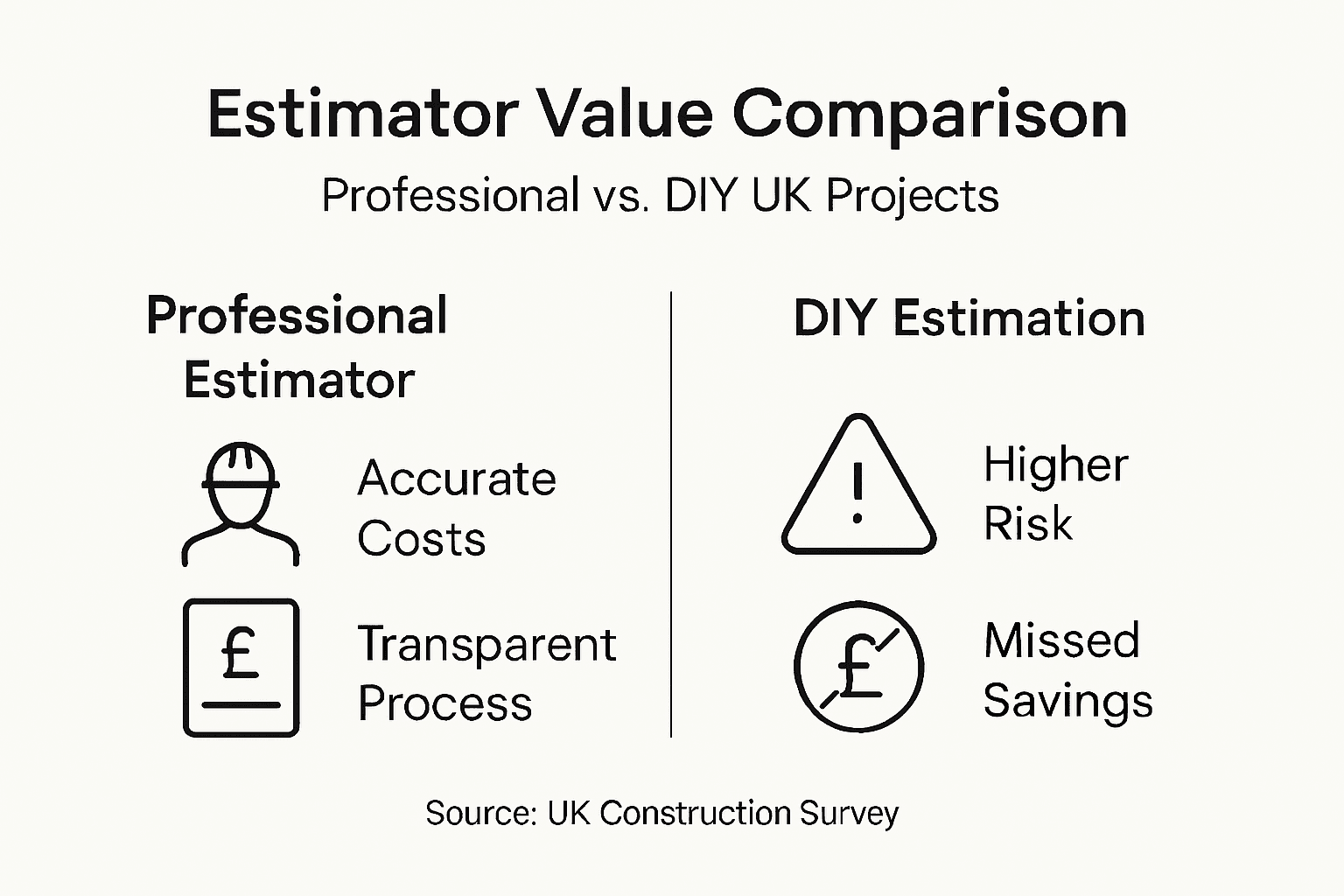
Comparing professional estimating services with alternative approaches reveals significant distinctions in financial outcomes, project efficiency, and long-term value generation. Professional estimation provides comprehensive project insights that go beyond simple numerical calculations, delivering strategic financial management across project lifecycles.
From a direct cost perspective, professional estimators may appear more expensive initially, but they generate substantial savings by preventing budget overruns and minimising financial risks. While amateur or internal estimation approaches might seem cost-effective, they frequently lack the sophisticated risk assessment techniques that professional services employ. These professionals utilise advanced analytical tools, extensive market knowledge, and iterative estimation processes that can identify potential financial vulnerabilities before they become costly problems.
Time management represents another critical dimension of value comparison. Professional estimators streamline project planning by providing rapid, accurate cost projections that enable faster decision-making and more efficient resource allocation. Their structured approach reduces project delays, mitigates unexpected complications, and creates a more predictable project trajectory. Unlike alternative methods that might involve prolonged internal discussions or speculative budgeting, professional estimation offers a clear, defensible financial framework that supports quicker project initiation and smoother execution.
Expert Tip: Calculate the potential return on investment by comparing the upfront estimation costs against the potential financial risks of inaccurate project budgeting.
Maximise Your Project Success with Professional Estimating Services
Accurate cost forecasting and transparency are the backbone of any successful UK construction project. If you are concerned about budget overruns, unreliable DIY estimates, or insufficient risk assessment as highlighted in “Why Choose Professional Estimators for UK Projects”, it is time to rely on proven expertise. At My Project Estimating, we understand the challenges of interpreting technical drawings, evaluating market fluctuations, and managing contingencies. Our experienced UK estimators deliver detailed, transparent cost reports that empower architects, builders, and developers to make informed financial decisions confidently.
Explore tailored solutions such as early-stage cost planning, detailed quantity takeoffs, and Bill of Quantities preparation on our Uncategorized Archives. Don’t leave your project’s financial health to chance. Visit My Project Estimating now and experience fast turnaround times with clear and reliable cost estimates. Start your journey towards controlled budgets and reduced risk today.
Frequently Asked Questions
What are the main responsibilities of professional estimators?
Professional estimators assess project costs by analysing architectural drawings, calculating financial requirements, and gathering quotes from suppliers to provide accurate cost predictions.
How can professional estimators improve project budgeting?
They conduct detailed financial breakdowns that include all potential costs, helping to reduce the chances of budget overruns and ensuring projects remain economically viable.
What types of estimating services do professionals offer?
Professional estimators provide various services, including preliminary estimates, detailed estimates, quantity surveying, tender estimates, and sustainable estimates, each tailored to specific project needs.
Why is it risky to rely on DIY estimation methods?
DIY estimation methods often lead to significant financial risks, such as budget overruns and schedule disruptions, as they lack the sophisticated analysis and risk assessments found in professional estimating services.
Recommended
- Why Hire an Estimator: Protecting Your Budget and Build
- Role of Cost Estimator: Complete Guide for UK Construction – My Project Estimating
- Cost Estimation Methods Explained – UK Construction Impact
- How Construction Estimating Services Save You Time & Money
- 7 Essential Automation Tools for Construction Success – BoxBuild